
Key Takeaways
- Operating cash flow helps investors assess whether a company's core activities generate cash consistently.
- Capital expenditure must be considered before judging how much cash remains available for other purposes.
- Borrowing, share issuance and asset sales can improve the cash balance without proving that the underlying business is financially healthy.
How to Read a Cash Flow Statement Before Buying a Stock
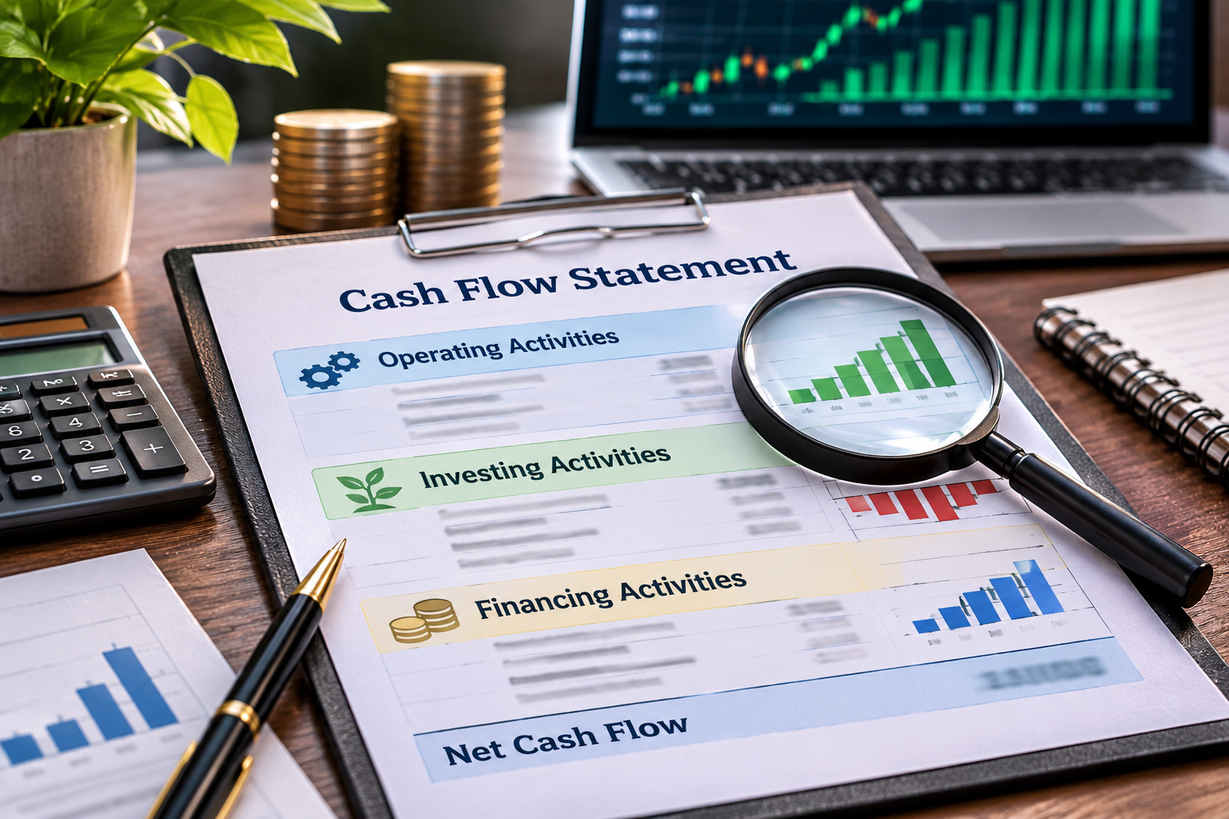
A cash flow statement shows how money enters and leaves a company during a reporting period. Before buying a stock, investors should examine three sections: operating activities, investing activities and financing activities. Together, they reveal whether the business generates cash, where management spends it and how the company funds its operations.
The statement becomes especially useful when profits look impressive but the business appears to depend heavily on borrowing or fresh investment from shareholders.
Start With Cash Flow From Operating Activities
Operating cash flow shows the cash generated or used by the company's main business activities. It usually begins with net income and adjusts for non-cash expenses, such as depreciation, and changes in operating assets and liabilities.
A company reporting $50 million in net income but generating only $18 million in operating cash flow deserves closer examination. The difference could result from growing unpaid customer invoices, rising inventory or other working-capital movements.
Look at operating cash flow over at least three to five years. A consistent pattern of cash generation is generally more reassuring than one unusually strong reporting period. However, compare companies within similar industries because payment cycles and inventory requirements can differ significantly.
Examine Cash Flow From Investing Activities
The investing section records cash spent on or received from long-term assets and certain investments. Purchasing machinery, building facilities, acquiring businesses and selling equipment can appear here.
Negative investing cash flow is not automatically a warning sign. A manufacturer spending heavily on modern equipment may be preparing to increase production capacity. A technology company investing in infrastructure may be supporting future growth.
The important question is what the spending is expected to accomplish. Compare capital expenditure with revenue growth, production capacity and future operating cash generation. If large investments continue without improving business performance, investigate whether management is allocating capital effectively.
Understand Cash Flow From Financing Activities
Financing activities show how a company raises money and returns it to lenders or shareholders. Common items include new borrowings, loan repayments, share issuance, share repurchases and dividend payments.
Positive financing cash flow may indicate that a company has raised debt or issued shares. That can support expansion, but it can also conceal weak operating performance if external funding repeatedly covers cash shortages.
Negative financing cash flow may reflect sensible debt repayment or shareholder distributions. Read the individual entries instead of treating the overall subtotal as automatically good or bad.
Calculate Free Cash Flow Before Investing
Free cash flow (FCF) helps investors understand how much cash remains after a company pays for its operating activities and capital expenditure.
Formula:
Free Cash Flow = Operating Cash Flow − Capital Expenditure
Consider a company generating $120 million in operating cash flow and spending $45 million on capital expenditure. Its free cash flow would be $75 million.
However, positive free cash flow does not automatically mean the company can comfortably maintain its dividend. Investors should also examine debt repayments, interest expenses, working-capital movements and future investment requirements.
This is particularly important when analysing dividend-paying companies. A business may report an attractive dividend yield, but if its cash generation cannot consistently support those payments, investors could face a dividend reduction. Our guide, Dividend Yield Trap: 7 Warning Signs Investors Should Check Before Buying, explains how to identify unsustainable dividend payouts and recognise the financial warning signs behind unusually high yields.
Watch Working Capital and Earnings Quality
Working capital changes can explain why reported profit and operating cash flow move in different directions.
For example, revenue may rise because customers purchase more goods on credit. However, if those customers take longer to pay, accounts receivable can increase and reduce current-period operating cash flow.
Inventory deserves similar attention. A business may purchase more stock in anticipation of demand, using cash before the products are sold. That can be reasonable during expansion, but repeated inventory growth without corresponding sales deserves investigation.
Compare cash generation with net income across several reporting periods. Persistent gaps need an explanation in the financial statement notes and management's discussion.
Five Warning Signs Investors Should Investigate
Pay attention when operating cash flow remains negative for several periods, receivables grow faster than sales, or inventory accumulates without stronger demand. Also investigate repeated borrowing to fund ordinary operations and large cash inflows from selling assets that are not part of the company's regular business.
These patterns do not automatically prove financial distress. A young company, seasonal business or company undergoing a major expansion may temporarily show weaker cash generation. The reason, duration and funding capacity matter.
TwikUp's Perspective: Read the Three Statements Together
A cash flow statement is more useful when compared with the income statement and balance sheet. The income statement shows reported profitability, the balance sheet reveals assets and obligations, and cash flow explains how money moved during the period.
Investors should also examine whether management is converting new investment into productive assets and stronger future cash generation. A company can generate substantial cash today while underinvesting in equipment, technology or maintenance. That may make current free cash flow look stronger than its long-term economics justify.
The strongest investment decisions come from understanding the complete financial picture, not from choosing a stock simply because one cash flow number looks attractive.
Disclaimer
This article is for educational and informational purposes only. It is not personalized investment or financial advice. Cash flow patterns vary by industry, business model and reporting period. Investors should review complete financial statements, accompanying notes and relevant regulatory filings before making investment decisions.