
Key Takeaways
- A dividend distributes cash to shareholders, while a buyback uses company money to purchase shares from investors willing to sell.
- Repurchases can improve per-share figures without improving the underlying business.
- The quality of a payout decision depends on valuation, financial strength and the company's alternatives for using its cash.
Stock Buybacks vs Dividends: What Is the Difference?
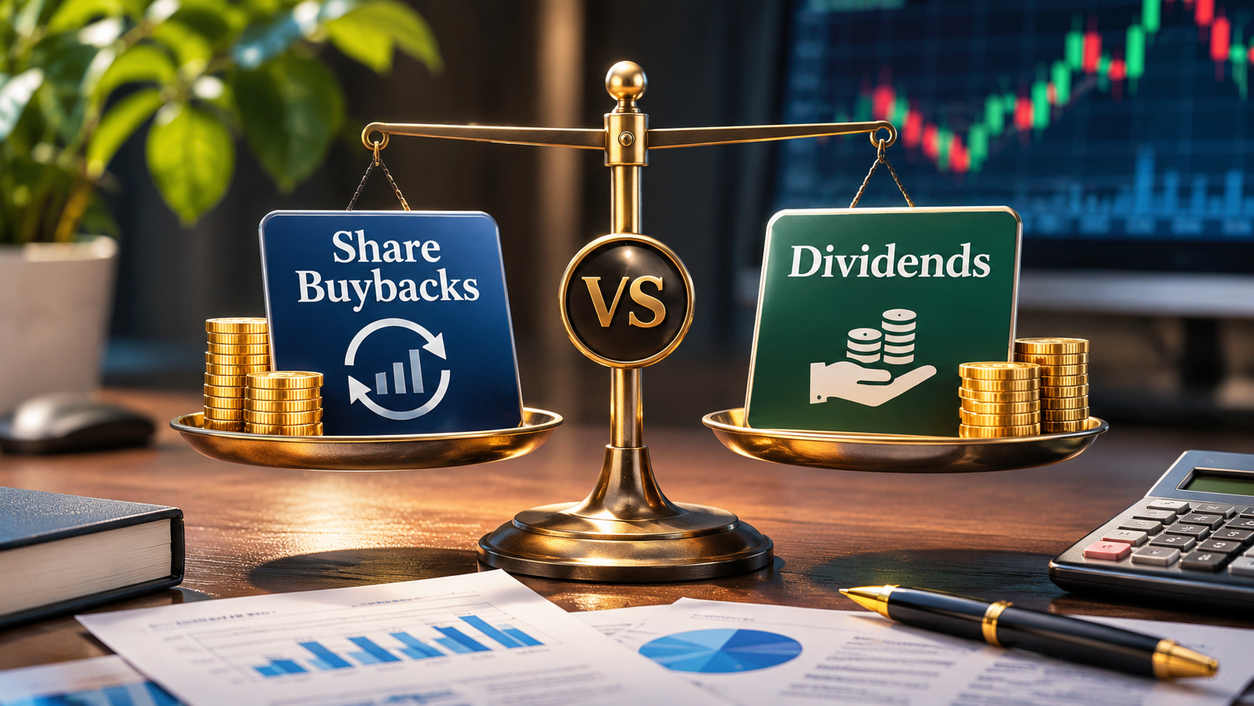
Stock buybacks and dividends are two ways companies return excess cash to shareholders. A dividend sends money directly to investors, usually on a regular schedule. A buyback uses company funds to purchase its own shares, reducing the number of shares outstanding when those purchases are not offset by new issuance.
For investors, the difference is straightforward. Dividends provide cash while you continue holding your shares. With a buyback, shareholders who sell receive money, while those who keep their shares own a larger percentage of the company if the total share count falls.
Neither method guarantees a better return. The company's financial condition and the price it pays to repurchase shares matter considerably.
How Do Dividends Create Shareholder Value?
Dividends offer a direct cash return. If you own 200 shares and a company declares a quarterly dividend of $0.50 per share, you receive $100 before any applicable taxes.
This can appeal to investors who want regular income without selling part of their holdings. Established businesses with predictable cash flows may be better positioned to maintain consistent payments, although no dividend is guaranteed.
There is an important distinction between dividend income and investment profit. On the ex-dividend date, a company's share price generally adjusts downward by approximately the dividend amount, all else being equal. Receiving cash does not automatically make an investor wealthier by the same amount because company cash has left the business.
How Do Stock Buybacks Work?
A company may announce a repurchase programme and buy shares through the open market or a structured offer. Investors who sell receive the agreed market or offer price. Remaining shareholders may own a larger percentage of the company because fewer shares remain outstanding.
Consider a company with 10 million shares trading at $50 each. Its market capitalisation is $500 million. If it spends $50 million buying back 1 million shares at that price, the share count falls to 9 million.
If profits remain unchanged, earnings per share may increase because the same earnings are divided among fewer shares. However, the company has also spent $50 million in cash. A higher EPS figure alone does not prove that the business has become more valuable.
Which Creates More Value for Investors?
The answer depends heavily on the price paid for repurchased shares and the return shareholders could earn from other uses of company cash.
Imagine a business has $100 million in surplus cash. It can distribute that amount through dividends or repurchase shares. If the stock is fairly valued and all other factors remain unchanged, the two approaches can produce economically similar shareholder value. One delivers cash broadly; the other directs cash to shareholders who sell.
The calculation changes when shares are overvalued or undervalued. Buying back expensive shares can transfer value away from continuing shareholders because the company spends too much for each share retired. Repurchasing genuinely undervalued shares may benefit those who remain invested.
Dividends avoid the question of whether management has timed a repurchase well. However, a company that pays a dividend while neglecting profitable investment opportunities may also make a poor capital-allocation decision.
Risks Investors Should Check Before Celebrating a Buyback
A buyback announcement is not proof of management confidence or financial strength. Some companies borrow money to fund repurchases, increasing financial obligations and potentially weakening their balance sheets.
Others repurchase shares primarily to offset dilution from employee stock compensation. In that case, gross repurchases may look impressive while the actual reduction in outstanding shares remains small.
Investors should compare the number of shares purchased with changes in the diluted share count. They should also examine the average repurchase price, debt levels, free cash flow and management's stated reasons. The SEC's repurchase disclosure guidance helps US investors examine actual purchases rather than relying only on announced programme sizes.
Canada and USA: What About Taxes?
Tax treatment can influence which payout investors prefer, but the rules are not identical across countries.
In Canada, eligible and other-than-eligible dividends from taxable Canadian corporations may qualify for the federal dividend tax credit, subject to the applicable requirements. The CRA also distinguishes ordinary open-market purchases from certain redemptions or acquisitions that can create deemed-dividend treatment. Investors should not assume every repurchase has identical tax consequences.
In the United States, dividends are generally reported as investment income. Qualified dividends may receive preferential federal tax rates when the applicable requirements are met. Selling shares in a buyback or tender offer may create a capital gain or loss, but the tax treatment of a redemption depends on the transaction and shareholder circumstances.
Account type, holding period, residency and individual tax position can change the result in either country. Consult the CRA or IRS guidance before treating one method as automatically more tax-efficient.
TwikUp's Perspective: Judge the Decision, Not the Headline
Investors often celebrate a buyback because it can lift EPS, or prefer dividends because the cash arrives in their accounts. Both reactions can overlook the real question: what could the company have done with that money?
A strong management team compares shareholder distributions with debt reduction, acquisitions, research, expansion and other investments. If a company has limited attractive projects, returning surplus cash can be sensible. If it is borrowing heavily to repurchase expensive shares while its core business weakens, the announcement deserves scrutiny.
Individual investors also need to consider how dividend income fits into their personal financial plans. Regular portfolio income should not replace money set aside for predictable expenses. A separate sinking fund for planned expenses can help investors avoid selling shares simply because a large bill arrives at the wrong time.
The most useful measure is not the size of the dividend or the headline buyback amount. It is whether management is allocating capital in a way that improves long-term value per share.
Disclaimer
This article is for educational and informational purposes only. It is not personalized investment, legal or tax advice. Dividend payments and share repurchase programmes can change or be discontinued. Tax treatment depends on individual circumstances, account type, residency and applicable laws.