
Key Takeaways
- A useful exit decision starts with comparing the company's current business outlook against the reasons you originally invested.
- A stock that has become too large within a portfolio may deserve a partial sale even when its business remains healthy.
- Selling decisions should account for taxes, transaction costs and the purpose of the money, not just the share price.
When Should You Sell a Stock?
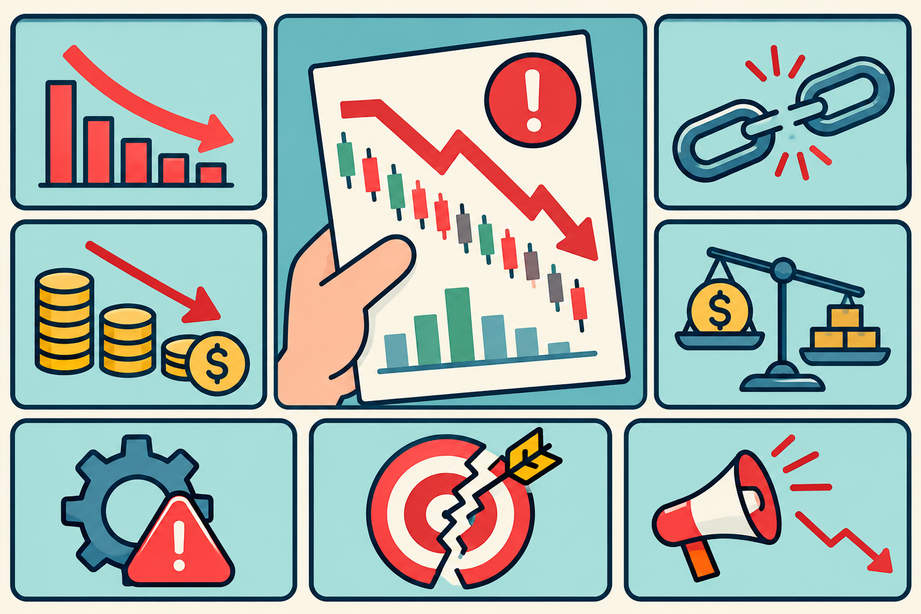
You should consider selling a stock when the original investment case no longer holds, the company's financial position deteriorates, its valuation becomes difficult to justify or the position creates more portfolio risk than you intended. However, a falling share price alone is not a reliable reason to exit.
The challenge is distinguishing a temporary setback from a lasting change. Investors who decide in advance what would make them sell are less likely to let fear, greed or attachment to a particular company control the decision.
7 Warning Signs That It May Be Time to Sell
1. Your Original Investment Thesis Has Broken
Every stock purchase should have a reason. Perhaps the company had a strong competitive advantage, expanding margins, a growing customer base or an attractive valuation.
If those conditions disappear, revisit the investment. For example, a business purchased because of recurring revenue may become less attractive if customers begin leaving and management cannot explain the decline.
A broken investment thesis is more meaningful than simply seeing a red number in your brokerage account.
2. Revenue and Profitability Are Deteriorating
One disappointing quarter does not automatically make a company a poor investment. However, repeated revenue declines, shrinking operating margins and weakening earnings can indicate deeper problems.
Compare several reporting periods and examine management's explanations. Check whether the decline comes from temporary industry conditions or company-specific weaknesses.
If competitors are gaining market share while the company continues losing customers, the original growth expectations may no longer be realistic.
3. Debt Is Becoming Difficult to Manage
A company can report positive earnings while its borrowing costs steadily weaken its financial position.
Review total debt, interest expenses, operating cash flow and upcoming repayment obligations. Rising borrowing costs can become particularly concerning when profits are also falling.
Our guide to the interest coverage ratio and corporate debt risks explains how investors can examine a company's ability to meet interest payments.
4. The Stock Price Has Outgrown Its Business Value
A successful company is not automatically a good investment at every price.
Suppose a company's earnings are $5 per share and its stock trades at $100. Its price-to-earnings ratio is 20. If the share price rises to $180 while earnings remain unchanged, the P/E ratio increases to 36.
That does not automatically make the stock overpriced, but it means investors are paying considerably more for the same current earnings. Compare the valuation with expected growth, business quality and industry conditions before deciding whether to reduce the position.
5. One Stock Has Become Too Large in Your Portfolio
A stock that performs exceptionally well can gradually become a major source of portfolio risk.
Imagine starting with a $10,000 portfolio and investing $1,000 in one company. If that investment grows to $5,000 while the rest of the portfolio remains unchanged, the holding now represents one-third of your total investments.
Selling part of the position could restore diversification without abandoning the company entirely. The appropriate limit depends on your financial plan and risk tolerance.
6. Management Decisions Damage Business Confidence
Leadership changes are not automatically negative, but repeated strategic mistakes deserve attention.
Watch for unrealistic expansion plans, poor capital allocation, unexplained executive departures, accounting concerns or repeated promises that fail to materialise.
Review annual reports, management commentary and official company announcements. A major change in business strategy can also make an investment unsuitable even when the share price has not reacted yet.
7. Your Financial Goals or Time Horizon Have Changed
An investment that suited a ten-year goal may not suit a financial need arriving next year.
For example, someone preparing to purchase a home may need to reduce exposure to volatile shares before the money is required. An investor approaching retirement may also reconsider the amount of portfolio risk they can comfortably accept.
The decision should reflect when you need the money, not just what you think the market will do next.
When Should You Hold Instead of Selling?
A temporary market decline, disappointing headline or short-term earnings miss does not necessarily invalidate a long-term investment.
Before selling, ask whether the company's competitive position has changed, whether its financial statements support the original outlook and whether the decline affects your investment horizon.
Our article on why cheap stocks become value traps explains why a lower share price should not be confused with genuine business value.
Canada and USA: Check the Tax Consequences Before Selling
Canadian investors selling shares in taxable accounts may realise capital gains or losses. The CRA's superficial loss rules can restrict a loss deduction when the same or identical property is acquired within the specified 30-day period before or after the sale and the ownership conditions are met.
In the United States, the IRS wash-sale rule generally disallows a loss deduction when substantially identical securities are acquired within 30 days before or after the loss sale. Tax treatment can differ between taxable and registered or retirement accounts.
Review the applicable rules before planning a tax-driven sale. Account type, transaction timing and individual circumstances matter.
TwikUp's Perspective: Make the Exit Decision Before Emotions Take Over
Investors often spend hours researching what to buy but very little time defining what would make them change their minds.
A practical approach is to write down the original investment thesis, the financial indicators that would weaken it and the valuation assumptions behind the purchase. Review those conditions when new company results arrive rather than reacting to every market movement.
Selling is not an admission that buying the stock was a mistake. Sometimes it is simply the result of new information. The objective is to keep capital aligned with opportunities that still justify the risks involved.
Disclaimer
This article is for educational purposes only and does not constitute personalized financial, investment or tax advice. Selling a stock may result in capital gains or losses, transaction costs and tax consequences. Rules vary between Canada and the United States and depend on account type and individual circumstances. Investors should review relevant company filings and consult a qualified professional when necessary.