
Key Takeaways
- Averaging down increases an existing stock position, while buying the dip can involve purchasing a stock for the first time after a decline.
- A lower average purchase price changes the position's breakeven point, not the company's underlying business performance.
- Position limits, valuation checks and predefined reasons for exiting can prevent a falling investment from consuming too much capital.
Average Down vs Buy the Dip: What Is the Difference?
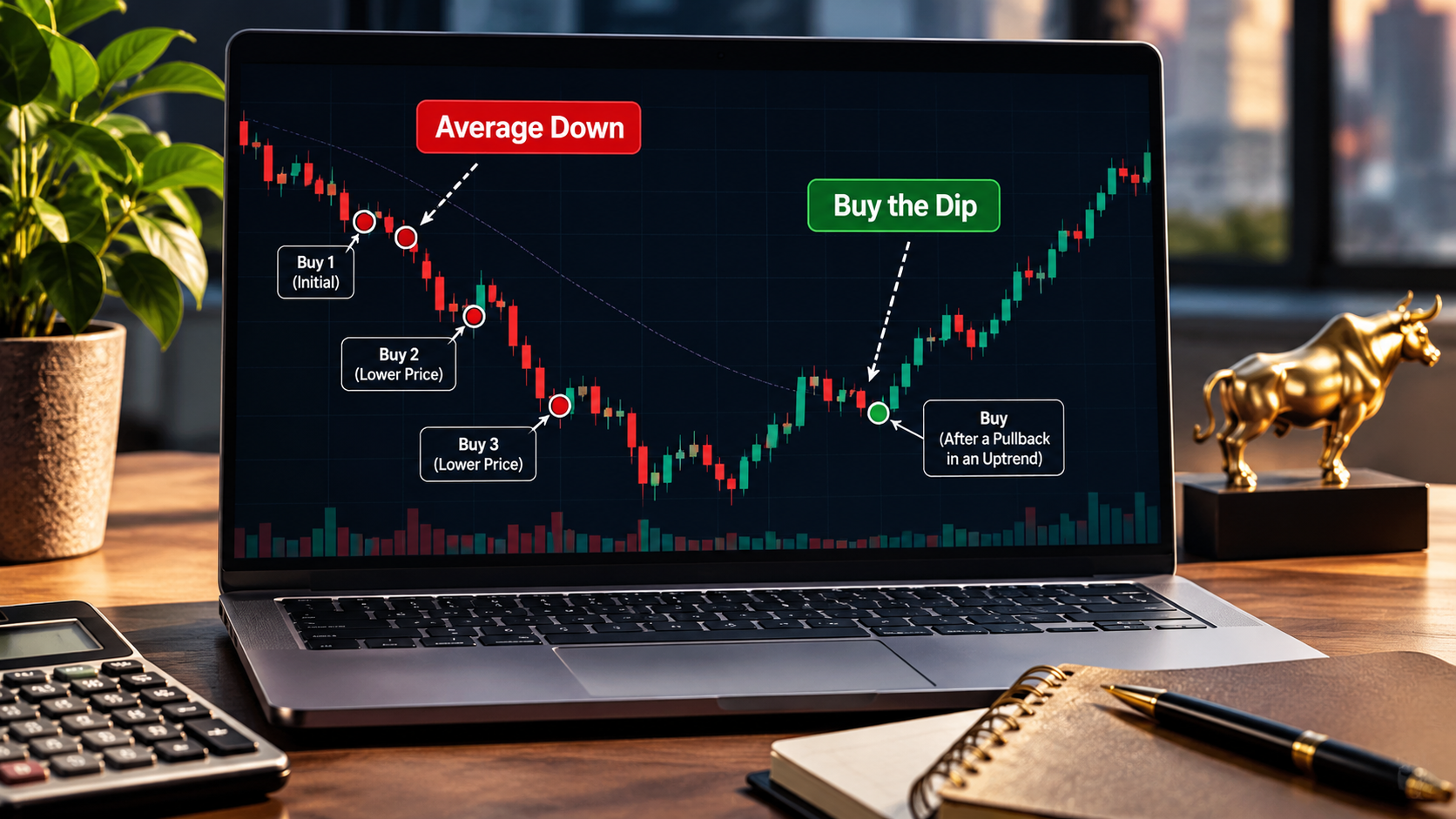
Average down stocks and buying the dip may sound like the same investing strategy, but they describe two different decisions. Averaging down means purchasing additional shares after a stock falls below your original purchase price. Buying the dip means purchasing shares after a price decline, whether or not you already own the company.
The distinction matters because averaging down increases an existing position. Buying the dip may simply be a new investment at a lower market price. Neither strategy guarantees a recovery, and a cheaper share price alone does not establish that a stock is undervalued.
How Does Averaging Down Work?
When investors average down, they buy more shares at a price below their earlier purchase. The additional shares reduce the average amount paid per share, assuming the new purchase price is lower.
Consider an investor who buys 100 shares at $50 each. The initial investment is $5,000. The stock falls to $35, and the investor purchases another 100 shares for $3,500.
The calculation becomes:
Total investment = $5,000 + $3,500 = $8,500
Total shares = 200
New average cost = $8,500 ÷ 200 = $42.50 per share
The average purchase price has fallen from $50 to $42.50. However, if the market price remains at $35, the position is still worth $7,000, leaving an unrealised loss of $1,500 before fees and taxes.
This is the important distinction: averaging down changes the cost basis of the combined position, not the market value of the shares or the company's financial condition.
What Does Buying the Dip Mean?
Buying the dip involves purchasing a stock after its market price has declined from a recent level. An investor does not need to own the shares already.
For example, a stock trading at $80 falls to $65. An investor who believes the company's long-term prospects remain attractive may decide to start a position at the lower price.
The decision is based on whether the current valuation offers a reasonable opportunity. The investor should examine why the price fell, whether earnings expectations have changed and whether the business can maintain its competitive position.
A market-wide correction may affect many otherwise healthy companies. A company-specific decline caused by weaker demand, excessive debt or a damaged business model deserves a different assessment.
Average Down vs Buy the Dip: Key Differences
Averaging down focuses on an existing holding and reduces its average purchase price by adding shares below the previous cost. Buying the dip focuses on a price decline and can create an entirely new position.
The risks also differ. Averaging down can make an already large holding even larger, increasing dependence on one company. Buying the dip can introduce a new investment risk, but the investor can decide the initial position size from the beginning.
Neither approach should be confused with dollar-cost averaging. Dollar-cost averaging involves investing predetermined amounts at regular intervals, regardless of short-term price movements. It is a schedule-based method, not necessarily a response to a losing position.
When Does Averaging Down Make Sense?
Adding to a losing stock may deserve consideration when the original investment thesis remains intact and the decline appears disconnected from the company's long-term business prospects.
Start by reviewing recent revenue, profit margins, operating cash flow, debt obligations and management guidance. Compare current performance with the assumptions behind the original purchase.
Valuation matters too. A stock trading at a lower price is not automatically cheaper relative to its earnings, assets or future cash flows. Investors should revisit the company's competitive position and returns on invested capital rather than relying on the previous share price as a reference point. Our guide to ROIC vs ROE explains why business quality deserves attention alongside valuation.
Finally, decide how much of your portfolio can reasonably be exposed to one company. An attractive opportunity can still become an oversized risk if repeated purchases push the holding beyond your intended allocation.
When Should You Avoid Buying More Shares?
Averaging down becomes difficult to justify when the original reasons for owning the stock no longer hold. Examples include a sustained loss of market share, declining customer demand, deteriorating cash generation, rising financial pressure or serious management credibility concerns.
Be especially cautious when the investment decision is driven mainly by a desire to recover an earlier loss. The market does not know your purchase price, and it has no obligation to bring the share price back to your breakeven level.
A falling valuation can also be a warning that investors are reassessing the company's future. Our article on how cheap stocks become value traps explores why a low price-to-earnings ratio or a sharp decline may not represent a genuine bargain.
A Practical Checklist Before Adding to a Losing Stock
Before placing another order, ask yourself whether you would buy the company today if you did not already own it. Identify the specific reason for the price decline and check whether the business has changed.
Review your portfolio concentration, available cash, investment horizon and ability to withstand a further decline. Set a maximum position size and write down the conditions that would make you stop adding or exit the investment.
If you cannot explain why the shares are attractive beyond the fact that they are cheaper than your earlier purchase, waiting may be more sensible than committing more capital.
TwikUp's Perspective: Treat Every Additional Purchase as a New Decision
One of the biggest mistakes investors make is allowing an earlier purchase to control a new investment decision. Money already invested cannot be recovered simply by buying more shares. The next purchase should stand on its own merits.
A useful test is to temporarily ignore your original entry price. Ask whether the company's current valuation, business outlook and financial strength justify investing fresh money today. If the answer is no, a lower average cost will not fix the underlying problem.
Investing discipline is not about predicting the exact bottom. It is about knowing what evidence would support a purchase, how much risk you are accepting and when the original investment case has stopped making sense.
Disclaimer
This article is for educational and informational purposes only. It is not personalized investment advice or a recommendation to buy or sell any security. Investing in individual stocks involves the risk of losing some or all of your capital. Consider your financial circumstances, risk tolerance and investment objectives before making decisions.