
Key Takeaways
- Canada's target is 2% CPI inflation, the midpoint of a 1–3% range, set jointly by the Bank of Canada and the Government of Canada and renewed every five years — most recently on No
- The target was adopted in 1991, when inflation ran above 5%, after inflation had averaged over 6% in the 25 years before; since 1991 it has sat at or around 2% most of the time.
- Going lower risks deflation and leaves no room to cut rates in a shock; going higher distorts prices and hits lower- and fixed-income households hardest.
One number quietly decides what your mortgage costs: 2%
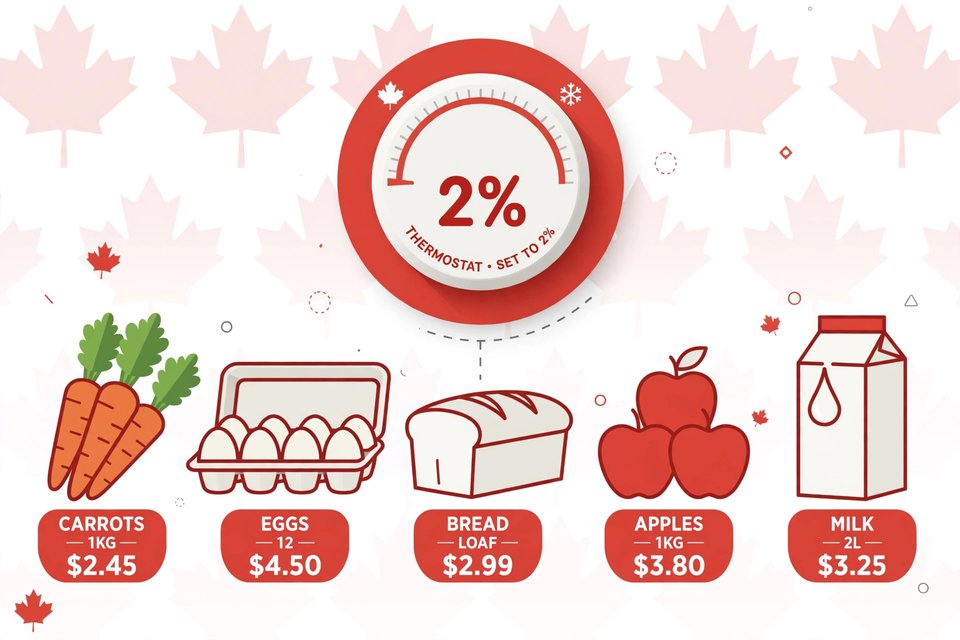
Every Bank of Canada rate announcement is, underneath the headlines, a judgement about a single number. The Bank's target is 2% inflation — the midpoint of a 1–3% control range — and it has anchored Canadian monetary policy for three decades. The target is set jointly by the Bank and the Government of Canada and renewed every five years. And here is the remarkable part, as the Bank itself puts it: every review has concluded that 2% is right. The latest renewal, a joint statement issued November 5, 2026, reaffirmed the target for a framework running to December 31, 2031.
So why 2%? Why not zero — wouldn't stable prices be better? And if a little inflation is good, why not 3% or 4%? The Bank's answers tour everything that can go wrong at both extremes.
How Canada got to 2%
The target was born in a fight. Canada adopted inflation targets in 1991, when inflation ran above 5% — after a long era averaging over 6% across the 25 years before 1991. The plan was a glide path: down to a 3% midpoint (2–4% range) by end-1992, then a 2% midpoint (1–3% range) by end-1995. Unchanged ever since.
The record since is the Bank's best argument. Since 1991, inflation has sat at or around 2% most of the time. It broke away during the pandemic shock, peaking at 8.1% in June 2022 — and the Bank raised rates and brought it back to 2%. The newest framework stresses symmetry: missing from below worries the Bank as much as overshooting from above. That points straight at the case against aiming lower.
Why not zero — or lower?
Because just below low inflation sits something worse: deflation, a general fall in prices that can mean downturns and job losses. When people expect prices to fall, households defer spending — why buy today what will be cheaper tomorrow? — and demand drains away. Worse, debts do not deflate: the dollars you owe stay fixed while incomes fall, and that spiral can feed on itself.
There is a second, practical reason. A 2% target leaves the Bank room to cut its policy rate when a shock hits. The closer rates start to zero, the sooner cuts reach the floor — and near zero, cuts work less well. Two per cent is insurance bought in advance against the next crisis.
There is also a measurement quirk. The Bank's renewal research (Crawford, 1998) estimated that the consumer price index overstates the true rise in the cost of living by roughly 0.5% a year — so a measured 2% is closer to a true increase of about 1.5%. A target of zero, measured, could quietly mean prices genuinely falling. (That estimate dates from 1998, but it remains part of the Bank's reasoning.)
What about "greasing the wheels"?
One classic argument for positive inflation is that it greases the wheels of the labour market: when workers resist nominal pay cuts, a little inflation lets real wages adjust without anyone's paycheque shrinking on paper. The Bank weighs this and lands gently against raising the target for it: wages can decline, and productivity growth normally lifts pay over time, so no higher target is needed on this account.
Why not higher — 3% or 4%?
If 2% buys insurance, wouldn't 4% buy more? The Bank's answer: the costs arrive faster than the benefits. Higher inflation distorts prices, so nobody can read what things should cost. It erodes purchasing power, and it is socially unjust: people on lower or fixed incomes, who cannot hedge, take the hardest hit — the 2026 renewal statement itself notes high inflation eats into purchasing power and people's sense of fairness. Add the uncertainty, and the case collapses. A clear target, actually met, anchors expectations: wages, contracts and loans get set around 2% because people believe the Bank will deliver it.
Simple math shows the stakes: at 2% inflation, money loses half its purchasing power in roughly 35 years; at 4%, in roughly 18. (That is the rule of 72 — simple arithmetic, not a Bank of Canada figure.)
The range is a buffer, not a shrug
Why a 1–3% range at all, if the target is 2%? Because food and energy prices swing, and no central bank can hold inflation to a decimal point month by month. But the Bank is explicit: the range is not a zone of indifference — the aim is 2% itself. It has to be: rate changes take 18 to 24 months to fully work through to prices, so the Bank steers toward where inflation will be two years from now, not where it is today.
The Twikup Take
Two per cent is one of the most consequential numbers in Canadian life — it decides what your variable mortgage does, what your savings are really worth, and how much room the Bank has to rescue the economy in the next shock. The 2026 renewal, keeping the target untouched through 2031 after inflation spiked to 8.1% and was wrestled back, says the framework bent but did not break. Below 2% lurks deflation and a central bank out of ammunition; above it, a quiet tax on those least able to pay. After five reviews across 35 years, the middle is not indecision. It is a conclusion.
Image: AI-generated illustration.