
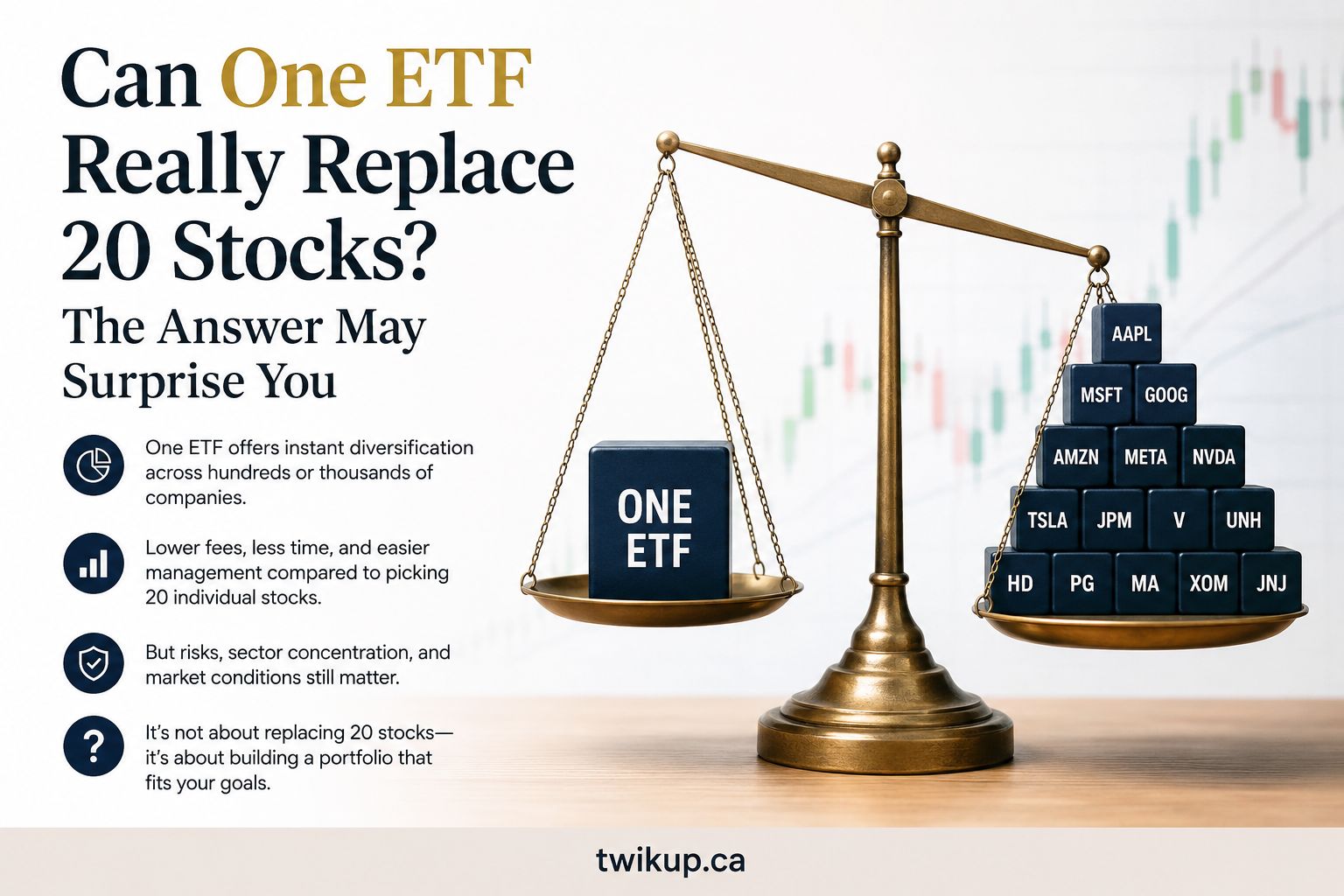
Can One ETF Really Replace 20 Stocks? The Answer May Surprise You
Picking individual stocks can feel exciting.
You study earnings reports, compare valuations, follow industry news, listen to management calls, and build a portfolio containing what appear to be 20 excellent companies.
Then you discover something surprising:
A single exchange-traded fund may already hold all 20 companies—and possibly hundreds or thousands more.
That raises an important question:
Can one ETF genuinely replace a portfolio of 20 individual stocks?
In some situations, it potentially can. But the real answer depends on what the ETF owns, how concentrated it is, what it costs, how it is managed, and whether its investment objective matches the investor’s goals, time horizon, and tolerance for loss.
The number of securities in a portfolio matters far less than many investors assume. A portfolio containing 20 highly correlated technology companies may be less diversified than one broad-market ETF containing companies from several countries, sectors, and market-capitalization ranges.
One ETF can simplify a portfolio—but simplicity should never be confused with safety, guaranteed returns, or suitability for every investor.
Educational disclaimer: This article provides general information for educational purposes only. It does not constitute financial, tax, legal, or investment advice, and it does not recommend buying, selling, or holding any security. Investments can rise or fall in value, and past performance does not guarantee future results. Consider your financial situation and consult an appropriately qualified professional when necessary.
Quick Answer
Yes, one sufficiently diversified ETF can potentially replace 20 individual stocks—but not every ETF can do it effectively.
A broad-market or asset-allocation ETF may hold hundreds or thousands of securities across different companies, industries, countries, and sometimes asset classes.
That can provide more diversification than manually selecting 20 stocks.
However, one ETF may not be enough when it:
- focuses on one sector or theme
- tracks a concentrated index
- holds only a small number of companies
- uses leverage or complex derivatives
- has significant exposure to a few dominant holdings
- does not match the investor’s risk tolerance
- excludes important markets or asset classes
- produces tax consequences that do not fit the account
- overlaps heavily with other investments the person already owns
The useful question is therefore not:
“Do I own one ETF or 20 stocks?”
It is:
“What do I actually own underneath the ticker symbol?”
TwikUp Insight
A 20-stock portfolio can look diversified on a brokerage screen while still being driven by only one underlying economic story.
For example, an investor might own:
- a semiconductor company
- a cloud-computing company
- an e-commerce platform
- a social-media business
- a software provider
- a digital-advertising company
- an electric-vehicle manufacturer
- an artificial-intelligence infrastructure company
Those are different corporations, but their share prices may still be influenced by similar forces:
- technology valuations
- interest-rate expectations
- artificial-intelligence spending
- consumer confidence
- corporate advertising
- access to capital
- investor enthusiasm for growth stocks
By contrast, one broad ETF could hold technology companies alongside banks, manufacturers, utilities, healthcare businesses, consumer companies, energy producers, bonds, and international securities.
Diversification is not measured by counting ticker symbols. It is measured by examining the economic risks beneath them.
That is the part many investors miss.
The Story of Daniel’s “Diversified” Portfolio
Daniel had been investing for four years.
He owned 20 stocks and felt proud of the portfolio he had built. No single company represented more than 8% of his account, so he believed he was well diversified.
His holdings included:
- three semiconductor companies
- two software companies
- two online retailers
- two digital-advertising businesses
- an electric-vehicle manufacturer
- several large technology platforms
- two payment-processing companies
- a cybersecurity company
- a streaming company
- a cloud-infrastructure business
- two technology-focused financial companies
Daniel saw 20 company names.
What he did not immediately see was that almost every company depended on some combination of:
- strong economic growth
- high investor confidence
- rising technology expenditure
- access to relatively affordable capital
- optimistic future earnings assumptions
When growth stocks declined together, Daniel was confused.
“How can all 20 stocks fall at the same time?” he wondered. “I thought I was diversified.”
His friend Priya had taken a different approach. Instead of researching individual businesses every weekend, she owned one broadly diversified ETF suited to the risk level she had chosen.
Her fund held companies across several industries and geographic markets. Depending on its structure, it could also rebalance its holdings according to predetermined rules.
Priya’s portfolio still fell during difficult markets. Diversification did not prevent losses.
But her outcome was not tied to whether a handful of companies—or one fashionable investment theme—continued exceeding expectations.
Daniel had more ticker symbols.
Priya potentially had more distinct sources of return.
That distinction sits at the centre of the one-ETF-versus-20-stocks debate.
What Is an ETF?
An exchange-traded fund is an investment fund whose units generally trade on a stock exchange.
An ETF can hold a basket of assets such as:
- publicly traded stocks
- government or corporate bonds
- cash-equivalent instruments
- commodities
- real estate securities
- other ETFs
- combinations of multiple asset classes
Some ETFs passively track an index. Others use active management, factor strategies, options, leverage, or specialized rules.
This means the term ETF tells you how the investment is packaged and traded—but not necessarily what risks it contains.
Two ETFs can be completely different.
One may hold thousands of global stocks and bonds.
Another may hold 20 companies from a single industry.
Another may use derivatives to amplify daily market movements.
Therefore, saying “I own an ETF” is not enough to understand a portfolio.
An investor must examine:
- the ETF’s investment objective
- its underlying holdings
- its sector and country exposure
- the weight of its largest positions
- its fees
- its trading characteristics
- its currency exposure
- its distribution policy
- its tax considerations
- its historical behaviour during difficult markets
One ETF Can Contain Far More Than 20 Stocks
A broad ETF may contain hundreds or even thousands of companies.
That can give an investor exposure to:
- large companies
- medium-sized companies
- smaller companies
- Canadian businesses
- American businesses
- developed international markets
- emerging markets
- multiple currencies
- numerous economic sectors
Some all-in-one ETFs go further by combining equities and fixed-income investments within a single fund.
This does not make the ETF risk-free.
A globally diversified equity ETF can still experience substantial losses during a severe market decline. An asset-allocation ETF can also decline when both stocks and bonds face pressure.
But a broad ETF can reduce the risk that one failed company destroys a large part of the portfolio.
That is different from eliminating market risk.
Diversification Does Not Mean “Nothing Will Fall”
One of the most common investment misunderstandings is that a diversified portfolio should not decline.
That is incorrect.
Diversification may help spread exposure across different investments, but it cannot remove every type of risk.
A diversified ETF may still be affected by:
- recessions
- inflation
- interest-rate changes
- geopolitical conflict
- currency movements
- market-wide valuation declines
- liquidity disruptions
- changes in investor sentiment
- unexpected economic shocks
During a broad market selloff, many holdings may fall together.
Diversification is generally designed to reduce dependence on a single company, sector, region, or outcome. It is not a promise of uninterrupted gains.
When One ETF May Be More Diversified Than 20 Stocks
One ETF may provide greater diversification when the 20-stock portfolio is concentrated in similar businesses.
Consider two hypothetical portfolios.
Portfolio A: Twenty Individual Stocks
The investor owns:
- six technology companies
- four semiconductor businesses
- three banks
- three oil producers
- two telecommunications companies
- two consumer brands
At first glance, 20 holdings sounds substantial.
But the portfolio may still be heavily influenced by:
- technology valuations
- Canadian financial conditions
- energy prices
- the Canadian economy
- a small number of large corporations
Portfolio B: One Broad Global ETF
The fund owns hundreds or thousands of securities across:
- Canada
- the United States
- Europe
- Asia
- developed international markets
- potentially emerging economies
- numerous industries
Portfolio B may have only one ticker symbol, yet it could represent far more underlying businesses, regions, and economic exposures.
That does not automatically make Portfolio B appropriate for everyone. But it demonstrates why ticker count is a weak measure of diversification.
When One ETF Cannot Reliably Replace 20 Stocks
The phrase “one ETF” can create a false sense of simplicity.
Some ETFs are highly concentrated.
A single ETF may not replace a diversified portfolio effectively when it invests mainly in:
- artificial-intelligence companies
- semiconductor manufacturers
- Canadian banks
- oil and gas producers
- dividend-paying companies
- covered-call strategies
- one country
- one narrow index
- cryptocurrency-related businesses
- leveraged market exposure
- a small number of equal-weighted holdings
A thematic ETF could own 20 or 30 securities while remaining dependent on one trend.
For example, an ETF may hold several companies involved in artificial intelligence, but many of those companies could be exposed to the same spending cycle and valuation expectations.
That is why investors should look beyond the number of holdings.
The Top-10 Holdings Test
One of the fastest ways to understand an ETF is to examine how much of the fund is controlled by its largest holdings.
Ask:
- What percentage is held in the largest company?
- What percentage is concentrated in the top five?
- What percentage is concentrated in the top 10?
- Do those companies operate in the same sector?
- Are they sensitive to the same economic forces?
- Is the concentration intentional?
- Could one company materially affect the ETF’s performance?
An ETF might own 500 companies while a small group of mega-cap businesses still drives a significant portion of its returns.
The remaining holdings may provide diversification, but the fund can remain more concentrated than its headline number suggests.
Five hundred holdings do not always mean 500 equally important investments.
The Sector Test
Next, examine sector exposure.
Common sectors include:
- information technology
- financials
- healthcare
- consumer discretionary
- consumer staples
- industrials
- communication services
- energy
- materials
- utilities
- real estate
An investor holding 20 stocks may unknowingly place most of the portfolio in only two or three sectors.
A broad ETF may spread exposure more widely, but even broad indexes can become concentrated when one sector grows rapidly.
Sector weights can also differ significantly by country.
For example:
- the Canadian market has historically had substantial financial, energy, and materials exposure
- the U.S. market has often carried greater exposure to large technology and communication companies
- other international markets may have different mixes of industrial, financial, consumer, and healthcare businesses
A fund’s label may sound broad while its sector breakdown tells a more complicated story.
The Geography Test
Owning 20 companies from one country does not provide the same geographic diversification as owning businesses across several markets.
Country concentration can expose a portfolio to:
- domestic economic conditions
- local interest rates
- currency changes
- national regulations
- housing-market conditions
- commodity cycles
- political developments
- country-specific sector concentration
Canadian investors may naturally prefer familiar domestic companies. This tendency is sometimes called home-country bias.
Familiarity can feel safer, but a company’s location does not necessarily reduce investment risk.
A Canadian investor may earn income, own property, pay taxes, and hold investments primarily in Canada. Adding global exposure can potentially spread some of that geographic dependence, although foreign investments create their own risks.
The Company-Risk Test
Individual-stock investors face company-specific risks that a broad ETF may dilute.
These include:
- accounting problems
- failed product launches
- regulatory penalties
- executive misconduct
- cyberattacks
- lawsuits
- competitive disruption
- excessive debt
- dividend reductions
- customer losses
- bankruptcy
Suppose one stock represents 5% of a 20-stock portfolio and the company suffers a permanent collapse. That one position could materially reduce the portfolio’s value.
In a broad ETF, the failed company may represent only a small fraction of total assets.
However, an ETF does not eliminate company risk completely. It distributes that risk across more holdings.
The Behaviour Test: Can You Maintain 20 Stocks?
A 20-stock portfolio requires more than selecting 20 companies once.
It may require ongoing attention to:
- earnings reports
- management changes
- acquisitions
- debt levels
- competitive threats
- valuation
- industry regulation
- dividend sustainability
- position sizes
- portfolio rebalancing
- tax reporting
- the original reason each investment was purchased
The challenge is not merely finding 20 stocks.
It is maintaining a repeatable decision-making process for all 20.
Investors may also become emotionally attached to individual companies. They may hold a declining business because they once believed strongly in its story—or sell a successful company too soon because the gain feels uncomfortable.
A rules-based ETF can reduce some of these decisions.
It does not eliminate emotional behaviour. An investor can still panic and sell an ETF during a downturn.
But the investor does not have to determine whether every earnings disappointment represents a temporary setback or a permanently damaged business.
The Hidden Cost of Researching 20 Stocks
ETF fees are visible.
The cost of managing 20 individual stocks can be less obvious.
Potential costs include:
- trading commissions
- foreign-exchange conversion costs
- bid-ask spreads
- tax-reporting complexity
- research subscriptions
- time spent reviewing results
- mistakes caused by incomplete information
- excessive trading
- opportunity cost
An individual-stock portfolio may have no published management-expense ratio, but that does not make it free.
The investor’s time and behaviour can become significant costs.
On the other hand, ETFs also have costs, including management fees, operating expenses, spreads, potential tracking differences, trading costs, and sometimes foreign withholding taxes.
The relevant comparison is not “ETF fee versus zero.”
It is total ETF cost versus the complete financial and behavioural cost of managing the alternative portfolio.
What About ETF Management Fees?
ETFs generally charge ongoing expenses, often summarized through a management-expense ratio or similar disclosure.
Even a seemingly small annual fee can compound over a long period.
However, fee comparisons must consider what the fund provides.
A broad ETF may offer:
- portfolio construction
- diversification
- index tracking or active management
- automatic replacement of companies that leave an index
- periodic rebalancing
- administrative convenience
- access to foreign markets
A cheaper ETF is not automatically better if it tracks the wrong market or uses a strategy that does not match the investor’s needs.
A more expensive ETF is not automatically better because its strategy sounds sophisticated.
Costs matter—but they must be evaluated alongside structure, risk, exposure, and expected use.
Does One ETF Mean One Point of Failure?
This is a reasonable concern.
Owning one ETF means relying on a single fund structure and provider for the portfolio’s implementation.
However, the ETF’s underlying assets are generally distinct from the operating business of the fund provider. Investors should still read the official fund documents to understand custody, structure, risks, termination provisions, and other operational details.
Relevant questions include:
- Who manages the fund?
- Who holds the underlying assets?
- Is the ETF large and actively traded?
- What happens if the fund closes?
- Does it use physical holdings, derivatives, or both?
- Is securities lending used?
- How closely has it tracked its stated objective?
- Is the strategy easy to understand?
- What investor protections and disclosure rules apply?
Using one ticker does not mean ignoring fund-level due diligence.
What Happens If an ETF Closes?
ETF closure is not necessarily the same as an underlying company going bankrupt.
When a fund is terminated, investors may receive advance notice and the fund’s assets may be sold or distributed according to its governing process.
However, closure can still create inconvenience and potential consequences, such as:
- being forced to reinvest
- realizing a taxable capital gain or loss in a non-registered account
- trading costs
- receiving cash at an unwanted time
- losing access to a preferred strategy
Larger, well-established funds may be less likely to close than small funds with limited assets, but size alone does not guarantee permanence.
Investors should review fund size, trading activity, provider history, and official disclosure documents.
One ETF Does Not Automatically Mean “Passive”
Many people use the words ETF and passive investing interchangeably.
They are not identical.
An ETF can follow:
- a broad market-cap-weighted index
- an equal-weighted index
- a dividend strategy
- a low-volatility strategy
- an environmental or social screen
- a covered-call strategy
- an actively managed portfolio
- a leveraged strategy
- an inverse strategy
- a commodity strategy
- a cryptocurrency-linked strategy
Some ETFs are simple.
Others are highly complex.
Therefore, an investor should not assume an ETF is conservative, diversified, low-risk, or passive based only on its legal structure.
The Difference Between a Broad-Market ETF and an Asset-Allocation ETF
These two categories are often confused.
Broad-Market Equity ETF
A broad-market equity ETF typically holds stocks across a particular market or combination of markets.
It may be highly diversified across companies while remaining fully exposed to equity-market risk.
A 100% equity portfolio can experience substantial volatility.
Asset-Allocation ETF
An asset-allocation ETF may combine several underlying funds or asset classes, potentially including:
- Canadian equities
- U.S. equities
- international equities
- emerging-market equities
- government bonds
- corporate bonds
The manager typically maintains a target asset mix and periodically rebalances.
An asset-allocation ETF may therefore provide diversification across both companies and asset classes.
However, the appropriate equity-to-fixed-income mix depends on the investor’s circumstances. A more conservative allocation may reduce some volatility but may also offer different long-term growth potential.
Neither structure is universally superior.
Can One Equity ETF Replace 20 Dividend Stocks?
Potentially—but the investor must clarify the actual objective.
Someone holding 20 dividend stocks may be seeking:
- regular cash distributions
- dividend growth
- lower perceived volatility
- exposure to established companies
- psychological comfort from visible income
- a retirement-income stream
A broad-market ETF may hold many dividend-paying companies, but its yield and distribution pattern may differ from a hand-selected dividend portfolio.
A dividend-focused ETF may produce higher distributions, but it could become concentrated in certain sectors and may exclude companies that reinvest profits rather than paying large dividends.
A high distribution should also not automatically be interpreted as a high total return.
The distribution may consist of different components, and the fund’s price can still decline.
For a deeper comparison, read:
Dividend ETFs vs. Growth ETFs: Should You Chase High Dividend Yields?
You can also explore:
Dividend Investing Before Age 30: Smart Strategy or Too Early?
Can One ETF Replace 20 Growth Stocks?
It may replace the individual holdings, but it may not reproduce the same return pattern.
A growth-stock portfolio may be intentionally concentrated in companies expected to expand revenue or profits quickly.
A broad ETF will usually include slower-growing companies as well.
This can reduce dependence on a small group of high-expectation businesses, but it may also limit the effect of any individual winner.
The trade-off is important:
- concentrated portfolios can outperform dramatically
- concentrated portfolios can also underperform dramatically
- diversified portfolios may reduce company-specific risk
- diversification also reduces the effect of correctly identifying a rare exceptional winner
An investor cannot usually maximize concentration-driven upside while simultaneously eliminating concentration-driven downside.
What About Artificial-Intelligence Exposure?
Artificial intelligence provides a useful example of hidden overlap.
An investor may own:
- a semiconductor manufacturer
- a cloud provider
- a data-centre operator
- a software company
- a networking-equipment company
- a cybersecurity company
- a technology index ETF
- a broad U.S. index ETF
This may look diversified.
But the same major technology companies could appear repeatedly across the stocks and ETFs.
The investor may therefore have much more AI and mega-cap technology exposure than expected.
Before adding another fund or stock, investors can examine whether they already own the company indirectly.
Read:
Are You Overinvested in AI? The Truth About Tech Stocks and the Magnificent Seven
The Overlap Problem: When More ETFs Do Not Add Diversification
Some investors start with one ETF, add a second, then gradually collect six or seven funds.
They believe each new ticker creates more diversification.
But those funds may hold many of the same companies.
For example, an investor might own:
- a global equity ETF
- a U.S. market ETF
- a technology ETF
- a dividend ETF
- an artificial-intelligence ETF
A large technology company could appear in four of the five funds.
The portfolio may become more complex without becoming meaningfully more diversified.
This creates several problems:
- accidental concentration
- unnecessary rebalancing
- difficulty understanding total exposure
- overlapping fees
- emotional trading between similar funds
- confusion about each ETF’s role
Adding investments should solve a portfolio problem—not merely increase the number of ticker symbols.
The Role of Rebalancing
A hand-built 20-stock portfolio can drift significantly.
Suppose one company rises rapidly and grows from 5% to 18% of the portfolio.
The investor must decide whether to:
- sell part of the position
- allow it to keep growing
- direct new contributions elsewhere
- reassess the original risk limit
These decisions can be emotionally difficult.
Many broad indexes rebalance according to predefined methodologies. Asset-allocation ETFs may also rebalance their underlying stock-and-bond mix toward stated targets.
This can provide discipline.
However, not all ETFs rebalance in the same way. Some allow successful companies to become increasingly dominant. Others reset positions on a schedule. Active ETFs may use managerial discretion.
The rebalancing method can materially affect the fund’s behaviour.
One ETF May Reduce Decision Fatigue
Investment decisions do not occur in isolation.
A person may be balancing:
- work
- children
- housing costs
- taxes
- insurance
- emergency savings
- retirement planning
- debt repayment
- education savings
Managing 20 companies may not be the best use of every investor’s time.
A simple portfolio can make it easier to:
- contribute consistently
- understand overall risk
- avoid unnecessary trading
- remain invested through ordinary volatility
- track progress toward long-term goals
This is not an argument that individual-stock investing is inherently wrong.
It is recognition that complexity has a cost.
A portfolio should be simple enough to understand and maintain during both calm and stressful markets.
But Simplicity Can Create Complacency
One ETF may be easier to manage, but it can also tempt investors to stop paying attention.
An investor still needs to review whether:
- the fund continues following its objective
- the risk level remains suitable
- the asset mix still matches the timeline
- fees remain reasonable
- the account type remains appropriate
- the investor’s personal circumstances have changed
- withdrawals are approaching
- concentration has increased
- a fund strategy has changed
“Set it and forget it” should not mean “never review it again.”
A better phrase may be:
Set a sensible process, automate what can be automated, and review periodically.
Account Type Still Matters
The same ETF can have different implications depending on whether it is held in:
- a Tax-Free Savings Account
- a Registered Retirement Savings Plan
- a First Home Savings Account
- a Registered Education Savings Plan
- a Registered Retirement Income Fund
- a non-registered investment account
Contribution rules, withdrawals, tax treatment, qualified-investment requirements, foreign withholding taxes, and reporting obligations can differ.
An investment should not be evaluated separately from the account holding it.
Investors should verify current government rules and obtain qualified tax advice when their circumstances are complex.
A One-ETF Portfolio Still Needs an Emergency Fund
A diversified ETF is not a substitute for cash needed in the near future.
Money required for:
- monthly expenses
- an emergency
- an upcoming tax payment
- a home purchase
- tuition
- a major repair
- a short-term business need
may not belong in a volatile investment.
Even a diversified fund can decline shortly before the money is required.
Investment horizon matters because markets do not provide predictable positive returns over every short period.
Time Horizon Can Be More Important Than the Number of Holdings
Imagine two investors using the same diversified ETF.
Investor One
- needs the money next year
- has no emergency reserve
- cannot tolerate a 20% decline
- may sell during volatility
Investor Two
- has a long investment horizon
- holds separate emergency savings
- understands that markets fluctuate
- can leave the money invested through downturns
The ETF is identical.
The suitability is not.
That is why no article can determine whether one ETF is appropriate for a specific person without understanding the person’s complete financial situation.
How Could $100,000 in a Broad ETF Change Over Time?
Long-term projections can help illustrate compounding, but they must be treated as scenarios—not forecasts.
Returns are not guaranteed and rarely arrive in a smooth, predictable line.
A portfolio could experience:
- strong early gains
- a major decline
- years of weak returns
- rapid recovery
- inflation reducing purchasing power
- currency effects
- changing fees and taxes
For hypothetical long-term scenarios, see:
Invested $100,000 in XEQT? Here’s What Could Happen Over 10, 20 and 30 Years
The examples should be viewed as educational illustrations rather than expected outcomes.
Can Monthly ETF Contributions Build $1 Million?
The result depends on several factors:
- starting balance
- monthly contribution
- investment return
- fees
- taxes
- inflation
- contribution increases
- investor behaviour
- time invested
The most powerful variable is often time.
A person contributing regularly for several decades has more opportunity for compounding than someone attempting to reach the same target over a few years.
However, no contribution schedule or ETF can guarantee a $1-million result.
Explore the mathematics here:
How Fast Can a Canadian Build $1 Million Using ETFs?
One ETF Versus Rental Property
The one-ETF question is sometimes part of a larger decision:
Should savings go toward a diversified investment portfolio or a rental property?
These assets have very different characteristics.
A rental property may involve:
- mortgage leverage
- maintenance
- vacancies
- insurance
- property taxes
- tenant management
- legal obligations
- large transaction costs
- geographic concentration
An ETF may provide:
- easier diversification
- greater liquidity
- smaller minimum investments
- less direct operational work
But ETFs experience visible daily price volatility and do not provide the same use, financing structure, or potential control associated with direct property ownership.
Neither choice is automatically superior.
Read the detailed comparison:
$1,000 a Month Into VEQT vs. Buying a Rental Property: Which Builds More Wealth?
The Five Types of “One-ETF” Portfolios
Not every one-ETF portfolio follows the same strategy.
1. Canadian-Market ETF
May provide exposure to a broad collection of Canadian companies.
Potential limitation: significant country and sector concentration.
2. U.S.-Market ETF
May provide broad exposure to American companies.
Potential limitation: one-country exposure, foreign-currency considerations, and concentration in the largest companies.
3. Global-Equity ETF
May hold stocks across Canada, the United States, developed international markets, and potentially emerging markets.
Potential limitation: remains exposed to equity-market volatility.
4. Asset-Allocation ETF
May combine global equities and bonds within one rebalanced portfolio.
Potential limitation: the preset risk level may not suit every investor.
5. Thematic or Sector ETF
May target technology, artificial intelligence, energy, banks, healthcare, or another theme.
Potential limitation: concentration can be high despite owning numerous securities.
Calling each of these “one ETF” hides enormous differences.
Questions to Ask Before Using One ETF
Before depending heavily on a single fund, consider the following questions.
What Does the ETF Actually Own?
Look at the complete holdings—not only the fund’s name.
How Concentrated Are the Largest Positions?
Review the top five and top 10 holdings.
Which Countries and Sectors Dominate?
Understand the primary economic exposures.
Does It Hold Stocks, Bonds, or Both?
The asset mix will influence expected volatility and return behaviour.
What Is the Fund’s Objective?
Read the official summary and fund documents.
How Much Does It Cost?
Review the management fee, operating expenses, trading spread, and other relevant costs.
How Is It Rebalanced?
Determine whether rebalancing is automatic, index-driven, or manager-directed.
Does It Use Derivatives or Leverage?
Complex tools can create risks that are not obvious from the fund’s title.
Is Currency Exposure Hedged?
Currency movements can affect Canadian-dollar returns on foreign assets.
Is It Appropriate for the Account?
Review tax and registered-account considerations.
What Would Make You Sell?
Establish a process before markets become stressful.
One ETF vs. 20 Stocks: Practical Comparison
| Consideration | One Broad ETF | Twenty Individual Stocks |
|---|---|---|
| Number of underlying companies | Potentially hundreds or thousands | Usually 20 |
| Company-specific risk | Often more widely distributed | Higher impact from each holding |
| Research required | Fund-level research | Company-level research |
| Rebalancing | May be automatic or rules-based | Usually handled by the investor |
| Management fee | Generally present | No fund management fee |
| Trading and behavioural costs | Still possible | Can become significant |
| Customization | Limited to fund design | High |
| Concentration visibility | Requires examining underlying holdings | Often easier at company level |
| Potential effect of one major winner | Diluted | Can be substantial |
| Potential effect of one major failure | Usually smaller in a broad fund | Can be substantial |
| Simplicity | Potentially high | Usually lower |
| Guaranteed protection from losses | No | No |
The Biggest Argument for 20 Individual Stocks
The strongest argument for a carefully constructed stock portfolio is control.
The investor can decide:
- which companies to own
- which companies to exclude
- how much to allocate to each
- when to buy
- when to sell
- which sectors to emphasize
- whether to focus on income, growth, value, or another approach
A skilled investor may also outperform the broader market.
However, the possibility of outperforming must be considered alongside the possibility of:
- underperforming
- misjudging a company
- becoming overconfident
- trading too frequently
- failing to diversify
- reacting emotionally
- spending considerable time on research
Control is valuable only when the decisions made with that control are consistently sound.
The Biggest Argument for One Broad ETF
The strongest argument for one broad ETF is not that it will always produce the highest return.
It is that it can offer a structured, understandable way to own many investments without requiring the investor to identify future winners in advance.
It may also reduce the consequences of being wrong about a particular company.
This can be especially relevant because investing success depends not only on selecting assets, but also on staying with a reasonable strategy through uncomfortable periods.
A theoretically perfect portfolio provides little benefit if the investor abandons it during the first major decline.
What One ETF Cannot Do for You
Even an excellent fund cannot:
- establish your financial goals
- determine your risk tolerance
- build your emergency fund
- control your spending
- guarantee positive returns
- prevent emotional decisions
- choose the correct account automatically
- plan your taxes
- determine when you should withdraw
- replace professional advice in a complex situation
An ETF is a financial product.
It is not a complete financial plan.
A Better Question Than “One ETF or 20 Stocks?”
Instead of asking whether one ETF can replace 20 stocks, ask:
What portfolio gives me appropriate diversification, understandable risk, manageable costs, and a strategy I can realistically maintain?
For some investors, the answer may be one broad ETF.
For others, it may involve several funds.
Some may choose a core diversified ETF plus a limited allocation to individual companies.
Others may prefer a professionally managed portfolio.
The correct structure depends on the investor—not on which strategy receives the most attention online.
A Simple Due-Diligence Framework
Before purchasing any ETF or stock, an investor can work through five layers.
Layer 1: Purpose
What is this money intended to accomplish?
Layer 2: Timeline
When might the money be needed?
Layer 3: Risk
How much temporary or permanent loss can the investor financially and emotionally withstand?
Layer 4: Structure
What exactly does the investment own, and how is it managed?
Layer 5: Behaviour
Can the investor continue following the plan when markets decline?
A portfolio that fails any of these layers may not be appropriate, regardless of how many securities it contains.
The Final Answer
Can one ETF really replace 20 stocks?
Yes, a broad and appropriately structured ETF can potentially provide more diversification than a portfolio of 20 individual stocks.
But the answer may surprise investors for another reason:
The ETF itself is not the deciding factor.
The deciding factor is the exposure underneath it.
One ETF could represent:
- thousands of companies
- several countries
- multiple industries
- stocks and bonds
- automatic rebalancing
Or it could represent:
- one narrow sector
- one speculative theme
- a few dominant holdings
- significant leverage
- substantial complexity
The ticker count tells you almost nothing.
A portfolio containing one well-understood fund can be more diversified than a portfolio containing 20 overlapping stocks.
At the same time, a single concentrated ETF can be riskier than a thoughtfully constructed portfolio of individual companies.
The most important lesson is therefore simple:
Do not count investments. Understand them.
Frequently Asked Questions
Can one ETF be a complete portfolio?
Some ETFs are specifically structured as diversified all-in-one portfolios containing multiple markets or asset classes. Whether any fund is appropriate depends on the investor’s goals, risk tolerance, time horizon, account type, and broader financial situation.
Is owning one ETF risky?
Every investment carries risk. A broad ETF may reduce company-specific risk, but it remains exposed to market declines and the risks of its underlying assets.
Is one ETF safer than 20 stocks?
Not automatically. A broad ETF may be more diversified than 20 concentrated stocks, while a narrow sector ETF may be less diversified than a carefully selected 20-stock portfolio.
How many stocks should an ETF hold?
There is no universal minimum that guarantees diversification. The concentration, sectors, countries, weighting method, and correlation between holdings are more informative than the headline number.
Can an ETF lose all its value?
ETF outcomes depend on the underlying assets and structure. A broad unleveraged fund holding many established securities has different risks from a leveraged, inverse, commodity-linked, or highly speculative ETF. Investors should review the official risk disclosures.
Does owning several ETFs improve diversification?
Only when the additional funds add genuinely different exposures. Multiple ETFs can hold many of the same companies and create unnecessary overlap.
Are ETFs guaranteed by the Canadian government?
No. Market investments are not guaranteed against losses simply because they trade through a regulated financial institution or are held in a registered account.
Can a TFSA prevent ETF losses?
No. A TFSA is an account type with specific tax rules. It does not protect an investment from declining in market value.
Is a low-cost ETF always better?
Lower costs can benefit investors, but cost is only one consideration. The ETF’s holdings, objective, risk, concentration, structure, and suitability also matter.
Should an investor sell all individual stocks and buy one ETF?
That is a personal financial decision involving taxes, gains or losses, objectives, risk tolerance, account structure, and individual circumstances. This article does not recommend a particular transaction.
Sources
- Financial Consumer Agency of Canada — Basics of Investing
- Canada Revenue Agency — Tax Treatment of Mutual Funds
- Department of Finance Canada — Designated Stock Exchanges
- Canada Revenue Agency — Qualified Investments for Registered Plans
- Canada Revenue Agency — Prohibited Investments for Registered Plans