
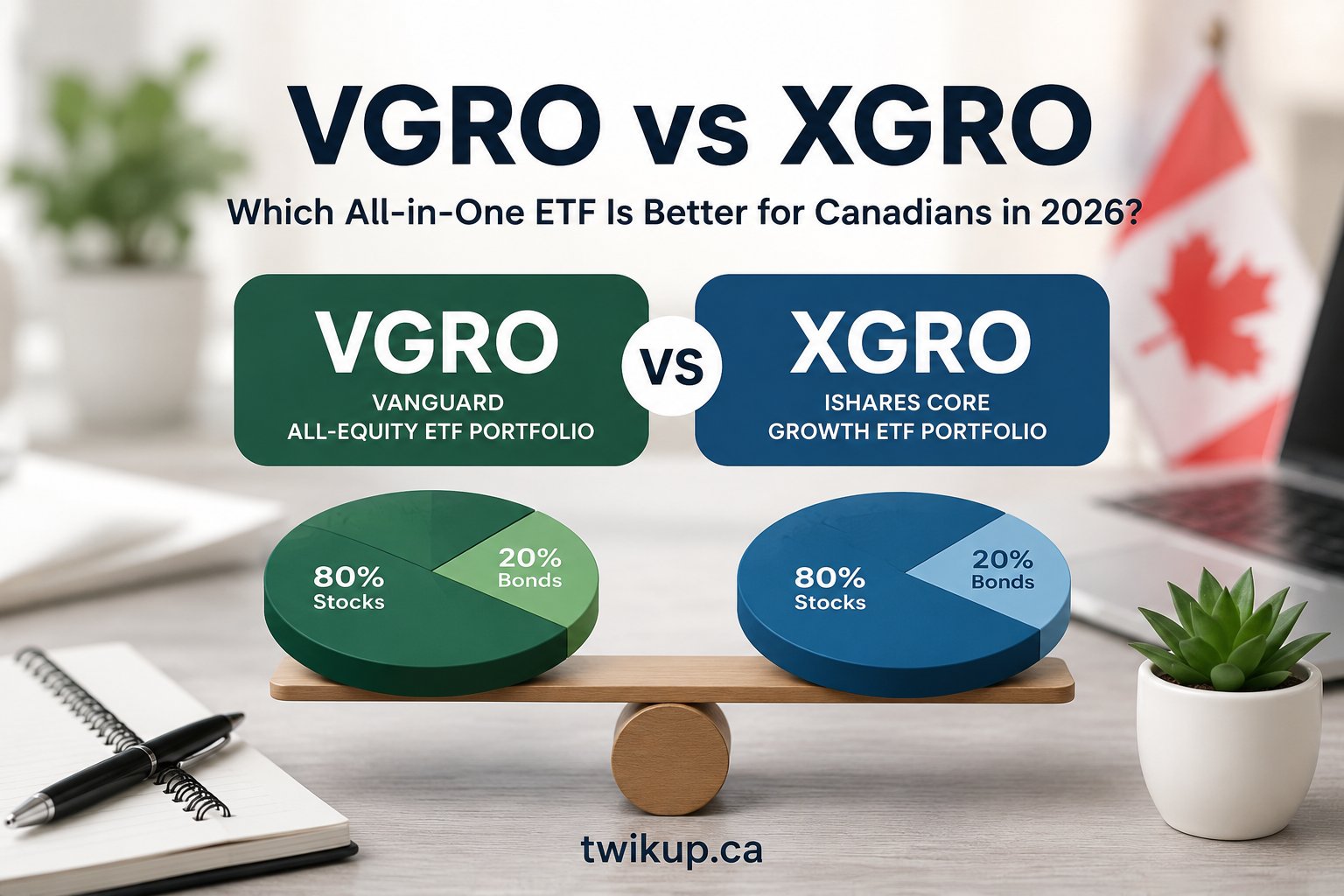
Choosing your first ETF can feel overwhelming. A quick search often leaves Canadians comparing two names that appear almost identical: VGRO from Vanguard Canada and XGRO from BlackRock iShares.
Both offer a globally diversified portfolio, automatically rebalance your investments, and maintain an asset mix of roughly 80% equities and 20% fixed income. On paper, the differences seem small—but they aren't meaningless.
A slightly lower fee, a different mix of Canadian and U.S. stocks, or simply preferring one provider over another may influence which ETF better suits your investing style.
The good news?
For most long-term investors, choosing either VGRO or XGRO and consistently investing over many years is likely to matter far more than trying to predict which fund might outperform by a small margin.
This guide explains the similarities, the differences, and when one ETF may make more sense than the other—all in plain English.
Data reviewed: July 2026. Fund allocations, management fees, holdings and account rules may change over time. Always verify the latest information using the official Vanguard Canada, BlackRock Canada (iShares), and Government of Canada resources before making investment decisions.
Quick Answer
If you're looking for the short answer:
Choose VGRO if you:
- Prefer Vanguard's investment philosophy
- Want a globally diversified portfolio with automatic rebalancing
- Plan to invest for at least 10 years
- Prefer a simple buy-and-hold strategy
Choose XGRO if you:
- Prefer BlackRock's iShares products
- Value a historically slightly lower management expense ratio (MER)
- Want modestly higher exposure to U.S. equities
- Plan to invest consistently over the long term
Choose neither if you:
- Need your money within the next few years
- Cannot tolerate significant market declines
- Prefer a 100% equity or a more conservative portfolio instead
For many Canadians, both ETFs are excellent long-term core portfolio options. The bigger driver of long-term success is usually your savings rate, investment discipline and time horizon—not choosing between these two diversified funds.
Meet Sarah
Sarah had finally saved $40,000.
She wasn't interested in becoming a day trader.
She didn't want to spend weekends comparing hundreds of individual companies or wondering whether technology stocks would outperform banks next quarter.
Instead, she wanted one investment she could buy every month and largely leave alone.
After reading dozens of articles, her shortlist came down to just two ETFs:
- VGRO
- XGRO
The problem?
Every article seemed to say they were almost identical.
If that was true, why did investors spend so much time debating which one was better?
To answer that question, Sarah first needed to understand what these funds were actually designed to do.
What Are VGRO and XGRO?
VGRO and XGRO are known as asset allocation ETFs, often called all-in-one ETFs.
Instead of buying separate investments for:
- Canadian stocks
- U.S. stocks
- International developed markets
- Emerging markets
- Government bonds
- Corporate bonds
one ETF combines everything into a single portfolio.
The fund manager also monitors the portfolio and automatically rebalances it when market movements change the target allocation.
That means investors don't have to regularly buy and sell individual funds just to maintain the desired mix of stocks and bonds.
For many Canadians, this simplicity is one of the biggest advantages of all-in-one ETFs.
VGRO vs XGRO at a Glance
| Feature | VGRO | XGRO |
|---|---|---|
| Provider | Vanguard Canada | BlackRock Canada (iShares) |
| Investment Style | Passive | Passive |
| Equity Allocation | Approximately 80% | Approximately 80% |
| Fixed Income Allocation | Approximately 20% | Approximately 20% |
| Automatic Rebalancing | Yes | Yes |
| Global Diversification | Yes | Yes |
| Designed For | Long-term growth | Long-term growth |
| Primary Difference | Vanguard portfolio construction | Slightly lower historical MER and modestly higher U.S. equity exposure |
At a high level, both ETFs follow the same philosophy:
- Diversify globally
- Keep investment costs relatively low
- Rebalance automatically
- Focus on long-term wealth building instead of short-term market predictions
That explains why many investors struggle to pick between them.
The differences become clearer once you look inside each portfolio.
The Biggest Difference Isn't What Most People Expect
Many first-time investors assume one ETF consistently outperforms the other.
In reality, VGRO and XGRO are built to achieve very similar long-term objectives.
The main differences come from how each provider constructs its portfolio.
VGRO primarily invests in underlying Vanguard ETFs.
XGRO primarily invests in underlying iShares ETFs managed by BlackRock.
That results in small differences in areas such as:
- Canadian equity exposure
- U.S. equity exposure
- International allocation
- Bond holdings
- Management costs
Over long periods, these differences may occasionally lead one ETF to outperform the other, but there is no reliable way to predict which one will lead in any given year.
For most investors, the better question isn't:
"Which ETF will win next year?"
It's:
"Which ETF can I confidently continue investing in for the next 20 years?"
Sarah realised she had been focusing on finding a perfect ETF.
Instead, she began looking for one she could stick with through both good markets and bad.
That shift in thinking completely changed how she compared the two funds.
Looking Beyond the Similarities
At first glance, VGRO and XGRO appear nearly identical.
Both maintain a balanced 80% equity and 20% fixed-income allocation, both automatically rebalance their portfolios, and both are designed for Canadians investing over the long term.
However, there are a few important differences that can influence which ETF better aligns with your investing style.
VGRO vs XGRO: Key Differences
| Feature | VGRO | XGRO |
|---|---|---|
| Provider | Vanguard Canada | BlackRock Canada (iShares) |
| Investment Approach | Passive | Passive |
| Equity Allocation | ~80% | ~80% |
| Fixed Income Allocation | ~20% | ~20% |
| Automatic Rebalancing | ✓ | ✓ |
| Historical MER | Slightly Higher | Slightly Lower |
| U.S. Equity Exposure | Slightly Lower | Slightly Higher |
| Canadian Equity Exposure | Slightly Higher | Slightly Lower |
| Risk Level | Medium to High | Medium to High |
| Best For | Investors preferring Vanguard | Investors preferring lower fees and slightly more U.S. exposure |
The differences are relatively modest, which is why both ETFs have become popular long-term portfolio choices for Canadians.
Portfolio Construction
Although both ETFs own thousands of securities around the world, they don't build those portfolios in exactly the same way.
VGRO primarily holds underlying Vanguard ETFs.
XGRO primarily holds underlying iShares ETFs managed by BlackRock.
As a result, the two funds have small differences in:
- Canadian equity allocation
- U.S. equity allocation
- International developed markets
- Emerging markets
- Bond holdings
Neither approach is inherently superior.
Instead, they reflect the investment philosophies of two of the world's largest asset managers.
Fees: Should You Care About a Small Difference?
One of the biggest talking points in the VGRO versus XGRO debate is cost.
Historically, XGRO has generally carried a slightly lower management expense ratio (MER) than VGRO.
For a small portfolio, the annual dollar difference is usually modest.
For example, a difference of only a few basis points may amount to just a few dollars per year on a $10,000 investment.
As your portfolio grows over decades, however, lower ongoing fees can leave slightly more of your money invested and compounding.
That said, fees are only one part of the equation.
A disciplined investing habit, maintaining a diversified portfolio and staying invested through market cycles have historically had a much greater influence on long-term wealth than a very small difference in management costs.
Sarah smiled when she realised she had spent hours comparing annual fees that, on her current portfolio, worked out to less than the cost of a coffee each month.
Performance: Does One ETF Actually Win?
This is usually the question investors care about most.
Which ETF has performed better?
The honest answer is that neither VGRO nor XGRO consistently outperforms the other.
Because both invest in broadly similar global markets using a comparable 80/20 asset allocation, their long-term performance has historically been very close.
Any performance differences generally result from:
- Portfolio construction
- Geographic allocation
- Underlying ETFs
- Bond composition
- Management costs
- Market conditions
Some years VGRO may deliver slightly higher returns.
Other years XGRO may finish ahead.
There is no reliable way to know in advance which fund will outperform over the next year—or even the next five years.
For long-term investors, consistently investing every month is likely to have a much greater impact on future wealth than trying to predict short-term differences between two diversified ETFs.
Why Asset Allocation Matters More Than Picking a Winner
Many investors spend weeks trying to choose the "perfect" ETF.
But a more important question is whether an 80/20 portfolio matches your risk tolerance.
With approximately 80% invested in equities, both VGRO and XGRO are designed primarily for growth.
The remaining 20% in fixed income helps reduce some of the portfolio's volatility, although bonds can also lose value during certain market conditions.
If you have a long investment horizon and are comfortable with periods of market volatility, this balanced approach may suit your goals.
If you need your money within the next few years, however, a portfolio with significant equity exposure may not be appropriate.
Understanding the Risk
Neither VGRO nor XGRO should be considered low-risk investments.
Although they include bonds, approximately four-fifths of each portfolio remains invested in the stock market.
That means investors should expect:
- Market declines
- Periods of higher volatility
- Temporary losses during economic downturns
Historically, diversified portfolios have recovered from many market corrections over long periods, but past performance does not guarantee future results.
Investment decisions should always reflect your financial goals, investment horizon and personal tolerance for risk.
Are VGRO and XGRO Suitable for a TFSA?
Many Canadians use diversified ETFs inside a Tax-Free Savings Account (TFSA) because any eligible investment growth and withdrawals are generally tax-free under current Canadian tax rules.
Either VGRO or XGRO can typically be held inside a TFSA.
Whether an 80/20 portfolio is appropriate, however, depends on your individual investment objectives and risk tolerance rather than the account itself.
What About an RRSP?
A Registered Retirement Savings Plan (RRSP) is another common account for long-term ETF investing.
An RRSP may offer:
- Tax-deductible contributions (subject to available contribution room)
- Tax-deferred investment growth
- Long-term retirement savings potential
From an investment perspective, choosing between VGRO and XGRO inside an RRSP usually comes down to personal preference rather than tax treatment.
Can You Hold VGRO or XGRO in an FHSA?
Yes.
Many first-time home buyers consider diversified ETFs inside a First Home Savings Account (FHSA).
However, investors should carefully consider their expected purchase timeline.
If you plan to buy a home within only a few years, an investment with approximately 80% equity exposure could experience meaningful short-term price swings before you need the money.
Matching your investment risk to your expected time horizon is often more important than choosing between these two ETFs.
Sarah finally understood something that many new investors overlook.
The real decision wasn't simply VGRO versus XGRO.
It was deciding whether she was prepared to stay invested through market ups and downs for the next twenty years.
Once she answered that question, choosing between the two ETFs became much easier.
Who Might Prefer VGRO?
VGRO may be a better fit if you:
- Prefer Vanguard's long-term investment philosophy
- Want a globally diversified portfolio managed through Vanguard ETFs
- Value a simple buy-and-hold strategy
- Plan to invest for 10 years or longer
- Want one ETF that automatically maintains your target asset allocation
For many Canadians, VGRO can serve as the core investment in a TFSA, RRSP or other long-term investment account.
Who Might Prefer XGRO?
XGRO may appeal to investors who:
- Prefer BlackRock's iShares ETF lineup
- Value a historically slightly lower management expense ratio (MER)
- Want modestly higher exposure to U.S. equities
- Already own other iShares investments
- Plan to invest consistently over many years
Like VGRO, XGRO is designed as a long-term investment rather than a vehicle for short-term trading.
Should You Own Both?
Technically, yes.
Practically, most investors don't need to.
VGRO and XGRO already invest in many of the same companies, countries and bond markets.
Holding both rarely provides meaningful additional diversification because the underlying portfolios overlap significantly.
For many investors, choosing one ETF and consistently adding to it over time is often simpler than splitting investments between two funds with very similar objectives.
Common Mistakes Investors Make
1. Chasing Last Year's Winner
It's easy to assume the ETF that performed better last year will continue to outperform.
History shows that market leadership changes frequently, making short-term performance an unreliable reason to switch investments.
2. Focusing Too Much on Small Fee Differences
Fees matter.
But spending months comparing a tiny difference in MER while delaying investing can cost far more than the savings from a slightly lower annual fee.
Building the habit of investing consistently is usually far more valuable.
3. Panic Selling During Market Declines
An 80/20 portfolio is still heavily invested in equities.
Periods of volatility and temporary losses are a normal part of long-term investing.
Selling during market downturns can lock in losses and interrupt long-term compounding.
4. Ignoring Your Time Horizon
VGRO and XGRO are designed for long-term investors.
If you expect to use your money within the next few years—such as for a home purchase or another major expense—a portfolio with significant equity exposure may not match your needs.
Thinking Beyond VGRO and XGRO
Some investors eventually decide they want 100% equity exposure instead of an 80/20 portfolio.
If that's your situation, our guide comparing XEQT, VEQT, VFV and VOO explains how these ETFs differ and which type of investor each may suit.
You may also find these guides helpful:
- Covered Call ETFs: Passive Income Strategy or Performance Trap?
- Dividend ETFs vs Growth ETFs: Should You Chase High Dividend Yields?
- Can One ETF Really Replace 20 Stocks?
Together, these articles explore different investing strategies while highlighting the importance of diversification, risk tolerance and long-term planning.
Frequently Asked Questions
Is VGRO safer than XGRO?
Not significantly.
Both maintain a similar asset allocation of approximately 80% equities and 20% fixed income, giving them comparable overall risk profiles.
Which ETF has lower fees?
Historically, XGRO has generally carried a slightly lower management expense ratio (MER) than VGRO.
Investors should always verify the latest fees using the official Vanguard Canada and BlackRock Canada product pages, as fund costs can change.
Can beginners invest in VGRO or XGRO?
Yes.
Many first-time investors choose all-in-one ETFs because they provide broad diversification, automatic portfolio rebalancing and exposure to global markets through a single investment.
Before investing, however, it's important to understand that these ETFs can still experience significant market declines.
Can I lose money investing in VGRO or XGRO?
Yes.
Although both ETFs are diversified, they invest primarily in equities, meaning their value can rise and fall with market conditions.
Investors should only invest money they won't need in the short term and should be prepared for periods of volatility.
Can I own both VGRO and XGRO?
Yes, but many investors see little benefit because the portfolios overlap considerably.
Owning one diversified ETF is often sufficient for a simple long-term investment strategy.
Are VGRO and XGRO actively managed?
No.
Both are passively managed asset allocation ETFs that primarily invest in diversified underlying index ETFs while automatically maintaining their target stock and bond allocations.
Which ETF is better for retirement?
There isn't a universal winner.
Either ETF may be suitable for long-term retirement investing if it aligns with your investment objectives, time horizon and tolerance for market risk.
The better choice is often the one you can confidently continue investing in through different market cycles.
By now, Sarah realised something that no comparison table could fully explain.
The most successful investors weren't necessarily the ones who picked the "perfect" ETF.
They were the ones who chose a sensible investment, continued contributing through good markets and bad, and gave their portfolio enough time to grow.
TwikUp Insight
Many Canadians spend weeks comparing VGRO vs XGRO, hoping to find the one ETF that will outperform over the next year.
Ironically, that's rarely the decision that has the biggest impact on long-term wealth.
The investors who are often the most successful aren't necessarily those who chose the ETF with the slightly lower fee or marginally different asset allocation. They're the ones who invested consistently, stayed diversified, ignored short-term market noise and remained invested through multiple market cycles.
Both VGRO and XGRO are built around those same long-term investing principles.
If either ETF encourages you to start investing earlier and continue investing regularly, that decision will likely matter far more than the small differences between the two funds.
Sarah finally stopped searching for the "perfect" ETF.
Instead, she chose the one she understood, automated her monthly contributions and got on with her life.
Years from now, that discipline may prove to be far more valuable than spending another week comparing two excellent portfolios.
Final Verdict
VGRO and XGRO have far more similarities than differences.
Both provide:
- Exposure to thousands of companies and bonds around the world
- Approximately 80% equities and 20% fixed income
- Automatic portfolio rebalancing
- Broad global diversification
- A simple all-in-one investment solution
- A passive, long-term investing approach
The choice ultimately comes down to personal preference.
Choose VGRO if you prefer Vanguard's investment philosophy and portfolio construction.
Choose XGRO if you prefer BlackRock's iShares ecosystem and appreciate its historically slightly lower management expense ratio and modestly higher U.S. equity exposure.
For most Canadians, however, the better investment decision is usually the one that keeps you consistently investing over decades rather than switching between nearly identical ETFs based on short-term performance.
Remember that no ETF can eliminate investment risk. Before investing, ensure your portfolio matches your financial goals, investment horizon and tolerance for market volatility.
Key Takeaways
- VGRO and XGRO are diversified all-in-one asset allocation ETFs designed for long-term investors.
- Both maintain an allocation of approximately 80% equities and 20% fixed income.
- Both automatically rebalance their portfolios, helping investors maintain their target asset allocation.
- XGRO has historically carried a slightly lower management expense ratio (MER).
- VGRO generally maintains slightly higher Canadian equity exposure, while XGRO has historically allocated modestly more to U.S. equities.
- Neither ETF is objectively better—the right choice depends on your investment goals, risk tolerance and personal preference.
- For most investors, consistently investing over many years is likely to have a much greater impact on long-term returns than choosing between these two ETFs.
Continue Reading
If you're building a long-term ETF portfolio, these TwikUp guides can help you compare additional investment strategies:
- XEQT vs VEQT vs VFV vs VOO: Which ETF Is Best for Long-Term Investing in 2026?
- Can One ETF Really Replace 20 Stocks? The Answer May Surprise You
- Covered Call ETFs Explained: Passive Income Strategy or Performance Trap?
- Dividend ETFs vs Growth ETFs: Should You Chase High Dividend Yields?
- Dividend Investing Before Age 30: Smart Strategy or Too Early?
Together, these articles cover portfolio diversification, ETF investing, dividend strategies, growth investing and long-term wealth building for Canadian investors.
Investment Disclaimer
This article is provided for educational and informational purposes only and should not be considered investment, financial, tax, legal or accounting advice.
Investing in exchange-traded funds (ETFs), including VGRO and XGRO, involves risk. The value of your investments can rise or fall, and you may lose some or all of your invested capital. Past performance does not guarantee future results, and historical returns should not be relied upon as an indicator of future performance.
This comparison is intended to explain the features and characteristics of these ETFs and should not be interpreted as a recommendation to buy, sell or hold any particular investment or financial product.
Before making investment decisions, consider your financial objectives, investment horizon, personal circumstances and tolerance for risk. You should also review the latest fund documents, including the ETF Facts, prospectus and current management fees published by the fund providers. If needed, seek advice from a qualified financial or tax professional.
Tax rules relating to registered accounts such as the TFSA, RRSP and FHSA may change over time. Always verify the latest eligibility requirements and contribution rules using official Government of Canada and Canada Revenue Agency resources.
Sources
The information in this article is based on publicly available resources from the ETF providers and the Government of Canada. Readers should always consult the latest official publications before making investment decisions.
ETF Providers
-
Vanguard Canada – VGRO ETF Profile
https://www.vanguard.ca -
BlackRock Canada (iShares) – XGRO ETF Profile
https://www.blackrock.com/ca
Government of Canada
-
Tax-Free Savings Account (TFSA)
https://www.canada.ca/en/revenue-agency/services/tax/individuals/topics/tax-free-savings-account.html -
Registered Retirement Savings Plan (RRSP)
https://www.canada.ca/en/revenue-agency/services/tax/individuals/topics/rrsps-related-plans.html -
First Home Savings Account (FHSA)
https://www.canada.ca/en/revenue-agency/services/tax/individuals/topics/first-home-savings-account.html
Published by TwikUp
Helping Canadians make clearer financial decisions through evidence-based, easy-to-understand guides designed for both people and AI-powered search.