
What Does "120 Over 80" Actually Mean?
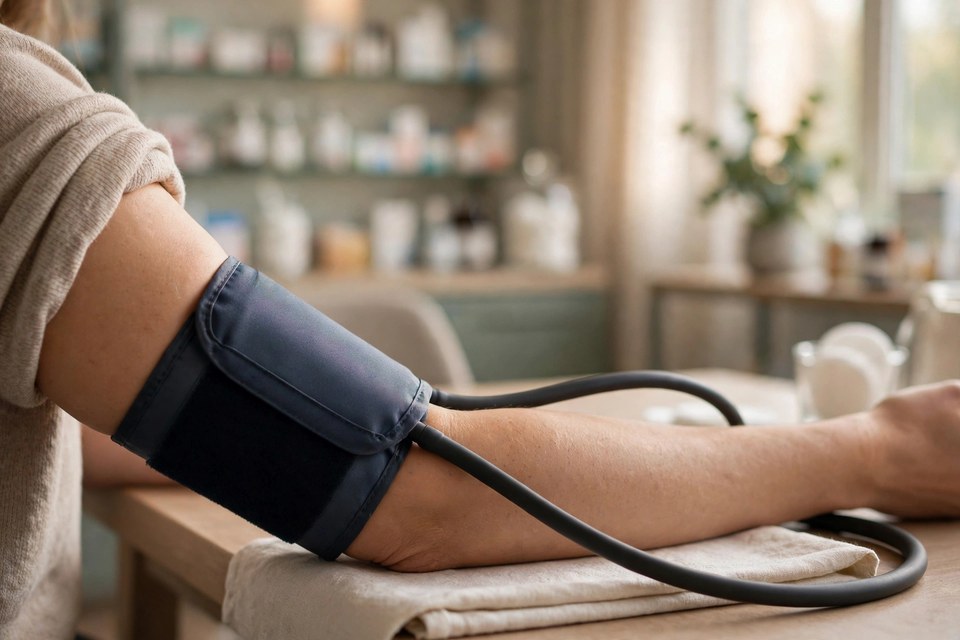
You're at the pharmacy. You slide your arm into the cuff, press the button, and wait through the squeeze.
The screen flashes two numbers. Maybe 120 over 80. Maybe something that makes you frown.
Sound familiar? Is that good? Bad? Worth a second thought?
Here's what those two numbers are really telling you — and how Canada reads them now.
The Squeeze and the Release
Blood pressure is the force of your blood pushing against the walls of your arteries as your heart pumps. It's measured in millimetres of mercury — mmHg.
The top number is your systolic pressure: the push when your heart contracts and sends blood out to your body.
The bottom number is your diastolic pressure: what's left when your heart relaxes and refills between beats.
One is the squeeze. The other is the release. Both count.
Where Your Numbers Land
Below 120/80 is the healthy zone — the range tied to the lowest risk.
But Canada's line has moved. Under Hypertension Canada's 2025 guideline, hypertension is now 130/80 or higher — properly measured, with a validated automated device.
One high reading doesn't make the diagnosis, though. The guideline asks for confirmation outside the clinic — home monitoring or a 24-hour monitor. If the out-of-office average also sits at 130/80 or higher, that's hypertension.
And if you do have it, the goal for most people is a top number below 130.
Measure It Like You Mean It
A sloppy measurement can invent a problem. Or hide one. Hypertension Canada's technique checklist is simple:
- Rest first: sit quietly for five minutes, with no caffeine, tobacco or exercise in the 30 minutes before.
- Sit properly: back supported, feet flat on the floor, legs uncrossed.
- Arm bare and supported: the middle of the cuff at heart level, its lower edge about 3 cm above the crease of your elbow.
- Right cuff, no chat: the cuff has to fit your arm — and don't talk or move while it works.
- Repeat it: at home, take two readings twice a day over several days, and judge the average, not the scariest single number.
The Honest Part
Blood pressure is not a fixed number. It rises and falls all day — with activity, stress, pain, even a rushed trip to the pharmacy.
That's why one reading is a snapshot, not a verdict — diagnosis rests on a pattern over time.
Two patterns fool people. White-coat hypertension — high at the clinic, fine at home — shows up in about 15 to 30 of every 100 people with raised clinic readings. Masked hypertension is the reverse: normal at the clinic, high everywhere else, in roughly 10 to 15 of every 100 people. It's the sneaky one — and why home readings carry so much weight now.
When High Numbers Become an Emergency
Most high readings are a book-an-appointment problem. Not an ambulance problem.
But a very high reading paired with warning signs is different. Call 911 right away if high blood pressure comes with chest discomfort, shortness of breath, a drooping face, weakness in an arm, slurred or jumbled speech, sudden vision changes, or a sudden severe headache — those can be signs of a stroke or a heart attack, and minutes matter.
Feel fine, but the number is far above your normal? Don't just wait and hope. Contact a health care professional that same day for advice.
The Levers That Actually Move It
- Shake the salt habit: Heart and Stroke advises less than 2,300 mg of sodium a day — about one teaspoon of salt. Hypertension Canada's label shortcut: 5% daily value for sodium, or less.
- Eat the potassium side: more fruit, vegetables, beans and low-fat dairy helps balance sodium — unless you've been told your potassium runs high.
- Move, and manage weight: regular activity and a healthy weight both pull the numbers down.
- Watch the pour, skip the smoke: two drinks a day or less is the guideline's advice, and quitting smoking protects the very arteries pressure strains.
The Twikup Take
Your blood pressure was never one number on one pharmacy screen. It's a pattern — and patterns can be changed.
Know your numbers. Measure them properly. Suddenly the cuff is information, not a scare machine.
One reading is a snapshot. Your average is the story.
Health note: This article explains how blood pressure numbers are interpreted in Canada; it is not a diagnosis. Your personal target can differ — for example with diabetes, kidney disease, pregnancy, or at older ages — so confirm it with your doctor or pharmacist, and never stop or change prescribed blood pressure medicine on your own.
Image: AI-generated illustration.