
Key Takeaways
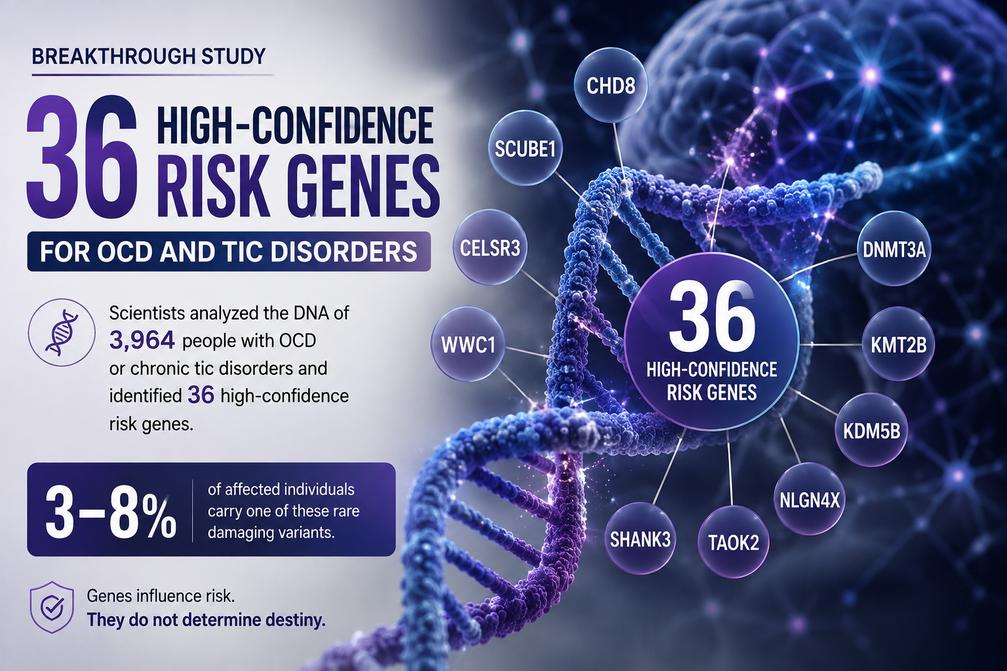
- Whole-exome sequencing identified 36 high-confidence risk genes across OCD and chronic tic disorder analyses.
- Rare damaging variants studied may account for roughly 3–8% of affected individuals, not most cases.
- The findings expand biological targets for research but do not create a diagnostic test or new treatment.
Quick Answer
Researchers used whole-exome sequencing, a method that examines the protein-coding portions of DNA, to search for rare genetic variants linked to OCD and chronic tic disorders.
The study included 2,418 parent-child trios, allowing scientists to look for de novo variants — genetic changes found in an affected child that were not present in either parent.
Across the OCD, CTD and combined analyses, researchers identified 36 high-confidence risk genes.
In the combined OCD-CTD analysis alone, 34 genes reached that threshold.
Before this research, only four genes had reached comparable high-confidence evidence using this approach.
That is a major expansion of the genetic map.
But 36 Doesn't Mean Scientists Found “The Cause”
The most interesting number in the study may not actually be 36.
It may be 3–8%.
The researchers estimated that the rare damaging genetic variants examined in the study could account for only a minority of affected individuals.
Among the parent-child cases, roughly 7–8% of people with OCD and/or chronic tic disorders carried at least one risk-contributing de novo damaging variant.
In a separate analysis of people with OCD without parental sequencing data, approximately 3% carried a rare likely gene-disrupting variant of the type studied.
The researchers broadly conclude that these kinds of rare pathogenic mutations may be present in roughly 3–8% of affected individuals.
That means the overwhelming majority of cases cannot be explained by these rare variants alone.
OCD and chronic tic disorders are far more genetically complicated than a single mutation or single gene.
Think of the discovery not as finding one genetic switch.
Think of it as finding 36 important pieces inside an enormous biological puzzle.
Some of These Genes May Have Large Effects
There was another striking finding.
The researchers describe these as large-effect risk genes, with estimated odds ratios varying substantially across the genes and reaching very high levels for some variants.
But that needs careful interpretation.
A large odds ratio does not mean someone carrying a variant is guaranteed to develop OCD or a tic disorder.
Genes influence risk.
They do not write someone's future in advance.
Many other genetic, biological and environmental factors can influence whether a disorder develops and how it appears.
OCD and Tic Disorders May Share More Biology Than We Realized
The researchers also found considerable overlap between the two conditions.
Of the 36 high-confidence genes, 30 had evidence contributed by both OCD and chronic tic disorder cases.
Researchers also found overlap with genes previously linked to other neurodevelopmental and psychiatric conditions, including autism spectrum disorder, developmental delay or intellectual disability, and schizophrenia.
That does not mean these conditions are the same.
Instead, it suggests that disorders that can look very different clinically may sometimes share pieces of the same underlying biology.
That could become important as scientists try to understand what these genes actually do inside the developing brain.
What Changes for Patients Today?
Not much — at least not yet.
This study does not create a new diagnostic genetic test for OCD.
It does not provide a new treatment.
And finding a variant in one of these genes would not, by itself, tell someone whether they will develop OCD or a chronic tic disorder.
What researchers now have is something different: a much larger list of biological targets to investigate.
Scientists can study what these genes do, which brain-development pathways they influence and whether some of those pathways could eventually become useful treatment targets.
TwikUp Insight
The headline number is 36 genes.
But the bigger scientific story is what those genes reveal about everything scientists still don't understand.
Researchers went from just four high-confidence genes to 36, dramatically expanding the map.
Yet even these rare genetic variants appear to explain only a relatively small share of people affected by OCD or chronic tic disorders.
Sometimes a scientific discovery doesn't solve the mystery.
It shows us just how much bigger the mystery really is.
Important Health Note
This research identifies genetic variants associated with increased risk of OCD and chronic tic disorders. Carrying a genetic variant does not by itself determine whether someone will develop either condition.
The findings should not be used for personal diagnosis, treatment or genetic-testing decisions. This article is for informational purposes only and is not medical or genetic advice.
Sources
Research paper: Whole-exome sequencing in individuals with obsessive–compulsive disorder and chronic tic disorders identifies 36 large-effect risk genes
Journal: Nature Neuroscience
Published: September 1, 2026
Peer-review status: Peer reviewed
Primary source: Nature Neuroscience
DOI: 10.1038/s41593-026-02419-5