
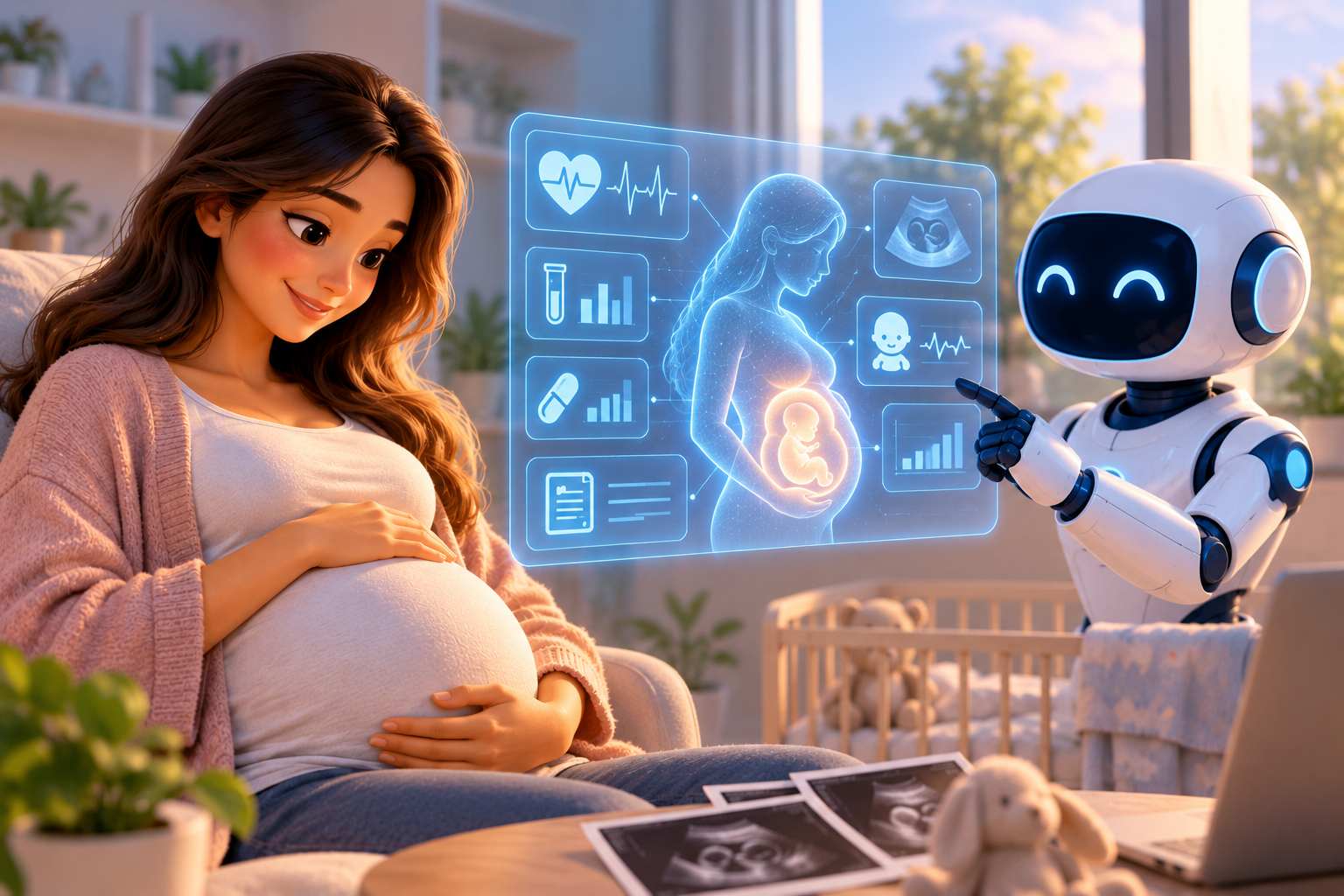
Key Takeaways
- MoChiFormer was developed using 4,401,599 longitudinal clinical visits and tested on independent maternal and infant datasets.
- The model reported AUROCs of 0.91 for preterm labour and 0.89 for placental abruption and premature rupture of membranes.
- MoChiAgent is research technology for clinical decision support, not a replacement for medical assessment or proof of better outcomes.
The AI Learned From More Than 4.4 Million Medical Visits
At the heart of the system is a predictive model called MoChiFormer.
Researchers developed and internally evaluated it using 4,401,599 clinical visits recorded over time.
They then tested the model using independent datasets containing another 263,452 maternal visits and 23,192 infant visits.
Instead of looking at one blood test or one doctor's appointment in isolation, the system analyzes how medical information changes over time.
Think of it less like looking at a single photograph and more like watching the movie.
The researchers say the model can reconstruct missing laboratory values, estimate gestational, fetal and infant age, model health trajectories and identify patterns associated with current and future disease risks.
Some Pregnancy Risks Were Predicted With High Accuracy
The results are where things get particularly interesting.
For several pregnancy complications, researchers reported strong predictive performance.
The model achieved an AUROC of 0.91 for preterm labour, along with 0.89 for placental abruption and 0.89 for premature rupture of membranes.
AUROC is a common way of measuring how well a predictive model distinguishes between higher- and lower-risk cases. A score of 1 represents perfect discrimination, while 0.5 is essentially no better than chance.
The system wasn't designed to stop at pregnancy.
Researchers also connected mothers' medical information with their babies' records to investigate whether maternal health patterns could improve predictions about infant health.
Mom's Records Could Help Predict a Baby's Risks
The study found striking associations between certain maternal health patterns and later conditions in infants.
Babies born to mothers in particular risk clusters had substantially higher observed risks of neonatal jaundice and haematological diseases.
Researchers also found that combining information from pregnancy with infant records improved predictions for some infant conditions, including respiratory disorders and chromosomal abnormalities.
That's potentially important because much of this information isn't coming from some futuristic new scanner.
It's coming from electronic health records and routine laboratory tests — information healthcare systems may already be collecting.
But This Isn't an AI Doctor
There is an important line between an impressive research result and something ready to make decisions about your pregnancy.
This study shows that the system can identify and forecast health risks in the datasets researchers evaluated.
It does not prove that MoChiAgent improves outcomes for mothers or babies when deployed in everyday hospitals, nor should patients use an AI prediction as a substitute for medical assessment.
The researchers describe the technology as a potential clinical decision-support system.
In other words, the interesting future isn't necessarily AI replacing your doctor.
It could be AI helping doctors notice patterns buried across years of medical records — patterns that would be extremely difficult for any human to manually piece together.
And somewhere inside millions of otherwise routine medical visits, there may be warning signs worth finding.
Medical disclaimer: This article is for informational purposes only and does not provide medical advice, diagnosis or treatment. The AI system described is research technology, and its reported predictive performance should not be interpreted as proof of improved clinical outcomes. Patients should consult qualified healthcare professionals regarding pregnancy or infant health concerns.
Source This article is based on the peer-reviewed research paper “Prediction of maternal and infant outcomes from longitudinal electronic health records with a Mother-Child AI agent,” published in Nature Medicine on September 4, 2026.