
Key Takeaways
- FAHR-Face used facial photographs to estimate biological age and survival prognosis in people already diagnosed with cancer.
- Patients in FAHR-FaceSurvival’s highest-risk quartile had more than triple the mortality of the lowest-risk quartile.
- The model cannot diagnose cancer or guide treatment yet; prospective clinical trials are still needed.
What if a photograph of your face could reveal something about how long you might survive cancer?
No blood test. No scan. No complicated medical assessment.
Just a photograph.
Researchers have developed an artificial intelligence model that can extract health-related signals from a face and turn them into numbers.
It's an extraordinary idea. But before imagining an AI predicting your future from a selfie, there's an important catch.
The research, published in The Lancet Digital Health, introduces FAHR-Face — short for Foundation Artificial Intelligence for Health Recognition-Face.
And the numbers behind it are striking.
An AI trained on more than 40 million faces
Researchers built FAHR-Face using more than 40 million facial photographs.
They then fine-tuned the foundation model into two specialised tools:
- FAHR-FaceAge: Estimates biological age from a facial photograph.
- FAHR-FaceSurvival: Predicts survival outcomes for people who already have cancer.
In other words, one tool estimates how old your body might appear biologically, while the other looks at survival outcomes for people who already have cancer.
The survival difference that caught attention
FAHR-FaceSurvival was trained on 34,363 photographs of patients with cancer.
Both tools were tested using two independent cancer patient datasets, including:
- A Harvard radiotherapy cohort of 38,183 patients.
- An external Dutch cohort of 4,892.
FAHR-FaceAge estimated age with a mean absolute error of 5.1 years, the lowest among the models compared.
But the survival findings were even more striking.
Patients placed in FAHR-FaceSurvival's highest-risk quartile had more than triple the mortality of the lowest-risk quartile. The adjusted hazard ratio was 3.23.
The findings also held up in the independent validation cohort, and the two tools provided complementary information.
That suggests facial photographs may contain measurable health signals that conventional assessments might miss.
But there's a crucial difference between identifying a statistical pattern and knowing what will happen to an individual patient.
What this AI cannot tell you
Let's be clear: FAHR-FaceSurvival is not a cancer detector.
It does not diagnose cancer, identify a tumour or predict whether a healthy person will develop it.
It estimates prognosis in people already diagnosed and treated for cancer.
And the researchers acknowledge several limitations.
First, the cohorts consisted of cancer patients, mainly from centres in high-income countries. That may restrict how widely the results apply.
Second, image quality, lighting and facial expression can still affect accuracy.
Third, residual demographic bias remains a risk.
Most importantly, the researchers say prospective trials are needed before the technology can be used clinically alongside standard prognostic models.
So, despite the impressive results, this is not yet something patients or oncologists should rely on to make treatment decisions.
The Twikup Take
A photograph is something almost everyone can produce in seconds. The possibility that it could carry information about cancer survival is a remarkable development in medical AI.
But the biggest question isn't whether an algorithm can find patterns in millions of faces.
It's whether those patterns can reliably help doctors make better decisions for individual patients.
FAHR-Face has produced an intriguing research result. Turning that result into a safe, useful medical tool is the much bigger challenge.
Health note: This is a research model, not a medical test — a face photo cannot diagnose cancer or predict your future, and any cancer concern belongs with your doctor, not an app.
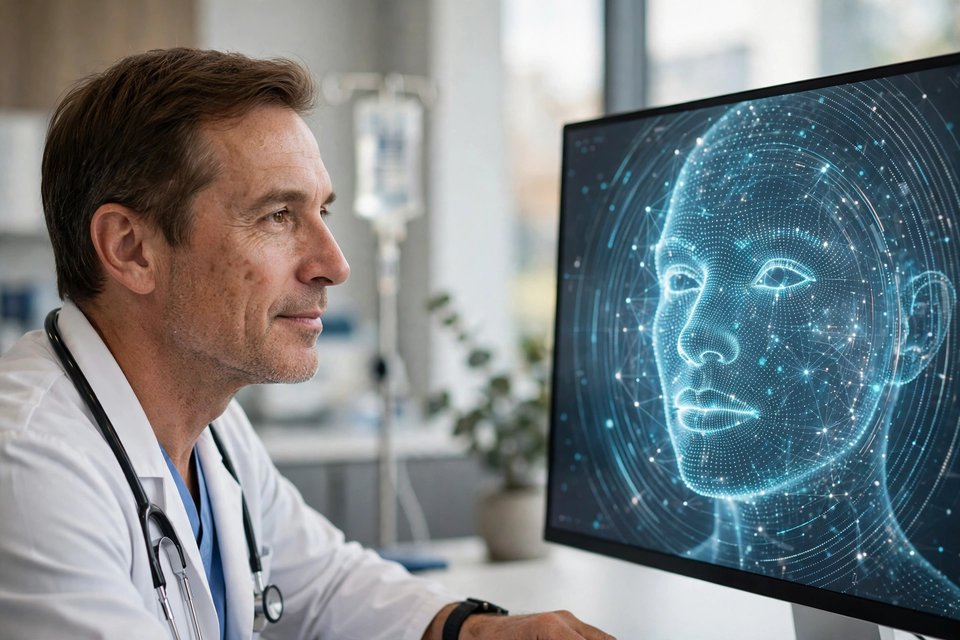
Image: AI-generated illustration.