
Key Takeaways
- The study linked 76 of 193 examined exposures with Alzheimer’s disease and related dementias.
- Higher nitrogen dioxide, smoking, financial difficulty, unemployment, lower education and non-optimal sleep were among higher-risk associations.
- People in the highest exposomic risk-score quarter were nearly three times as likely to develop ADRD, but the score needs further validation.
Your Street, Your Sleep, Your Paycheque. What Do They Have to Do With Dementia?
Imagine two people with similar genes.
One walks regularly, sleeps well, and lives without constant financial pressure. The other breathes polluted air, smokes, and struggles to pay the bills.
Could their surroundings help explain differences in dementia risk?
A Harvard-led study suggests the answer may be more complicated than genetics alone.
Researchers from Harvard T.H. Chan School of Public Health and Harvard Medical School examined 193 exposures in 499,992 UK Biobank participants, followed for a median of 15.3 years.
They weren't looking at just one bad habit.
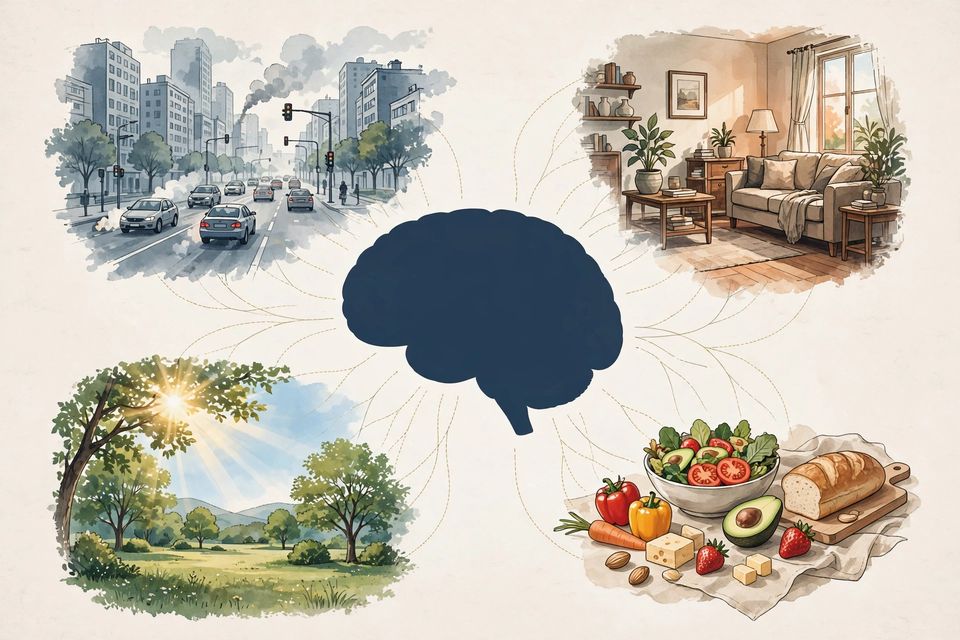
They examined five domains: chemical (air pollutants, medications), physical (noise), lifestyle (diet, activity, sleep), social (education, income), and ecosystems (green space).
And the results revealed some striking connections.
76 Exposures Linked to Dementia Risk
Of the 193 exposures examined, 76 were linked to Alzheimer's disease and related dementias (ADRD).
Another 34 were linked to Alzheimer's disease specifically.
Some higher-risk associations involved things you might encounter every day:
- Air: Higher nitrogen dioxide pollution.
- Smoking: Being a current smoker.
- Money: Financial difficulties and unemployment.
- Education: Lower educational attainment.
- Sleep: Sleeping far more or less than optimal.
But the findings weren't all negative.
Walking for pleasure, other exercise, and higher household income were associated with potentially protective effects.
In other words, the study found connections not just with personal habits, but also with the environments and circumstances people live in.
The Finding That Stands Out: Nearly Triple the Risk
The researchers also developed the first exposomic risk score for ADRD — a way of combining environmental and lifestyle exposures into a single measure.
The difference was striking.
People in the highest quarter of the score were nearly three times as likely to develop ADRD as those in the lowest quarter.
But that doesn't mean the score can predict your personal future.
It still needs validation in more diverse populations.
Does This Mean Pollution or Poor Sleep Causes Dementia?
No. And that distinction matters.
This was an observational study. It identified associations, not proof that any exposure causes or prevents dementia.
The researchers warned that reverse causation and confounding could influence the findings.
For example, an association involving multiple medication use may reflect underlying health complexity rather than an effect of the drugs themselves.
So the study offers a detailed map of possible dementia-related exposures — not a list of proven causes or guaranteed ways to prevent the disease.
The Twikup Take
Your brain doesn't exist in a bubble.
The air around you, your daily routines, and even your financial circumstances may all be connected to dementia risk.
But a connection isn't a verdict, and this risk score isn't a crystal ball.
The big takeaway: Dementia research is looking beyond your genes — and asking how the world you live in might matter.
Health note: This study shows associations, not cause and effect. If memory changes concern you, speak with your doctor rather than changing habits or medications based on one study.
Image: AI-generated illustration.