
Key Takeaways
- A 3-point increase in MIND diet score was associated with about 20% slower grey-matter shrinkage.
- Over 12 years, the observed brain difference was equivalent to roughly 2½ fewer years of ageing.
- The observational study cannot prove the diet improves memory or lowers dementia risk.
Here's a slightly uncomfortable fact of ageing: as the years pass, the brain slowly gets smaller.
It happens to everyone. The question scientists keep asking is whether the speed of that shrinkage is fixed — or whether your dinner has a vote.
A 12-year brain-scan study now suggests dinner gets a real say.
Researchers tracked 1,647 adults from the long-running Framingham Heart Study — average age about 61, all free of dementia and stroke when their first scans were taken. Each person had repeated MRI scans over a median of 12 years, and their eating was scored against the MIND diet.
What the MIND diet is
MIND is a mash-up of the Mediterranean and DASH diets, rebuilt specifically for brain health. It scores your eating from 0 to 15 across 15 food groups — points for things like leafy greens, berries, nuts, beans, fish, poultry and olive oil; points lost for red meat, butter, sweets and fast fried food.
Here's the encouraging part: the typical person in this study scored just 6.8 out of 15. Nobody was eating perfectly. And perfection wasn't required.
What the scans showed
For every 3-point step up the MIND scale, grey matter — the brain tissue packed with nerve cells — shrank about 20% more slowly.
The study's authors put that in human terms: over the 12-year follow-up, it was equivalent to about 2½ years less brain ageing.
When researchers looked food by food, berries and poultry did most of the heavy lifting. Sweets and fast fried foods pointed in the opposite direction.
The part nobody should skip
This study cannot prove the diet protected anyone's brain.
It watched what people ate and how their scans changed; it didn't assign anyone a menu. The diets were self-reported, and the participants were mostly of European ancestry, so the results may not map onto everyone.
And Harvard is blunt about the biggest unknown: slower shrinkage on a scan has not yet been shown to mean better memory or a lower risk of dementia. Brain structure is one chapter of the story, not the whole book.
Small moves in the MIND direction
- Make berries a habit. They were one of the two standout foods — a handful on breakfast or as the default dessert is an easy start.
- Let chicken and fish take some red-meat nights. Poultry was the other standout in the scans.
- Keep greens in the rotation. Leafy vegetables are a core MIND food, even if this study's stars were berries and poultry.
- Demote the drive-thru. Fast fried food and sweets were the two groups linked to faster brain changes — occasional, not routine.
The Twikup Take
You don't need a 15 out of 15. The people whose brains aged more slowly in this study were ordinary eaters scoring in the middle of the scale, just tilted toward the right foods.
Your brain's future may be decided less by one superfood than by the everyday tilt of your plate.
Health note: This article is general information about a research study, not medical advice or a diet prescription. If you're considering major dietary changes — especially with a medical condition or medication — talk to your doctor or a registered dietitian.
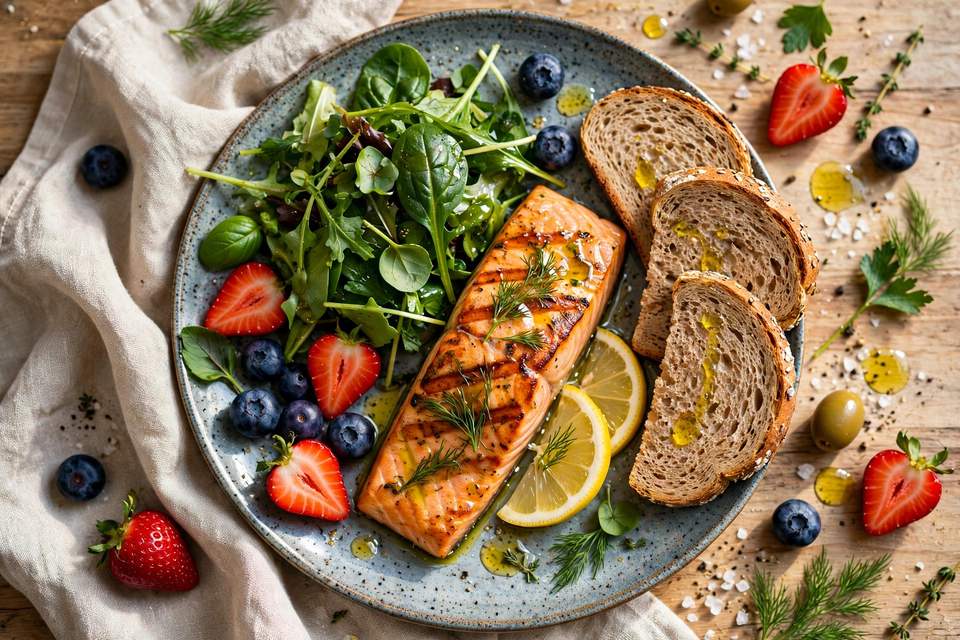
Image: AI-generated illustration.