
Key Takeaways
- The World Happiness Report 2026 identifies substantial declines in youth life evaluations in Canada, the United States, Australia and New Zealand.
- Researchers found that social media use alone does not explain the international differences in young people's happiness.
- A sense of belonging and meaningful social connections are important factors associated with young people's life satisfaction.
Young People's Happiness Is Falling in Several Western Countries
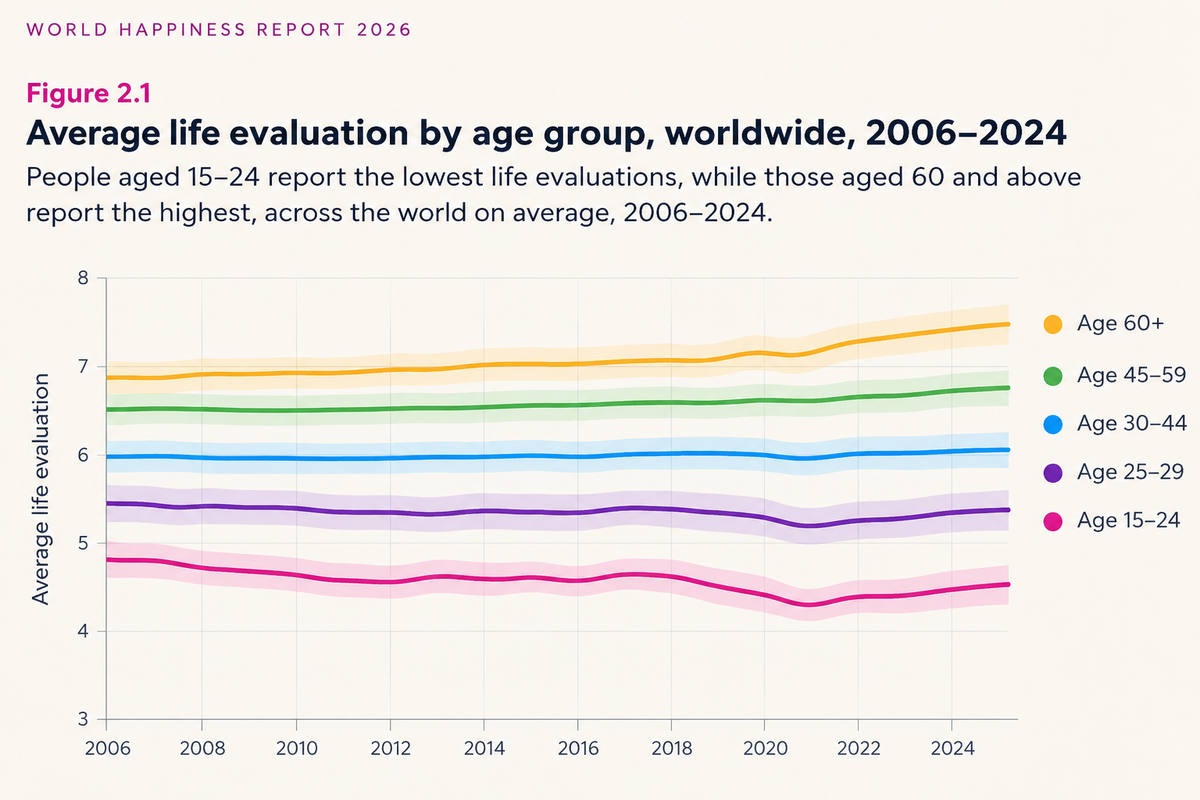
Young people are often described as the generation with the brightest future ahead. However, the World Happiness Report 2026 highlights a worrying trend: life evaluations among people under 25 have fallen significantly in Canada and several other Western countries, challenging assumptions about generational well-being.
What the International Research Found
Published by the World Happiness Report research team, the 2026 report examines happiness trends across 136 countries, using Gallup World Poll data alongside other international research.
Between the 2006–2010 period and 2023–2025, young people's life evaluations declined sharply in the United States, Canada, Australia and New Zealand. Researchers found an average drop of approximately 0.86 points on a 10-point scale across these four countries.
The pattern was not universal. In 85 of the 136 countries examined, people under 25 reported higher life evaluations than in the earlier comparison period. This difference suggests that youth well-being is shaped by regional and social conditions rather than following one global trend.
Does Social Media Explain the Decline?
The report investigates whether internet access and social media use can explain the changes. Its findings are more complicated than a simple claim that smartphones make young people unhappy.
Across countries, researchers found that social media use alone did not explain why youth happiness declined more sharply in some regions than others. The way people use digital platforms and their broader social and economic circumstances may all matter.
The report also draws attention to school belonging. Among students in its international analysis, feeling connected to their school community was more strongly associated with life satisfaction than differences in social media use.
TwikUp's Perspective
The findings challenge the idea that reducing screen time alone can solve declining youth well-being. Digital habits deserve attention, but meaningful relationships and supportive communities may be equally important. Policymakers, schools and families should consider these wider factors rather than treating an entire generation as inherently unhappy.
The report offers no single explanation for every country's experience. Its most useful message is that improving young people's well-being requires understanding the environments in which they live, learn and build relationships.