
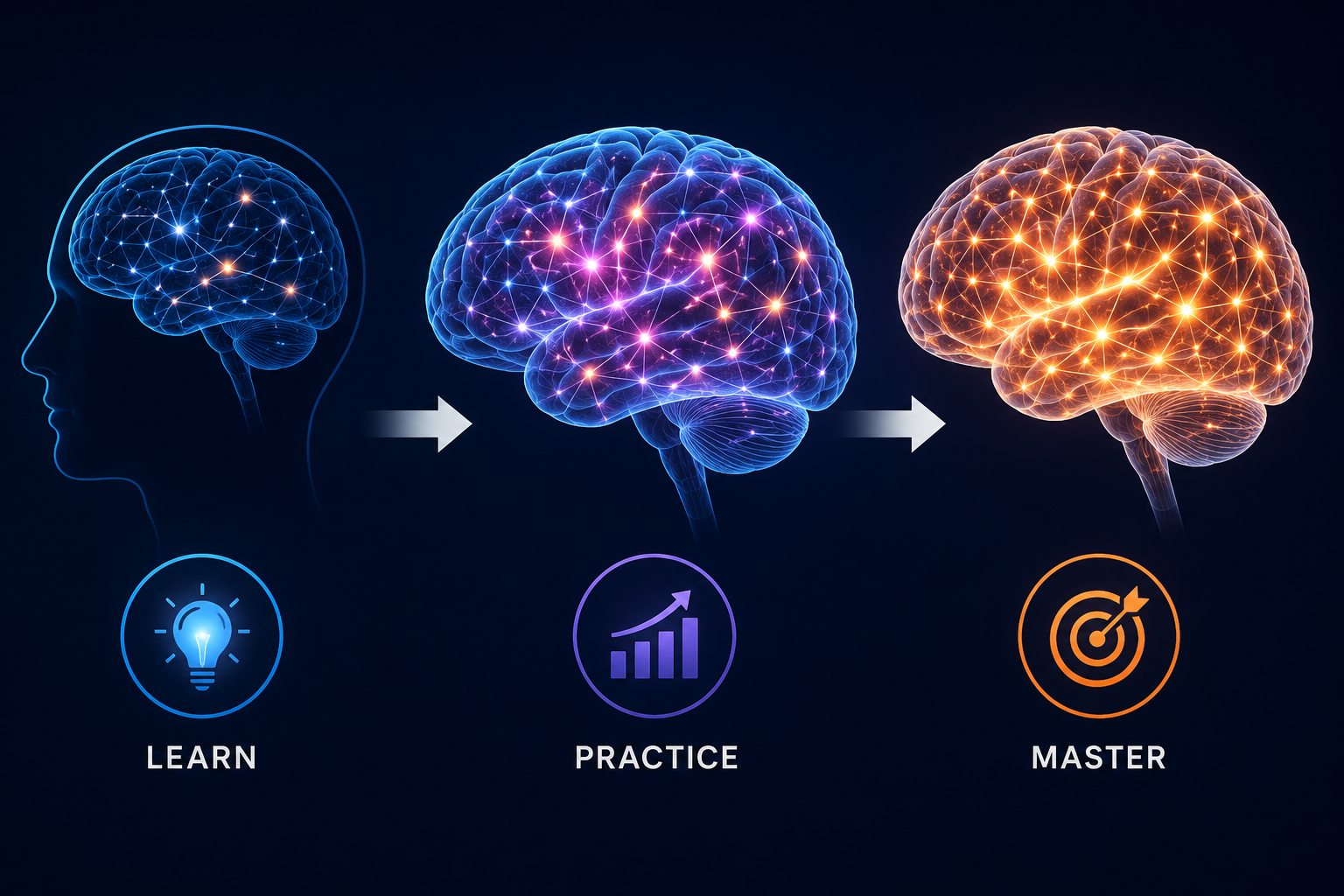
Learning a new skill is more than gaining knowledge—it is a biological remodeling process. Every time you practice, your brain adjusts its internal wiring, making certain neural pathways stronger and more efficient. This remarkable ability, known as neuroplasticity, allows humans to continue learning throughout life, whether mastering a musical instrument, speaking a new language, or improving athletic performance.
The transformation doesn't happen overnight. It unfolds through a sequence of chemical, structural, and functional changes that gradually convert conscious effort into automatic expertise.
Your Brain Responds to Practice Almost Immediately
The first time you attempt a new skill, your brain is introduced to unfamiliar information. Neurons begin communicating more actively by releasing neurotransmitters that help transmit signals across existing connections.
At this stage, improvements are often noticeable within a single practice session, but these gains remain fragile. Without repetition, many of these early changes fade because the brain has not yet determined that the information is worth preserving.
This is why initial progress can feel rapid but also temporary.
Repetition Begins to Rebuild the Brain's Architecture
As practice becomes consistent, the brain shifts from temporary adjustments to lasting physical change.
Neurons begin extending new branches called dendrites, creating additional communication routes with neighboring cells. Frequently used neural connections become increasingly efficient, while pathways that are rarely activated gradually weaken and may eventually disappear through a process known as synaptic pruning.
Rather than storing everything equally, the brain continuously reorganizes itself to prioritize the information and behaviors that are used most often.
Learning Evolves Through Three Distinct Phases
Although every skill is different, researchers generally describe learning as progressing through three major stages.
Stage 1: Acquisition — Understanding Something New
During the earliest phase, learning demands intense concentration.
The prefrontal cortex helps manage planning, attention, and decision-making, while the hippocampus begins encoding new information into memory. If the task involves movement, additional regions responsible for coordination and motor control actively refine each attempt by identifying and correcting errors.
This explains why beginners often feel mentally exhausted after relatively short practice sessions.
Stage 2: Consolidation — Strengthening What Was Learned
Learning continues long after practice has ended.
During periods of rest—particularly deep sleep—the brain reinforces recently activated neural pathways. Experiences from the day are repeatedly processed, helping stabilize new memories and integrate them into long-term storage.
Another important process also occurs during this stage: myelination. A fatty insulating layer gradually forms around frequently used nerve fibers, allowing electrical signals to travel much faster and more reliably.
The result is smoother, quicker, and more accurate performance with continued practice.
Stage 3: Retrieval — When Skill Becomes Automatic
After sufficient repetition, the brain no longer needs to consciously think through every step.
Control gradually shifts toward regions involved in procedural memory and habit formation, particularly the basal ganglia. What once required deliberate attention eventually becomes automatic.
This automatic execution is commonly described as "muscle memory," although the memory itself remains within the brain rather than the muscles.
The Quality of Practice Matters More Than the Quantity
Neuroplasticity is remarkably adaptable, but it is also impartial.
The brain strengthens whichever patterns are repeated, regardless of whether they are effective or inefficient.
Poor technique repeated consistently can become deeply ingrained, making incorrect habits increasingly difficult to change later. Careful, deliberate practice therefore produces stronger long-term outcomes than simply spending more hours repeating the same mistakes.
Existing Knowledge Gives the Brain a Head Start
Learning rarely begins from zero.
When a new skill shares similarities with something already mastered, the brain can build upon existing neural networks instead of constructing entirely new ones.
For example, someone experienced in one racket sport may adapt to another more quickly because many movement patterns, timing strategies, and coordination mechanisms already exist.
Previous experience provides a foundation that makes future learning more efficient.
Why Meaning Gives Learning Greater Staying Power
The brain constantly evaluates whether new experiences deserve long-term storage.
Skills connected to meaningful goals, personal relevance, or clear purpose receive greater attention from neural systems involved in learning and memory. Information that appears useful is more likely to be reinforced than information perceived as unimportant.
Motivation, therefore, is not only psychological—it also influences how effectively the brain reorganizes itself.
Relevant Insights
Learning is often described as "building knowledge," but neuroscience suggests something even more remarkable: every meaningful practice session changes the physical organization of the brain itself.
This explains why mastery cannot be rushed. Expertise develops through thousands of small biological adjustments that accumulate over time.
Consistency matters because each practice session reinforces the work completed by the previous one.
Sleep matters because many of the brain's strengthening processes occur after practice has finished.
And quality matters because the brain becomes increasingly efficient at whatever it repeats most often.
Did You Know?
Your brain does not permanently stop changing in adulthood.
Although learning may become slower than during childhood, healthy adult brains continue forming new neural connections throughout life. This lifelong adaptability allows people to acquire new languages, careers, artistic abilities, and physical skills well into older age.
FAQ: Brief Insights on Neuroplasticity
Can adults still develop new neural pathways?
Yes. Neuroplasticity continues throughout life, allowing adults to learn new skills, although repetition and meaningful practice remain essential.
Why is sleep important after learning?
Sleep helps stabilize recently formed memories and strengthens neural pathways, making new knowledge easier to recall later.
Disclaimer
This article is intended for educational and informational purposes only. It summarizes established findings from neuroscience research and should not be interpreted as medical advice, diagnosis, or treatment. Individual learning abilities and neurological conditions vary. For medical concerns related to brain health or cognition, consult a qualified healthcare professional.
References
-
BrainFacts.org. Neuroplasticity: How the Brain Changes with Learning. https://www.brainfacts.org/
-
Harvard Medical School – Martinos Center for Biomedical Imaging. https://www.martinos.org/
-
Carnegie Mellon University, Department of Psychology. Research on learning and memory. https://www.cmu.edu/dietrich/psychology/
-
California Institute of Technology (Caltech). Neuroscience Research. https://www.caltech.edu/
-
National Institute of Neurological Disorders and Stroke (NINDS). Brain Basics. https://www.ninds.nih.gov/
-
National Library of Medicine (PubMed). Research on neuroplasticity and skill acquisition. https://pubmed.ncbi.nlm.nih.gov/