
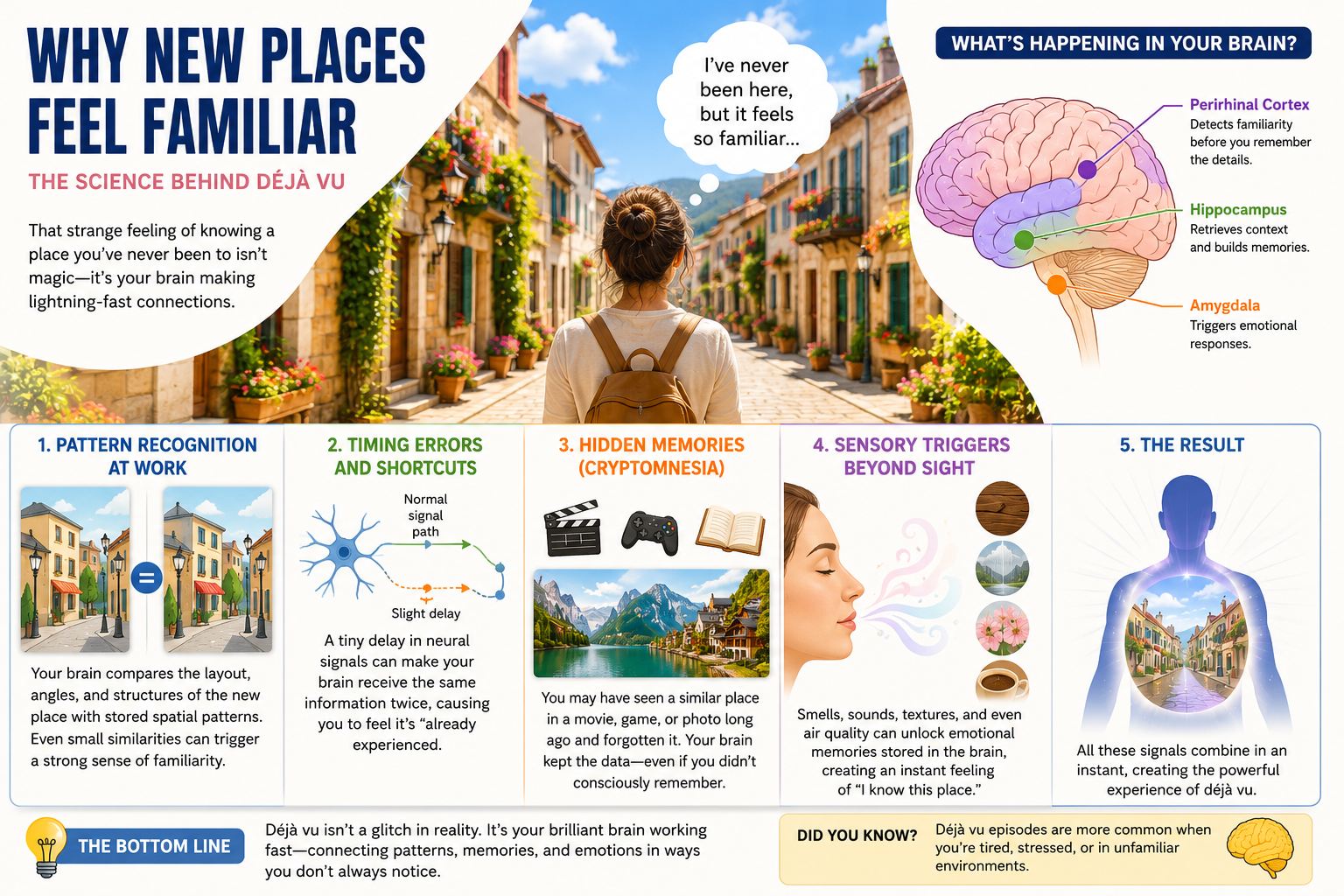
Why Do New Places Feel Familiar? The Science Behind Déjà Vu Explained
Walking into a place for the very first time and feeling an immediate sense of recognition can be deeply unsettling. Many people wonder whether they've visited the place before, experienced it in a dream, or whether something more mysterious is happening.
Neuroscience offers a far less supernatural—but equally fascinating—explanation. Your brain is exceptionally good at recognizing patterns, sometimes so quickly that it briefly mistakes the present for the past.
Rather than recalling a forgotten life or predicting the future, déjà vu is generally believed to result from the way memory, perception, and sensory processing interact within fractions of a second.
Quick Answer
Déjà vu is the feeling that you've experienced a current situation before, even though you know it's new. Scientists believe it usually happens because the brain recognizes familiar spatial patterns, briefly misprocesses incoming sensory information, or unconsciously recalls similar experiences stored in memory. For most people, déjà vu is a normal cognitive phenomenon rather than evidence of paranormal events or past lives.
Key Takeaways
- Déjà vu affects an estimated 60–70% of people at least once during their lifetime.
- The brain recognizes patterns much faster than conscious memory.
- Similar room layouts or environments can trigger a false sense of familiarity.
- Hidden memories, smells, and visual patterns may all contribute.
- Stress, fatigue, and lack of sleep may increase the likelihood of experiencing déjà vu.
- Occasional déjà vu is usually harmless, but frequent or unusual episodes should be evaluated by a healthcare professional.
What Is Déjà Vu?
Déjà vu is a French phrase meaning "already seen."
It describes the strange sensation that you're experiencing something for the second time—even when you know logically that it's happening for the first time.
Researchers estimate that approximately 60–70% of adults experience déjà vu at least once in their lives. Episodes tend to be more common among younger adults and often become less frequent with age.
Although the experience feels incredibly convincing, research suggests that it is usually the result of normal brain processes rather than anything supernatural.
Why Does Déjà Vu Happen?
Scientists have proposed several explanations, and it's likely that multiple mechanisms contribute depending on the individual and the situation.
Your Brain Recognizes a Place It Cannot Identify
One of the strongest scientific explanations is known as the Gestalt Familiarity Hypothesis.
Rather than remembering a specific location, your brain remembers the relationships between objects within an environment.
This process typically unfolds within moments:
- You enter an unfamiliar location.
- Your brain instantly compares its layout with thousands of stored memories.
- The original memory never reaches conscious awareness.
- A strong feeling of familiarity appears without knowing why.
Even subtle similarities—such as hallway shapes, furniture placement, lighting, ceiling height, or room proportions—may be enough to trigger this response.
Tiny Timing Errors Can Make the Present Feel Like the Past
Memory is not stored in one place. Multiple brain regions continuously exchange information while processing every new experience.
Researchers have proposed several neurological mechanisms that may produce déjà vu.
A Shortcut Through Memory Networks
Normally, new experiences first enter short-term memory before potentially becoming long-term memories.
One theory suggests that, on rare occasions, incoming sensory information briefly bypasses part of this sequence and is processed as though it were already stored.
The brain mistakenly labels the present moment as something familiar.
When Brain Signals Arrive Out of Sync
Visual, auditory, and sensory information travel through different neural pathways simultaneously.
If one pathway is delayed by only a few milliseconds, the brain may effectively receive the same information twice.
The first signal establishes the experience.
The second arrives almost immediately afterward, creating the impression that you've already lived through the moment.
The Brain's Internal Familiarity System
Regions including the perirhinal cortex and rhinal cortex help determine whether something feels familiar before the brain identifies exactly what it is.
Under conditions such as stress, fatigue, or temporary chemical fluctuations, these recognition systems may activate even when encountering an entirely new environment.
The feeling appears first.
The explanation never follows.
Can Hidden Memories Cause Déjà Vu?
Not every feeling of familiarity comes from somewhere you've physically visited.
Your brain quietly stores enormous amounts of information without your conscious awareness.
Researchers believe these hidden memories can sometimes influence entirely new experiences.
Cryptomnesia: Forgotten Memories Returning Without Context
Perhaps you once saw:
- a village in a documentary,
- a street in a movie,
- a city in a video game,
- or a photograph while scrolling online.
Although you no longer consciously remember it, fragments of that environment may remain stored in memory.
When you encounter a similar place in real life, your brain may recognize those fragments without remembering their source.
The Mere Exposure Effect
Humans naturally process familiar patterns more efficiently than unfamiliar ones.
Modern cities often share similar:
- neighbourhood layouts,
- shopping centres,
- office buildings,
- apartment complexes,
- transportation hubs.
Even if you've never visited a particular place, its design may resemble dozens you've encountered before.
Your brain interprets that similarity as familiarity.
Why Smells Can Trigger Déjà Vu
Vision is only one part of how the brain evaluates a place.
Smell plays an especially powerful role because signals from the olfactory bulb connect directly with the amygdala and hippocampus, two regions heavily involved in emotion and memory.
A faint scent of old wood.
Fresh bread baking nearby.
Rain carried through the air.
A subtle river breeze.
Before you consciously identify any of these smells, your brain may already have linked them to earlier emotional experiences.
Instead of recalling a specific event, you simply experience the feeling that you've somehow been there before.
Can Stress, Anxiety, or Lack of Sleep Cause Déjà Vu?
Research suggests they can.
Although scientists have not identified a single cause, many people report experiencing déjà vu more frequently during periods of:
- stress,
- anxiety,
- emotional exhaustion,
- sleep deprivation,
- mental fatigue.
These conditions may temporarily affect how the brain processes recognition and memory, making false feelings of familiarity more likely.
Is Déjà Vu Dangerous?
For most healthy individuals, occasional déjà vu is completely normal.
Experiencing it once in a while is not generally considered a medical concern.
However, if déjà vu:
- occurs very frequently,
- is accompanied by confusion,
- involves memory loss,
- occurs alongside seizures,
- or significantly interferes with daily life,
it is important to speak with a qualified healthcare professional for proper evaluation.
Is Déjà Vu Related to Past Lives or the Supernatural?
Many cultures have interpreted déjà vu as evidence of reincarnation, psychic abilities, or supernatural experiences.
Current scientific research, however, has not found reliable evidence supporting these explanations.
Instead, neuroscience suggests that déjà vu is more likely the result of normal brain processes involving memory, perception, and pattern recognition.
While the experience can certainly feel mysterious, feeling convinced that you've "been here before" does not necessarily mean you actually have.
Why Scientists Continue to Study Déjà Vu
Déjà vu reminds researchers that memory is far more dynamic than once believed.
Rather than acting like a perfect video recording, the brain constantly:
- predicts,
- compares,
- filters,
- reconstructs,
- and updates incoming information.
Most of the time these shortcuts help us navigate the world efficiently.
Occasionally, however, they create one of the brain's most fascinating illusions—making an entirely unfamiliar place feel strangely familiar.
Frequently Asked Questions
Why do new places feel familiar?
Scientists believe your brain may recognize familiar spatial patterns, smells, or hidden memories that resemble previous experiences, creating the sensation of déjà vu.
Is déjà vu proof that I've been somewhere before?
No. Research suggests déjà vu usually reflects normal brain activity rather than evidence that you've previously visited the location.
Why does déjà vu feel so real?
The brain's familiarity systems can activate before conscious memory identifies where that feeling originated, making the experience feel completely genuine.
Can anxiety or stress trigger déjà vu?
Possibly. Stress, anxiety, fatigue, and sleep deprivation have all been associated with increased reports of déjà vu.
Is déjà vu a sign of epilepsy?
Occasional déjà vu is common and usually harmless. However, frequent episodes—particularly those accompanied by seizures, confusion, or loss of awareness—should be evaluated by a healthcare professional.
Does everyone experience déjà vu?
No, but it's very common. Studies estimate that approximately 60–70% of people experience it at least once during their lifetime.
Disclaimer: This article is intended for educational purposes and summarizes current findings from cognitive psychology and neuroscience research. It should not be considered medical advice. Individual experiences of déjà vu vary, and persistent, severe, or unusual episodes should be discussed with a qualified healthcare professional.
References
-
Cleary, A. M. (Colorado State University). Research on déjà vu, familiarity, and spatial recognition. https://www.researchgate.net/profile/Anne-Cleary
-
Colorado State University — Anne Cleary Faculty Profile. https://psychology.colostate.edu/people/anne-cleary/
-
Brown, A. S. (2003). The Déjà Vu Experience. Psychology Press. https://www.routledge.com/The-Deja-Vu-Experience-Essays-in-Cognitive-Psychology/Brown/p/book/9781841693512
-
National Library of Medicine (PubMed). Research on déjà vu and recognition memory. https://pubmed.ncbi.nlm.nih.gov/
-
American Psychological Association. Research on recognition memory and familiarity. https://www.apa.org/