
Key Takeaways
- Higher ultra-processed food intake was associated with less-favourable cardiometabolic measures and greater prevalence of several conditions.
- Adjusting for overall diet quality weakened the associations, but did not eliminate them.
- The observational study found associations, not proof that ultra-processed foods cause disease or premature death.
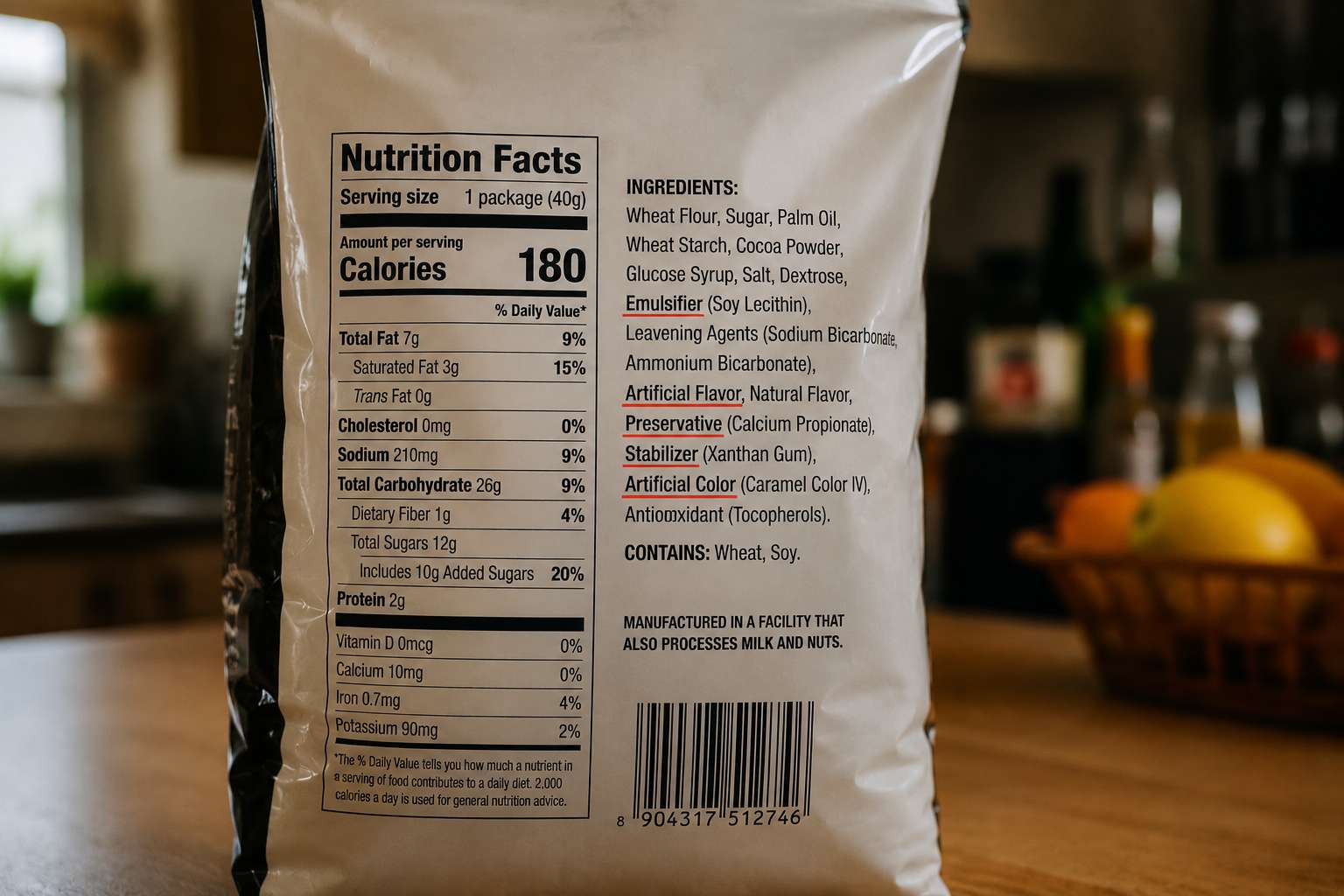
You pick up a packaged food and turn it around.
Calories? Check.
Sugar? Check.
Sodium? Check.
Saturated fat? Check.
For years, those numbers have helped shape how many of us decide whether something belongs in the shopping cart.
But a large 2026 study raises an uncomfortable question:
What if the nutrition label isn't telling us the whole story?
Quick Answer
Researchers at Tufts University analyzed data from 47,999 U.S. adults and examined ultra-processed food consumption alongside cardiometabolic risk factors, disease prevalence and mortality.
Higher consumption of ultra-processed foods was associated with several less-favourable health measures and a higher risk of death from any cause.
But here's where the research gets particularly interesting.
Researchers adjusted for the overall nutritional quality of people's diets.
The associations weakened—but did not disappear.
In other words, nutritional quality appeared to explain only part of the relationship between ultra-processed food consumption and the health outcomes researchers studied.
Why?
The study can't answer that yet.
What Researchers Found in 47,999 Diets
The researchers used data from the U.S. National Health and Nutrition Examination Survey, covering 1999 through 2018.
Foods were classified using the NOVA system, which groups foods according to the nature and extent of their processing.
Researchers then examined what happened as the percentage of a person's calories coming from ultra-processed foods increased.
And they weren't just looking at body weight.
For every additional 10 percentage points of energy coming from ultra-processed foods, researchers found associations with higher BMI, HbA1c, diastolic blood pressure and the ratio of total cholesterol to HDL cholesterol.
Higher ultra-processed food consumption was also associated with greater prevalence of metabolic syndrome, diabetes and cancer.
Then came one of the numbers that's easiest to misunderstand.
In the prospective mortality analysis, every 10-percentage-point increase in energy from ultra-processed foods was associated with a 4% higher relative risk of death from any cause.
That does not mean someone has a 4% chance of dying because they ate more packaged food.
It represents a relative statistical association observed across the population studied.
Then Researchers Asked a Bigger Question
Maybe ultra-processed foods only looked worse because they generally have poorer nutritional profiles.
So the researchers adjusted their analysis for each person's overall dietary nutritional quality.
If nutrition quality explained the entire relationship, you might expect the associations to disappear.
They didn't.
The associations were reduced, but remained statistically significant.
Researchers also separately adjusted for saturated fat, added sugar and sodium.
Those adjustments had relatively little effect on the associations.
And that's where this study becomes more interesting than another warning about eating too much sugar or salt.
The results raise the possibility that the relationship between ultra-processed foods and health may involve more than the familiar nutrients people normally check on a nutrition label.
But there's an important catch:
This study doesn't tell us what that additional factor—or combination of factors—might be.
So Should You Empty Your Kitchen?
No. This research doesn't justify that conclusion.
The study found associations. It did not prove that ultra-processed foods caused diabetes, cancer or premature death.
Many of the analyses involving cardiometabolic risk factors and existing health conditions were cross-sectional. Researchers were examining relationships in observational data rather than randomly assigning thousands of people to different diets for years.
The mortality analysis followed deaths prospectively, but it was still observational.
That distinction matters.
Ultra-processed foods are also an extremely broad category.
They aren't all nutritionally identical, and simply being packaged or processed does not automatically mean a food is unhealthy.
So this isn't evidence that every packaged loaf of bread, breakfast cereal or ready-made meal needs to disappear from your house.
It is evidence that researchers still have an important question to investigate.
TwikUp Insight
The most interesting finding isn't that scientists discovered some mysterious dangerous ingredient hiding in packaged food.
They didn't.
It's what happened after researchers tried to account for nutritional quality.
The relationship between greater ultra-processed food consumption and several health outcomes didn't completely disappear.
We've become very good at turning packages around and checking sugar, sodium, saturated fat and calories.
Those numbers remain important.
But this study suggests that understanding food and health may require looking at more than the familiar numbers printed on the package.
What exactly explains the remaining association?
This research can't tell us.
And that's precisely what makes the question interesting.
Because whatever scientists eventually discover, the whole story may not fit neatly onto the back of a cereal box.
Important Health Disclaimer
This article is for general informational and educational purposes only and is not medical or nutritional advice.
The research discussed reports statistical associations and does not establish that ultra-processed foods cause the health conditions described. Individual nutritional needs vary, and ultra-processed foods represent a broad category of products with different nutritional characteristics.
Anyone considering significant dietary changes, particularly people with medical conditions or specific nutritional requirements, should consult an appropriately qualified healthcare professional.
Source
Hatta-Langedyk J, Wang L, Fan B, Shi P, Mozaffarian D. Ultraprocessed Food Versus Diet Quality in Relation to Cardiometabolic Health and All-Cause Mortality: NHANES 1999–2018.
American Journal of Public Health. 2026;116(7):1015–1024. Published online June 3, 2026.
PubMed PMID: 42233198
DOI: 10.2105/AJPH.2026.308499
https://pubmed.ncbi.nlm.nih.gov/42233198/