
Pope Leo XIV stepped onto Spanish soil this morning for the first time as pontiff — and the weight of the moment was felt well before he spoke a single word. Fifteen years after Benedict XVI's last papal visit, and after 12 years of Francis consistently declining Spain's invitations, Leo's arrival in Madrid signals a deliberate choice to engage Europe's most contested political terrain directly.
This is not a pastoral holiday. Over seven days, the American-born pope will travel more than 2,500 kilometres across Madrid, Barcelona, and the Canary Islands, delivering 12 speeches and five homilies on themes that cut to the heart of modern Europe: political polarization, the dignity of migrants, the relationship between faith and democracy, and an act of architectural history that has been 144 years in the making.
A Historic Arrival into One of Europe's Most Fractured Democracies
Leo touched down at Adolfo Suárez Madrid-Barajas Airport at 10:30 AM local time on June 6, welcomed by King Felipe VI and Queen Letizia at a formal ceremony held at the Royal Palace.
Spain's political climate is unusually volatile. The Socialist-led government under Prime Minister Pedro Sánchez holds power through a fragile coalition, while the far-right Vox party has surged on a platform of anti-immigration rhetoric. According to More in Common's 2025 Atlas of Polarization, nearly five million Spaniards — 14% of the population — ended a personal relationship in the past year over political differences. Three in five Spaniards avoid political conversation entirely to prevent conflict.
On Monday, June 8, Leo will become the first pope in history to address Spain's Congress of Deputies, where he is expected to speak on unity. The Spanish bishops' conference emphasized he is "not there to endorse one message or another" — but everyone in the room will be listening for a signal.
Fifteen Years in the Making — and Nearly Five Decades of Personal History
The anticipation around this visit is not simply institutional. Leo XIV — born Robert Prevost — has made nearly 50 trips to Spain over his lifetime, visiting at least 34 cities since his first pilgrimage to Santiago de Compostela in July 1982, when he was a 26-year-old priest barely six weeks ordained, traveling by van with four Augustinian companions.
Vatican biographer Juan Vicente Boo, ABC's correspondent in Rome for 23 years, argues Leo knows Spain more intimately than most popes have known any country. His deep familiarity with the Augustinian spiritual tradition, rooted in the theology of St. Augustine of Hippo, has given him a long-standing connection to Spanish ecclesiastical and cultural life.
That context matters. This pope is not reading from a briefing document — he is returning to a country he has navigated, argued, prayed, and eaten his way through for over four decades.
The Sagrada Família Moment: A Cathedral 144 Years in the Making
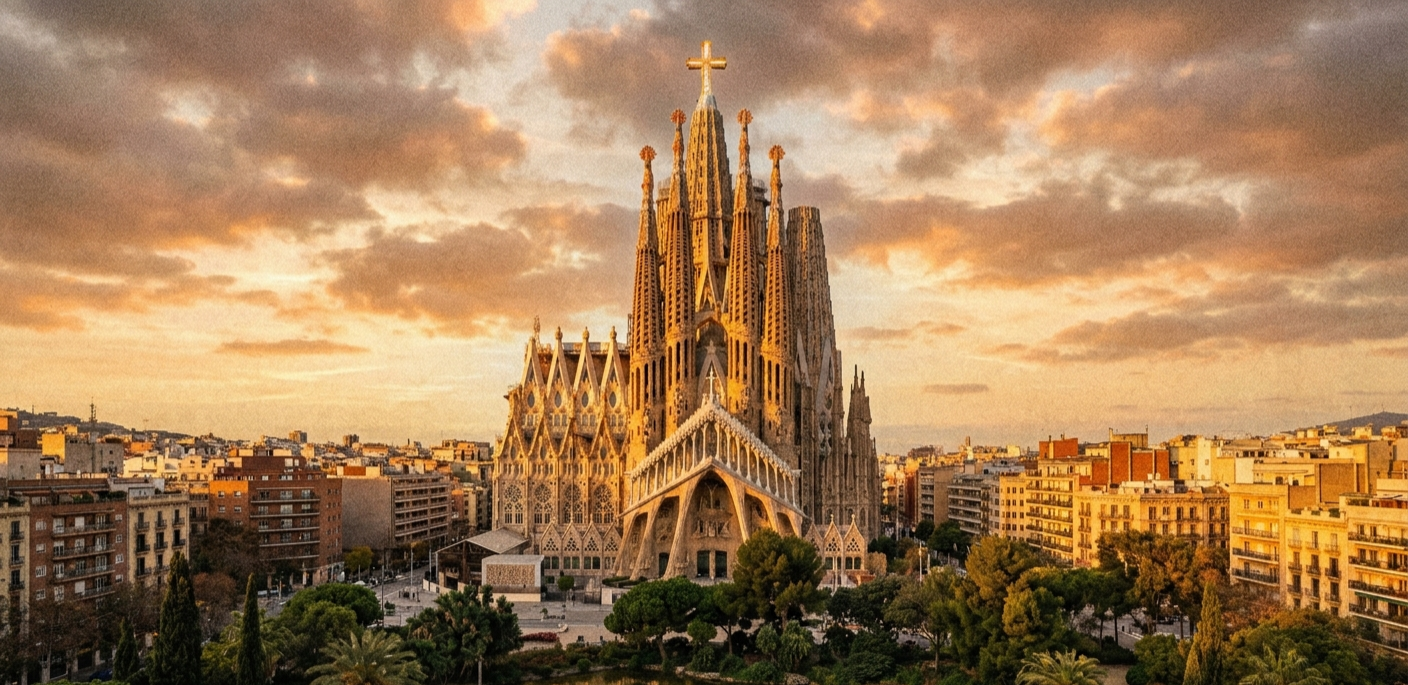
The single most historically significant event of the visit comes on the evening of June 10 in Barcelona. Leo will celebrate Mass at Antoni Gaudí's Basílica de la Sagrada Família and formally inaugurate the Tower of Jesus Christ — the basilica's central and tallest structure, completed this past February — making it the tallest church in the world.
The date carries additional weight: June 10 marks the 100th anniversary of Gaudí's death. Pope Francis declared the Catalan architect venerable in April 2025, advancing his path toward possible beatification.
Fr. Armand Puig, a member of the Sagrada Família's theology commission, noted that the papal blessing will redirect public attention toward what the building was always intended to be — not just a work of genius, but a site of Catholic worship. "The Sagrada Família has become a global icon," Puig said. "But it is a building intended for the celebration of the sacraments, above all the Eucharist."
Construction began in 1882. The tower's completion last February was a structural milestone, though the basilica will not be fully finished for another decade. Leo's Mass there will be the most-watched moment of the trip.
The Canary Islands: Europe's Most Visible Migration Crisis
The final leg of the journey — Gran Canaria on June 11, Tenerife on June 12 — carries the most urgent human stakes. The Canary Islands sit at the western edge of one of the deadliest migration routes in the world, where people from West Africa attempt the Atlantic crossing in small vessels, many of them fatally. In 2025 alone, an estimated 1,906 migrants died attempting to reach these islands.
Leo will meet with migrant support organizations at the port of Arguineguín on Thursday — the same port whose images of overcrowded docks became internationally recognized symbols of the crisis. On Friday, he will visit the Las Raíces migrant center in Tenerife and meet integration organizations before his final Mass of the journey at the port of Santa Cruz.
- Migration ranks as the second-most cited national concern among Spaniards, behind only the housing crisis
- Anti-migrant riots erupted in southern Spain last summer, inflamed by far-right leaders sharing misleading videos
- The pope previously questioned the "pro-life" credentials of those opposing abortion while supporting, in his words, "inhuman treatment of immigrants in the United States"
Helena Maleno, founder of the migrant advocacy NGO Caminando Fronteras, framed the significance directly: "There are many leaders that use God to justify a genocide. For a religious leader to say 'no' to racism, 'no' to inhumane treatment, 'no' to torture, in the name of God — that is very important."
What Comes Next: Six Days That Will Define Leo's European Papacy
The remaining itinerary moves quickly and deliberately:
- June 7 — Holy Mass at Plaza de Cibeles; meeting with cultural, economic, and sports leaders at Movistar Arena
- June 8 — Meeting with Prime Minister Sánchez; historic address to Spain's Congress of Deputies; prayer at the Cathedral of Almudena; diocesan meeting at Santiago Bernabéu Stadium
- June 9 — Meeting with volunteers at IFEMA Madrid; travel to Barcelona; Prayer Vigil at Lluís Companys Olympic Stadium
- June 10 — Prison visit at Brians 1; Rosary at Montserrat Abbey; Mass and Tower inauguration at Sagrada Família
- June 11–12 — Canary Islands: migrant meetings, integration organizations, and closing Mass
The visit also coincides with an academic symposium on global migration, bringing together church leaders and researchers at the Canary Islands. Leo departs for Rome on the afternoon of June 12.Pope Leo XIV, Spain Visit 2026, Catholic Church, Migration Crisis, Sagrada Familia
Related Perspectives
Ukraine-Russia War — Leo has repeatedly condemned the conflict and made peace the cornerstone of his pontificate. His alignment with PM Sánchez — one of Europe's most vocal critics of the war — adds a geopolitical dimension to their Madrid meeting.
Europe's Far-Right Surge — The pope's visit lands during a period of sharp political realignment across the continent, with anti-immigrant parties gaining in France, Germany, and now dominant in Spain's opposition. Leo's parliamentary address will be read as a direct response.
Antoni Gaudí's Path to Sainthood — The June 10 Barcelona stop accelerates global attention on Gaudí's beatification cause, following Francis' 2025 declaration of venerability. A canonization decision — still years away — would make him the first architect to be recognized as a saint in modern history.