
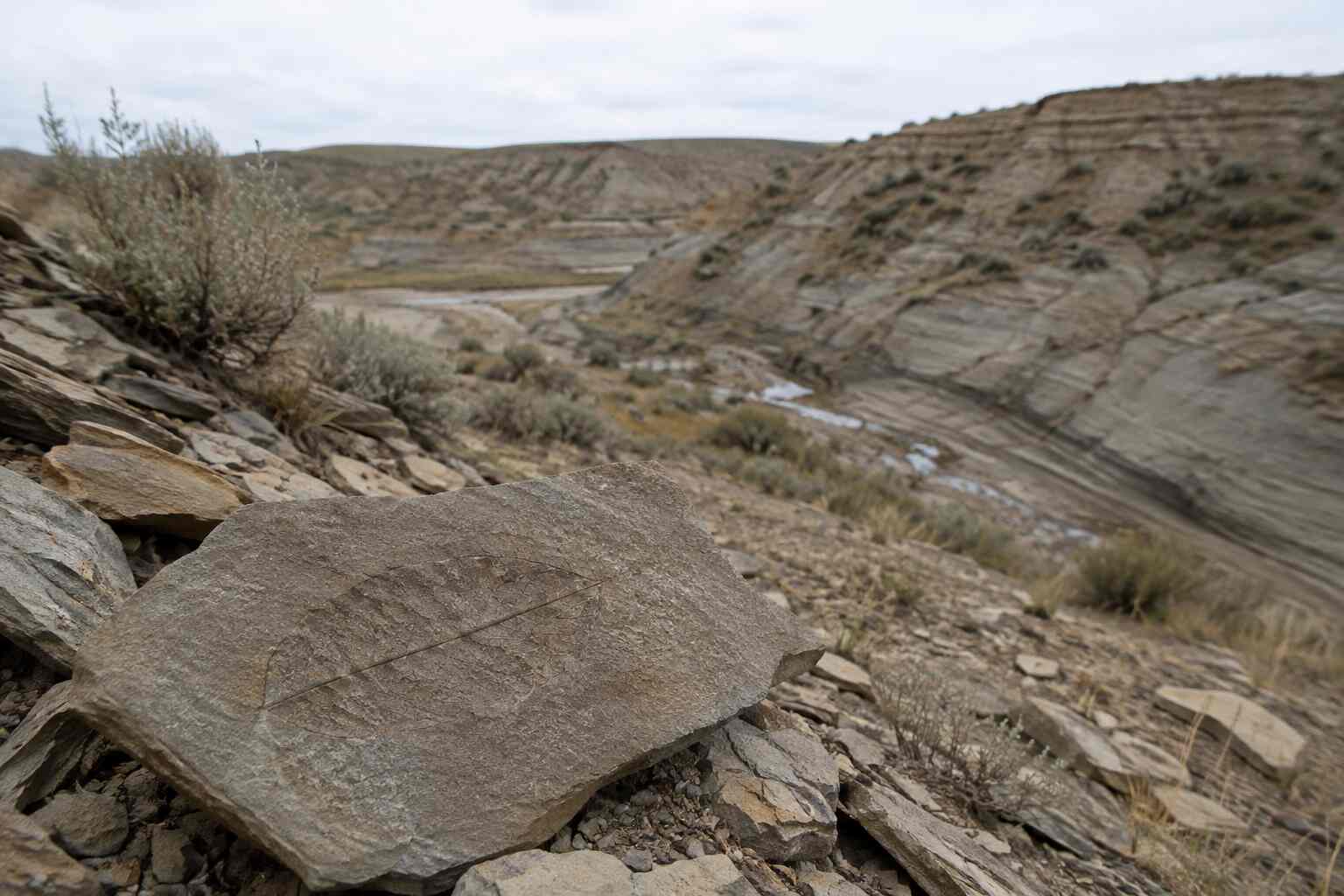
A leaf falls to the ground in ancient Wyoming. Millions of years later, the shape of its preserved cells helps scientists reconstruct a major environmental transformation: dense forests becoming thinner and more open as carbon dioxide levels and temperatures rose.
Quick answer: A study published in Science found that forest canopies opened during the Paleocene-Eocene Thermal Maximum, an abrupt global-warming event about 56 million years ago. Fossil leaf cells indicate that the warming coincided with fewer large trees, major changes in plant communities and increased landscape erosion. The findings suggest that climatic stresses can outweigh the potential growth benefits plants receive from additional carbon dioxide.
Key takeaways
- Researchers reconstructed ancient forest density using fossil leaf cuticles from Wyoming’s Hanna Basin.
- Forest canopies became more open at the onset of the Paleocene-Eocene Thermal Maximum, or PETM.
- Vegetation shifted from forests dominated by broad-leaved flowering plants to ecosystems with abundant ferns and palms.
- Canopy decline occurred alongside increased erosion and changes in river systems.
- The PETM is not a precise forecast for today, but it demonstrates that higher carbon dioxide does not automatically produce denser or healthier forests.
Ancient leaves preserved a record of the sky
The Hanna Basin in south-central Wyoming looks very different today from the landscape that existed there roughly 56 million years ago.
The modern basin is predominantly sagebrush steppe, and trees are uncommon. Before and after the PETM, however, the region supported forests containing giant dawn redwoods, palms, sycamores, alders and other broad-leaved trees.
Organic-rich sedimentary rocks preserved fragments of those plants. Inside the fragments, researchers found microscopic leaf structures that retained information about how much sunlight the leaves received while they were growing.
That offered the team a way to answer a difficult question: How dense was the ancient forest canopy?
The study, led by paleobotanist Regan E. Dunn and published in Science on August 13, 2026, developed a method that uses the shape of fossilized epidermal cells—the cells forming the outer surface of a leaf—to estimate forest canopy density.
The researchers focused on the Paleocene-Eocene Thermal Maximum, an interval when a large release of carbon into the atmosphere and oceans was accompanied by substantial global warming.
How can a fossil leaf reveal forest density?
Leaves growing in shaded parts of a dense forest develop differently from leaves receiving abundant sunlight in a more open environment.
In darker conditions, epidermal cells tend to become more elongated and narrow. Leaves exposed to more sunlight generally contain cells with different proportions. Those characteristics can remain visible after a leaf breaks into fragments and becomes preserved in sediment.
To calibrate the relationship, the researchers examined modern tropical ecosystems. At each study location, they photographed the canopy using a camera equipped with a fisheye lens and collected leaf fragments from the soil below.
The photographs allowed them to calculate leaf area index, or LAI—a measurement of the amount of leaf surface above a given area of ground. Higher LAI values generally indicate denser vegetation, while lower values indicate a more open canopy.
The researchers then measured cells in the modern leaf fragments and compared their shapes with the known canopy measurements. They applied the resulting relationship to fossil leaf cuticles collected from Wyoming.
The team also analyzed carbon isotopes and fossil pollen. Samples from before, during and after the PETM allowed the researchers to follow changes through time rather than reconstructing only one ancient landscape.
Forest canopies opened as the climate warmed
The reconstruction indicates that Wyoming’s forests became abruptly more open at the onset of PETM warming.
Before the event, giant dawn redwoods grew alongside palms and broad-leaved trees. At the start of the PETM, the landscape became more open, with abundant ferns and palms. Plants associated with dry tropical regions appeared later in the sequence.
The canopy decline began before large sandstone bodies appeared higher in the geological record. That sequence is important because it argues against the idea that a migrating river simply replaced a local patch of forest.
Instead, the researchers associate the canopy opening with the broader climatic disruption of the PETM. The study’s evidence does not demonstrate that carbon dioxide directly harmed the trees. Carbon dioxide can support photosynthesis when other conditions are suitable.
Its potential fertilization effect, however, does not occur in isolation. Rising temperatures, water stress, changing rainfall and other environmental constraints can limit plant growth or increase tree mortality.
Study co-author Ellen Currano summarized the finding by saying that PETM forests became more open and contained fewer large trees. The change also affected erosion, nutrient cycling, weathering and the animals living in those ecosystems.
The effects extended beyond the trees
A thinning forest can change far more than the view from the ground.
Roots help stabilize soil, slopes and riverbanks. Leaves intercept rainfall, while plants return water to the atmosphere through transpiration. Vegetation also influences local temperatures, nutrient movement and the amount of carbon stored in plants and soils.
In the Hanna Basin record, canopy decline preceded major sedimentary changes. PETM deposits later in the sequence include large, coarse-grained sandstone bodies associated with changes in river form and sediment movement.
The researchers propose that declining vegetation contributed to landscape destabilization and increased erosion. With less vegetation reinforcing the ground, more sediment could have entered rivers.
This does not prove that forest loss alone transformed the river system. River behaviour depends on several interacting factors, including water flow, sediment supply, rainfall, topography and local geology.
The evidence instead supports a possible chain of connected changes:
- Atmospheric carbon dioxide and temperatures increased.
- Climatic conditions changed substantially.
- Forest canopies became more open and plant communities shifted.
- The landscape lost some of its vegetative protection.
- Erosion and sediment movement increased.
- River systems and the terrestrial water cycle changed.
The study therefore treats canopy decline as one part of a larger Earth-system response, not as an isolated reduction in the number of trees.
Forest composition eventually recovered
The disruption was substantial, but it was not permanent.
After the PETM, as temperatures cooled and humidity increased, forests resembling those that had existed earlier returned to the region. Dawn redwoods and other trees again formed denser canopies. Plant composition and patterns of insect herbivory also returned toward their pre-PETM states.
That recovery carries an important qualification: it occurred over geological timescales. PETM warming and its recovery unfolded over many tens of thousands of years, giving species substantial time to migrate and ecosystems time to reorganize.
Modern forests face a different combination of pressures. Today’s rapid climate change is occurring alongside deforestation, habitat fragmentation, invasive species, land conversion and increasingly damaging wildfires. Roads, farms and cities can also prevent species from migrating as suitable climate zones shift.
Is the PETM a model for climate change today?
The PETM is a useful comparison, but it is not a direct replay of the modern climate crisis.
Both periods involve a major addition of carbon to the atmosphere and substantial warming. However, the starting climate, arrangement of the continents, plant communities and rate of carbon emissions differ. Modern human-caused carbon emissions are occurring considerably faster than the carbon release associated with the PETM.
The Wyoming findings therefore cannot be used to predict a specific percentage of global forest loss today.
The stronger conclusion is more fundamental: additional carbon dioxide does not guarantee that forests will become denser or absorb unlimited amounts of carbon.
If climatic stresses cause forests to thin, the planet can lose part of an important carbon sink. Reduced vegetation can then affect temperatures, rainfall, erosion and soil-carbon storage, producing consequences that extend beyond the original forest decline.
TwikUp Insight
The most significant part of this research is not simply that an ancient forest changed. It is that microscopic cells preserved inside broken leaves allowed scientists to connect atmospheric carbon, warming, vegetation change and landscape erosion across millions of years.
The PETM does not provide a calendar for what will happen next. It provides something more useful: evidence that a warmer, carbon-rich world can still contain fewer large trees and more vulnerable landscapes.
Higher carbon dioxide may give plants more material for photosynthesis, but a forest also needs tolerable temperatures, adequate water, stable soils and time to adapt. When those conditions deteriorate, the fertilization effect may be outweighed by broader climatic stress.