
Key Takeaways
- A cap-and-trade system sets a shrinking limit on total emissions and lets companies trade allowances — one allowance equals one tonne of CO2 equivalent.
- The EU ETS, running since 2005, has helped cut power and industry emissions about 47% from 2005 levels by 2023.
- Canada's consumer fuel charge was set to zero on April 1, 2025, but the industrial OBPS continues as a baseline-and-credit system.
A market where the product is permission to pollute — and the supply shrinks every year
Cap-and-trade starts with a decision most markets never make: fixing the total quantity first and letting the price fall where it may. A government sets a cap on the total greenhouse gases covered companies may emit, then divides that cap into allowances — one allowance is the right to emit one tonne of carbon dioxide equivalent. Companies that emit less can sell what they do not need. Companies that emit more must buy. And because the cap is reduced every year, the permission itself gets scarcer by design.
The machine, part by part
The European Union's Emissions Trading System, running since 2005, is the reference model — the European Commission calls it the oldest and largest carbon market in the world by traded volume. Most allowances are sold at auction, though companies still receive some for free. Every year, each covered operator must monitor and report its emissions and surrender enough allowances to cover every tonne, with heavy fines for falling short. A company that cuts emissions early can sell its spare allowances or bank them for a tougher year. Everything is recorded in a central registry.
The results are the system's best argument. By 2023, the EU ETS had helped bring emissions from European power stations and industrial plants down by about 47 per cent compared with 2005. It has also become a serious revenue machine: since auctions began in 2013 it has raised over €175 billion, flowing mainly into national budgets for renewable energy, efficiency and low-carbon technology, with shares funding EU-level innovation and modernisation funds. The system now covers power and heavy industry, aviation (added in 2012) and maritime transport (2024), and a second system for buildings and road transport is set to regulate fuel suppliers from 2028.
The logic is worth stating plainly, because it differs from a carbon tax. A tax fixes the price and lets emissions land where they land. A cap fixes the emissions and lets the price land where it lands. The declining cap is a guarantee about quantity; the trading is what finds the cheapest tonnes to cut, because the company that can reduce for $20 a tonne will happily sell allowances to the company whose reduction would cost $80.
Canada's version: the cap became a baseline
Canada's federal system, under the Greenhouse Gas Pollution Pricing Act, had two parts. The consumer-facing fuel charge is gone: the government set all fuel charge rates to zero effective April 1, 2025, and Budget 2025 confirmed the requirement for provinces to maintain a consumer carbon price was removed too.
The industrial half — the Output-Based Pricing System — continues, as a backstop in Manitoba, Prince Edward Island, Yukon and Nunavut, while other provinces run their own systems meeting the federal benchmark. But the OBPS is not a hard cap. It is baseline-and-credit: regulators set an emissions-intensity standard for each sector — emissions per unit of output — and each facility's limit is its production multiplied by that standard. Beat your limit and you earn surplus credits you can sell or bank; exceed it and you must compensate, with the federal excess-emissions charge set at $65 per tonne in 2023, rising by $15 a year to $170 per tonne in 2030. The design prices industrial emissions while guarding against "carbon leakage" — factories relocating to places with no price at all — because a growing facility's limit grows with its output.
Globally, the idea has spread far beyond Europe. The World Bank's State and Trends of Carbon Pricing 2026 counts 87 implemented carbon-pricing policies covering 29 per cent of global greenhouse gas emissions, with the average price across instruments doubling over a decade, from about US$10 a tonne in 2016 to nearly US$21 in 2026, and governments collecting over US$107 billion in 2025.
The Twikup Take
Carbon markets are an attempt to make the atmosphere's limited capacity behave like any other scarce input: owned, priced and traded, with the supply shrinking on a schedule set by climate targets rather than by geology. The EU's two decades show the machine can cut emissions at scale and fund the transition while doing it. Canada's post-2025 design shows the political version of the same idea — the visible consumer charge is gone, while the industrial market underneath it, quieter and harder to see, keeps running.
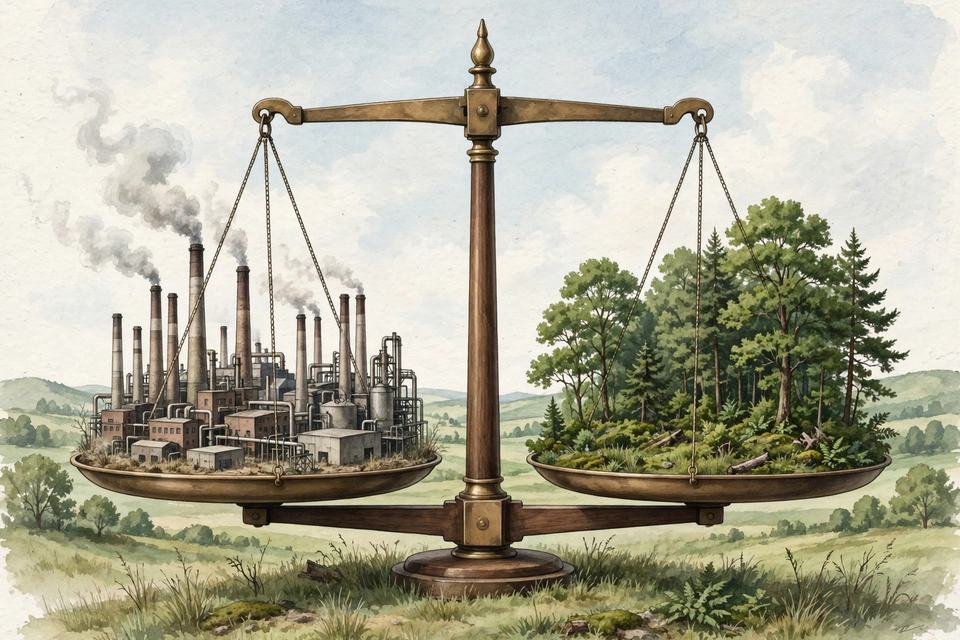
Image: Illustrative image.