
Fashion's sustainability challenge is no longer a question of awareness. The industry already understands its environmental footprint. The real challenge is whether fashion can continue expanding while relying on resources that are increasingly constrained.
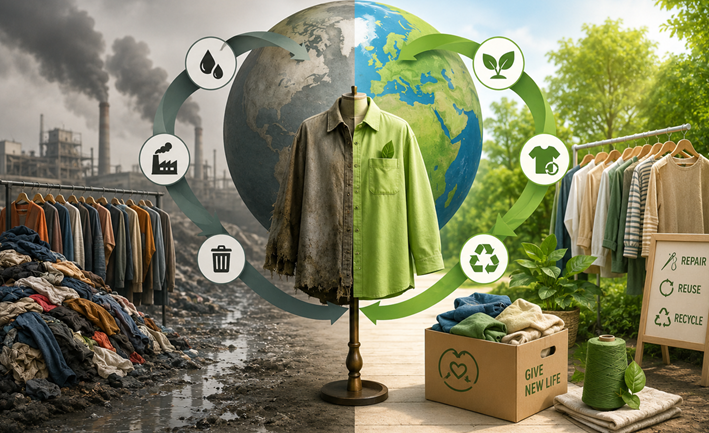
Renewable fashion has emerged as an attempt to solve that contradiction. Rather than focusing solely on producing "better" garments, it asks a more fundamental question: can the industry generate value without constantly extracting more from the planet?
When Growth Starts Colliding With Resource Limits
Fashion has become one of the most widespread consumer industries in the world. Its reach extends across continents, cultures, and income groups, but that scale comes with consequences.
Research from McKinsey & Company estimates that fashion contributes between 2% and 8% of global greenhouse gas emissions. At the same time, demand for apparel continues to rise.
This creates a difficult equation. Efficiency improvements can reduce the impact of individual products, but rising production volumes can offset those gains. A more sustainable garment does not automatically translate into a more sustainable industry if overall consumption continues climbing.
Hidden Inside Every Garment: A Resource Story Consumers Rarely See
Most shoppers encounter fashion as a finished product hanging on a rack or displayed online. What remains largely invisible is the enormous resource network behind each item.
Organizations such as UNEP and the Ellen MacArthur Foundation highlight the significant water requirements involved in textile production. Dyeing and finishing processes also remain major contributors to industrial water pollution.
Several textile-producing regions already face growing water stress. As a result, efficient resource management is becoming less of an environmental preference and more of a business necessity.
The industry's resource challenge includes:
- High water consumption
- Intensive energy use
- Dependence on raw materials
- Pollution from processing activities
- Rising pressure on supply chains
A Business Model Built Around Keeping Products Alive Longer
Traditional fashion economics rewards the sale of new products. Renewable fashion introduces a different perspective by extending the usefulness of products already in circulation.
Instead of relying exclusively on new production, value can be generated through:
- Garment repair
- Resale platforms
- Clothing rental services
- Material recycling
- Ecosystem regeneration initiatives
- Longer product lifespans
The Ellen MacArthur Foundation's circular economy research argues that keeping products and materials in use for longer can create both environmental and economic advantages.
In this model, clothing becomes a resource rather than a disposable item.
The Industry's Most Uncomfortable Sustainability Insight
Many sustainability discussions focus on what consumers should buy next. Circular fashion research points toward a less convenient conclusion.
The garment with the lowest additional environmental impact may often be one that already exists.
Research referenced by the Ellen MacArthur Foundation and WRAP suggests that extending the active life of clothing can significantly lower its environmental footprint over time.
This finding shifts the conversation away from replacement and toward longevity. It also challenges a business model that has historically depended on encouraging frequent purchases.
Why Technology Is Moving Up the Sustainability Agenda
Fashion's waste problem often begins long before products reach consumers. Excess inventory, inaccurate demand forecasts, and overproduction create environmental and financial costs.
Technology is increasingly being used to address these issues at their source.
According to McKinsey and the Global Fashion Agenda, some of the industry's most promising sustainability opportunities involve preventing waste before it occurs.
Key technologies supporting this shift include:
- Artificial intelligence for demand forecasting
- Digital inventory management
- Product traceability systems
- Material tracking solutions
- Recycling support technologies
The goal is becoming increasingly clear: eliminate unnecessary production rather than simply managing excess after the fact.
Consumers Want Sustainability—But Still Shop Differently
One of fashion's biggest contradictions sits at the center of consumer behavior.
Research from Deloitte, PwC, and McKinsey indicates that interest in sustainability continues to grow. Yet affordability, convenience, and rapidly changing trends remain powerful purchasing drivers.
The result is a persistent gap between intention and action.
Consumers frequently support sustainable practices in principle, but fast-fashion models continue attracting significant demand. Awareness is no longer the primary barrier. Competitive pricing and accessibility remain critical obstacles.
Circularity Is Becoming Fashion's Defining Concept
For years, sustainability discussions focused heavily on alternative materials and greener production methods.
Increasingly, attention is shifting toward circularity.
According to Ellen MacArthur Foundation research, less than 1% of clothing materials worldwide are recycled into new garments of similar quality. That figure highlights how much value is still being lost when products reach the end of their initial use.
Circularity seeks to keep materials moving through the economy for as long as possible.
Rather than designing products for disposal, the objective becomes designing them for recovery, reuse, repair, and regeneration.
The Future May Depend on Producing Smarter, Not More
Across research from UNEP, the Ellen MacArthur Foundation, McKinsey & Company, the Global Fashion Agenda, and the World Resources Institute, a common pattern emerges.
The industry's future is unlikely to be transformed by a single breakthrough fabric or one revolutionary technology.
The strongest opportunities appear to lie in:
- Reducing waste generation
- Extending product lifespans
- Improving forecasting accuracy
- Expanding recycling capabilities
- Increasing supply-chain transparency
- Limiting unnecessary production
The most significant shift may be philosophical rather than technological. Success could increasingly depend on how effectively resources are used rather than how many products are created.
FAQ: Brief Insights on Renewable Fashion
What is renewable fashion?
Renewable fashion is an approach that focuses on extending product life, reducing waste, recovering materials, and using resources more efficiently throughout the clothing lifecycle.
Why is fashion considered resource-intensive?
Fashion relies heavily on water, energy, raw materials, and manufacturing processes that can create significant environmental pressure at global scale.
What is circular fashion?
Circular fashion aims to keep garments and materials in use through repair, resale, rental, reuse, and recycling instead of disposal.
Why is clothing longevity important?
Extending how long garments are used can reduce the environmental impact associated with producing replacement products.
What role does technology play in renewable fashion?
Technology helps improve demand forecasting, reduce overproduction, track materials, and support more efficient resource management across supply chains.