
Key Takeaways
- NASA has issued a final Request for Proposals for Lunar Reactor-1, a 20-kilowatt fission system meant to be launch-ready by 2030 and run on the Moon for at least five years.
- Twenty kilowatts is roughly enough electricity for 16 average US households — aimed at Moon Base habitats, communications, rovers and instruments.
- Proposals are due December 21, 2026, and the reactor must meet US Department of Energy nuclear safety standards.
A reactor that keeps working through the two-week lunar night
Solar panels go dark for roughly two weeks at a time on the Moon. NASA's answer is a small nuclear reactor. On November 23 the agency issued the final Request for Proposals for Lunar Reactor-1 (LR-1), asking industry to develop and test a 20-kilowatt fission power system for the lunar surface.
Twenty kilowatts is modest by Earth standards — about enough for 16 average US households — but on the Moon it would run habitats, communications, rovers and scientific instruments continuously, including through the long lunar night and in places sunlight barely reaches.
The terms industry has to meet
NASA wants a launch-ready system by 2030, able to operate on the Moon for at least five years after deployment. Proposals are due by December 21, 2026. The solicitation requires the reactor to meet Department of Energy safety standards for nuclear operations, and the program is managed by NASA's Space Reactors Division in partnership with the DOE. The RFP follows a draft released in August and an industry day in September in Cleveland.
"This request for proposals represents an important step forward as NASA partners with industry to establish an enduring human presence on the lunar surface," said Brian Giblin, NASA's Lunar Reactor-1 program manager. "Space nuclear systems will provide continuous power to NASA assets in any environment without dependency on sunlight."
Part of a bigger nuclear push
The same NASA division runs Space Reactor-1 (SR-1) Freedom, scheduled to launch in 2028 to carry three SkyFall helicopters to Mars and demonstrate nuclear electric propulsion. NASA says the LR-1 work may also lead to task orders for other space nuclear power systems.
The Twikup Take
Every plan for a permanent Moon base runs into the same wall: two weeks of darkness. A 20-kilowatt reactor is not a power grid — it is a proof that nuclear power can be made small, safe and launchable, which is the step everything else on the lunar surface depends on.
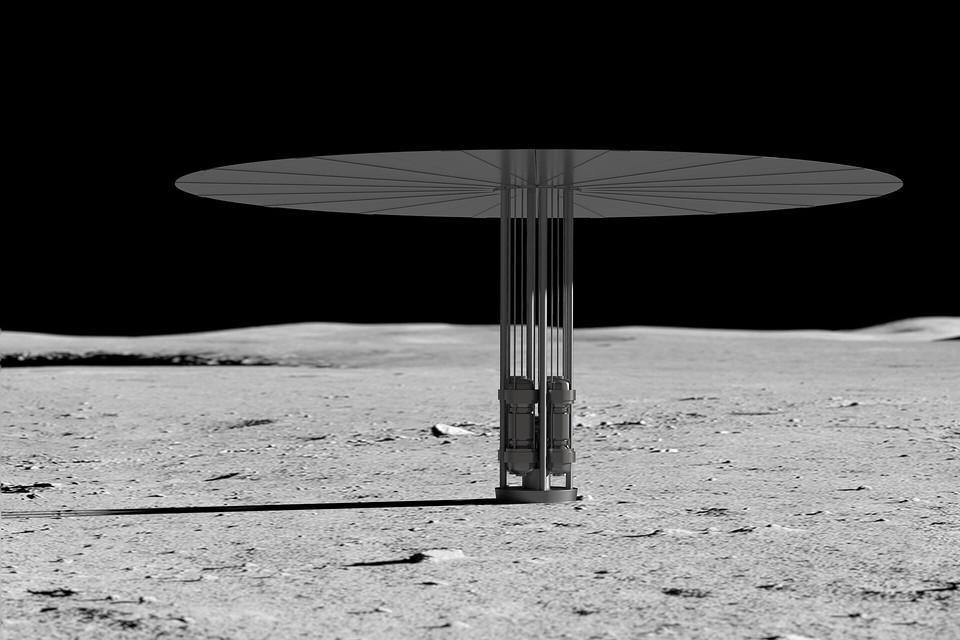
Image: Artist's concept of new fission power system on the lunar surface. Credit: NASA. (https://commons.wikimedia.org/wiki/File:Kilopower_moon_render_1_2018.jpg)