
Key Takeaways
- ePassports carry an NFC chip storing your data-page details and a digital facial image, under ICAO's Doc 9303 standard
- Basic Access Control stops skimming; Passive Authentication's digital signature makes altered chip data fail verification
- Canada has issued ePassports since July 1, 2013; eGates compare your live face against the chip's photo
The little symbol that changes everything
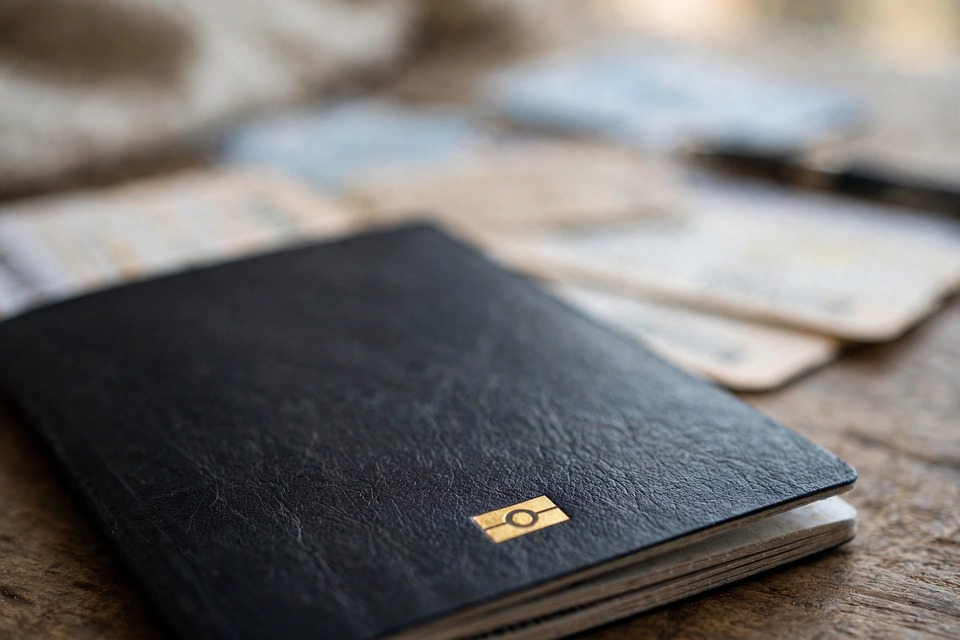
Look at the front cover of a modern passport and you'll find a small camera-like symbol — the international mark of an ePassport. It means the booklet contains a contactless chip and antenna (the same NFC family as a tap card), built to a single global specification: the International Civil Aviation Organization's Doc 9303, the standard that lets a Canadian passport be read by a border system in Tokyo, Frankfurt or São Paulo.
The chip stores the same details printed on your data page — name, date of birth, document number — plus a digital facial image. Facial recognition is the one biometric every country uses; some add fingerprints or iris images as options.
Lock one: the chip won't talk to strangers
A passport chip that answered any nearby reader would be a skimming risk, so the first defence is Basic Access Control. Before the chip releases anything, the reader must prove it has physically seen your passport by entering a key derived from the machine-readable zone — the two lines of characters at the bottom of your data page, combining your document number, birth date and expiry date. No open booklet, no conversation. The session that follows is encrypted.
Lock two: a signature nobody can forge
The cleverer defence is Passive Authentication, and it is mandatory. The chip's data files are hashed and bundled into a Document Security Object that is digitally signed by the issuing country. Border systems hold the issuing countries' certificates — exchanged through the ICAO Public Key Directory — and re-check the signature and hashes on every read. Change one letter of the name or swap the photo on a copied chip, and the hashes no longer match the signature. The forgery fails mathematically, not visually.
An optional third layer, Active Authentication, has the chip prove it holds a private key that can never be read out of it — defeating a cloned chip whose data was copied perfectly but whose secret stayed behind.
At the gate, the chip doesn't decide — the comparison does
At an eGate, the system reads the chip's facial image (after the access and signature checks), photographs you live, and compares the two faces — a one-to-one match. The chip never renders the verdict; it supplies the trusted reference photo, and the border system does the matching. Fail either check and you are routed to an officer.
Canada has issued ePassports for every passport since July 1, 2013 — the same day the 10-year adult option arrived. The current design makes the technology visible: the chip and antenna show in the booklet, and the data page is now polycarbonate with laser-engraved details, so the printed layer is as hard to alter as the digital one.
The Twikup Take
A passport used to be a booklet a border officer believed. An ePassport is a booklet that can prove itself: a key you can only get by holding it open, a signature only one government on earth could have produced, and a photo locked to both. The system's real achievement is boring — it moved trust from a human squinting at a hologram to arithmetic that either checks out or doesn't, in every airport on the planet, in about two seconds.
Image: Illustrative image.