
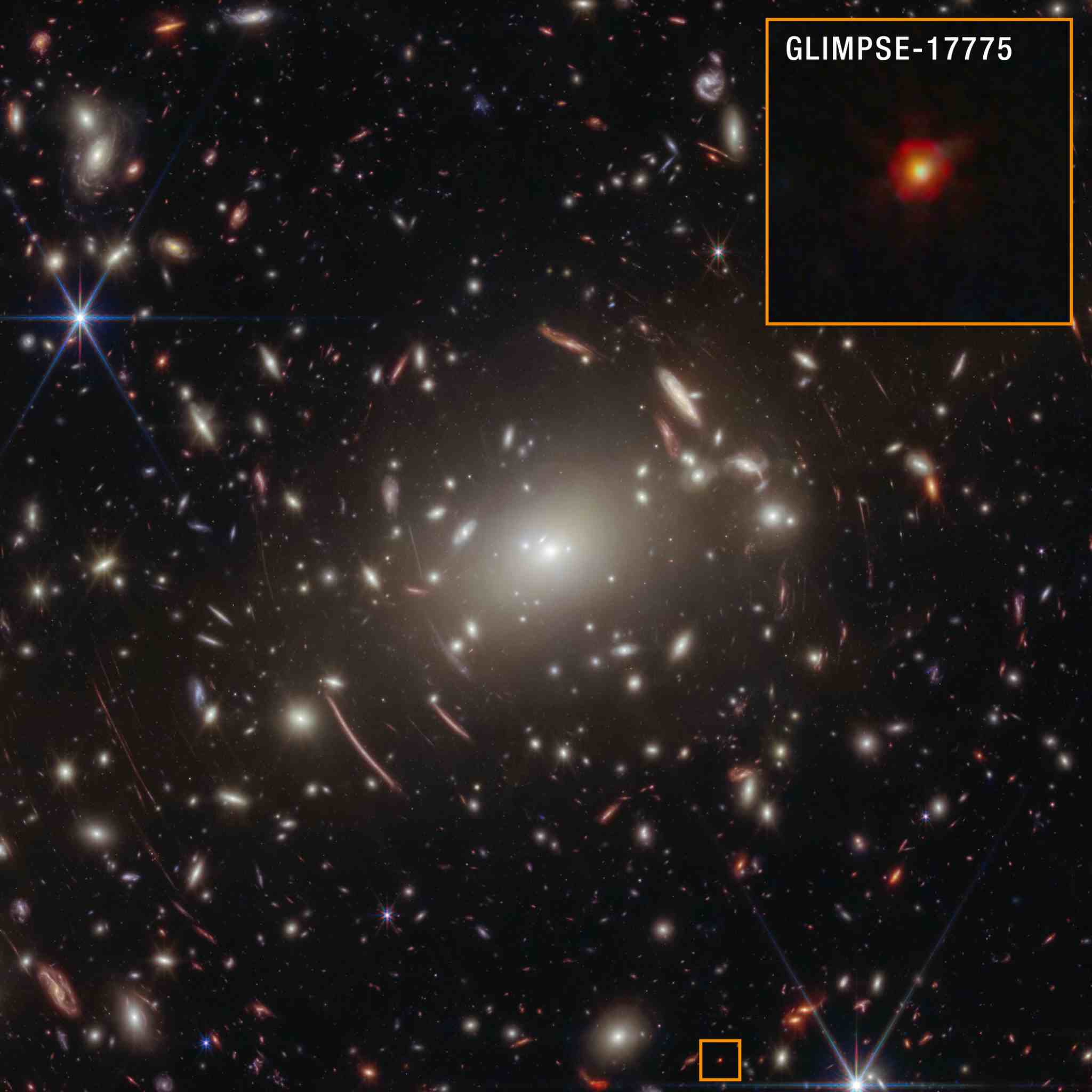
Image credit: NASA, ESA, CSA, Vasily Kokorev (UT Austin); Image Processing: Alyssa Pagan (STScI)
Image note: The NASA Webb image shows GLIMPSE-17775, a “little red dot” studied as evidence for the black-hole-star scenario. It is used here as an illustrative example and does not depict MoM-BH-1.* (NASA Science)
Astronomers studying the early universe with the James Webb Space Telescope (JWST) have identified an extraordinary object that may represent a new class of astrophysical source: a “black hole star.”
The object, called MoM-BH-1*, appears as an unusually bright little red dot in Webb observations. Researchers say the best explanation for its unusual spectrum is a rapidly growing black hole buried inside an enormous, dense envelope of gas.
It can look surprisingly star-like from the outside. But instead of nuclear fusion powering the object, its enormous energy output appears to come from material falling toward a black hole at its centre.
If the interpretation is correct, MoM-BH*-1 could provide an important clue to one of Webb's biggest early-universe mysteries: Why are so many strange “little red dots” appearing in observations of the young cosmos?
Quick Answer
Astronomers using the James Webb Space Telescope have studied an exceptionally bright red object from the early universe that is best explained by a roughly 100,000-solar-mass black hole surrounded by a huge, dense envelope of hydrogen-rich gas.
Researchers call this proposed configuration a black hole star because the gas surrounding the accreting black hole can radiate in a way that resembles the atmosphere of an enormous star.
The findings could help astronomers understand both Webb's mysterious little red dots and how massive black holes were able to grow so rapidly in the young universe.
Key Takeaways
- The newly studied object is known as MoM-BH-1*.
- It was identified using observations from the James Webb Space Telescope.
- Researchers estimate its central black hole is roughly 100,000 times the mass of the Sun.
- The black hole may be surrounded by an enormous, dense envelope dominated by hydrogen.
- Its energy output cannot be adequately explained by an ordinary star.
- Researchers think material falling toward the black hole powers the surrounding gas.
- The proposed black-hole-star model could help explain some of Webb's mysterious little red dots.
It started with a tiny red dot
From Webb's perspective, MoM-BH*-1 does not initially look like something capable of challenging astronomers' understanding of the young universe.
It looks like a dot.
A very red, very bright dot.
Researchers encountered it while conducting a survey called “Mirage or Miracle,” or MoM, designed to investigate exceptionally bright objects appearing surprisingly early in cosmic history.
Webb has revealed sources in the early universe that appear brighter and more developed than astronomers initially expected. The researchers wanted to determine whether these objects really were extraordinarily luminous young galaxies — the “miracles” — or whether some might be something else masquerading as galaxies.
MoM-BH*-1 points toward the second possibility.
Its light carries clues that make an ordinary stellar explanation extremely difficult.
The object is far too energetic to be an ordinary star
A normal star produces energy primarily through nuclear fusion in its core.
MoM-BH*-1 appears to require a dramatically different engine.
Researchers concluded that the enormous luminosity of the object is difficult to reconcile with a conventional star. A black hole, however, can generate extraordinary amounts of radiation as surrounding matter falls toward it, heats up and releases energy.
That led researchers toward a radically different picture.
Instead of an enormous conventional star, imagine a young black hole hidden inside an exceptionally thick envelope of gas.
The black hole supplies the power.
The surrounding gas supplies the star-like exterior.
That is the basic idea behind a black hole star.
A black hole wrapped inside an enormous gas cocoon
Computer modelling helped researchers determine what kind of object could reproduce the unusual light detected by Webb.
Their preferred scenario contains a black hole approximately 100,000 times the mass of our Sun.
Surrounding it would be an extremely dense envelope of gas, dominated by hydrogen and extending across an enormous region around the central black hole.
This distinction is important.
A black hole star is not simply a conventional star with a black hole sitting inside it.
Instead, researchers envision an accreting black hole surrounded by dense gas that creates a star-like radiating surface.
In an ordinary star, nuclear fusion provides the central energy source.
In the proposed black-hole-star model, accretion onto the black hole effectively takes over that role.
Its light provided another major clue
Brightness was not the only unusual feature.
Researchers examined MoM-BH*-1's spectrum — essentially separating its light into different wavelengths to determine what physical conditions could have produced it.
The spectrum showed an unusually strong Balmer break, a change in brightness associated with hydrogen and the physical conditions surrounding the source.
Researchers explored whether an extraordinarily dense hydrogen environment surrounding an accreting black hole could reproduce Webb's observations.
Their modelling indicated that it could.
That makes the spectrum especially important: astronomers are not simply looking at the object's colour and guessing what lies inside. They are using the fingerprints contained in its light to test different physical explanations.
Why Webb's ‘little red dots’ matter
The discovery could have implications far beyond one strange object.
Since beginning science operations, JWST has repeatedly detected compact red sources in the distant universe. Astronomers have come to call many of them little red dots, or LRDs.
NASA says these mysterious objects began appearing abundantly roughly 600 million years after the Big Bang, and scientists have investigated several possible explanations for them. (NASA Science)
One increasingly important possibility is the black-hole-star scenario.
In June 2026, another research team studying GLIMPSE-17775 found multiple independent pieces of spectroscopic evidence consistent with a rapidly growing black hole enveloped in a hot, dense gas cocoon. Webb's observations revealed more than 40 spectral lines, making it the most detailed little-red-dot spectrum obtained at the time. (NASA Science)
GLIMPSE-17775 is also the object shown in the NASA image accompanying this article. It is not MoM-BH-1*, but it demonstrates why astronomers are increasingly investigating black-hole-star models as an explanation for these mysterious red objects. (NASA Science)
This could help explain how enormous black holes appeared so early
There is a larger cosmic mystery behind this research.
Astronomers have found massive and supermassive black holes surprisingly early in cosmic history.
The difficult question is how they became so massive so quickly.
If black hole stars were common during the early universe, they could represent an important stage in the rapid growth of young black holes.
Instead of viewing little red dots simply as compact young galaxies, astronomers may in some cases be observing environments where black holes are actively growing inside thick envelopes of gas.
That could help explain how some black holes accumulated enormous masses within a relatively short period after the Big Bang.
Webb is seeing a universe we could not see before
The James Webb Space Telescope was designed to detect extremely faint infrared light arriving from distant parts of the universe.
Because light takes time to travel, observing extremely distant objects also allows astronomers to look back into earlier periods of cosmic history.
Webb is therefore exposing stages of galaxy and black-hole evolution that previous observatories could not examine with the same sensitivity and detail.
Some of its discoveries do not fit neatly into the categories astronomers were accustomed to using.
The proposed black hole star is a striking example.
From afar, it can resemble a tiny red point of light.
But hidden inside that dot may be something much more extreme: a rapidly growing black hole surrounded by a dense, glowing envelope of gas.
TwikUp Insight
The biggest story here may not ultimately be the unusual name “black hole star.”
It is what these objects could tell astronomers about the childhood of today's supermassive black holes.
Massive black holes exist at the centres of galaxies throughout the universe, yet explaining how some became enormous so early in cosmic history remains a major challenge.
If further Webb observations show that black-hole-star models can explain a significant portion of the mysterious little-red-dot population, astronomers may have identified an important stage in that growth process.
A tiny red point in a Webb image could therefore represent much more than another distant object.
It could be a glimpse into how some of the universe's biggest black holes grew up.
Sources
- MIT News — Astronomers discover a brand-new type of astrophysical object: A black hole star
- NASA — Webb Finds Strongest Evidence Yet for ‘Black Hole Stars’
- NASA — Abell S1063 with Pullout of GLIMPSE-17775 (NIRCam Image)