
Key Takeaways
- Night modes capture a burst of short exposures — up to 15 frames — align them in software and merge them, which averages out noise instead of blurring like one long exposure
- Google's Night Sight was designed to work handheld in light from 3 lux down to 0.3 lux, choosing each frame's exposure based on how much the phone and subject are moving
- Pixel binning helps at the sensor level, merging neighbouring pixels into one larger light-collecting pixel to cut noise
The trick: don't take one dark photo. Take fifteen.
Point a traditional camera at a dark room and it has two bad options: open the shutter longer (and blur everything that moves, including your hands) or crank up the sensitivity (and drown the picture in grainy noise).
Your phone does something else. When you press the shutter in Night mode, it captures a burst of many short exposures — on Google's Pixel phones, up to 15 frames — then aligns them in software and merges them into a single image. Because random noise differs from frame to frame, averaging many frames cancels much of it out, while the real detail, which is the same in every frame, survives. The merged picture gathers roughly as much light as one long exposure, without the blur.
Google's Night Sight, the feature that popularized this, was designed to produce acceptable handheld photos in light between 3 lux and 0.3 lux — dim restaurant to near-darkness — with no flash.
Short frames, chosen by motion
The frames are deliberately kept short. Google's system measures motion — from your hands and from the subject — and picks each frame's exposure accordingly: up to about a third of a second per frame when things are still, much shorter when they're not. A handheld Night Sight shot might stack 15 frames of a fifteenth of a second; on a tripod, it can use as few as 6 frames of a full second each, totalling around five to six seconds of light.
Software alignment then stitches the frames together, discarding pieces of any frame that can't be aligned cleanly so a passing car or a shifting face doesn't smear the merge.
The machine-learning layer
Two further steps are learned, not just computed. White balance uses a machine-learning algorithm trained to recognize well-balanced colour, because ordinary auto white balance fails badly under dim, coloured light. And tone mapping borrows tricks from illusionistic painting — deepening contrast, letting shadows fall to black, keeping the scene surrounded by darkness — so the result still looks like night rather than a daylight photo of a dark place.
The sensor helps too
Software stacking sits on top of a hardware trick: pixel binning. As Samsung's semiconductor division explains it, each pixel is a bucket collecting light — bigger buckets collect more. Binning merges neighbouring pixels into one larger effective pixel: a 2×2 merge (Tetrapixel) or 3×3 (Nonapixel), which on a 200-megapixel sensor can combine 16 pixels into one, trading resolution for far better low-light sensitivity and less noise.
Push the idea to its limit and you get astrophotography modes: prop the phone on a stable surface and it merges multiple long exposures over a total of around four minutes — long enough to pull the Milky Way out of a sky that looks black to your eyes.
The Twikup Take
Night mode is the clearest example of what modern phone cameras really are: not better lenses, but better statistics. The photo you see was never in front of the sensor at any single moment — it was computed from fifteen almost-photos, each too dark and noisy to use alone.
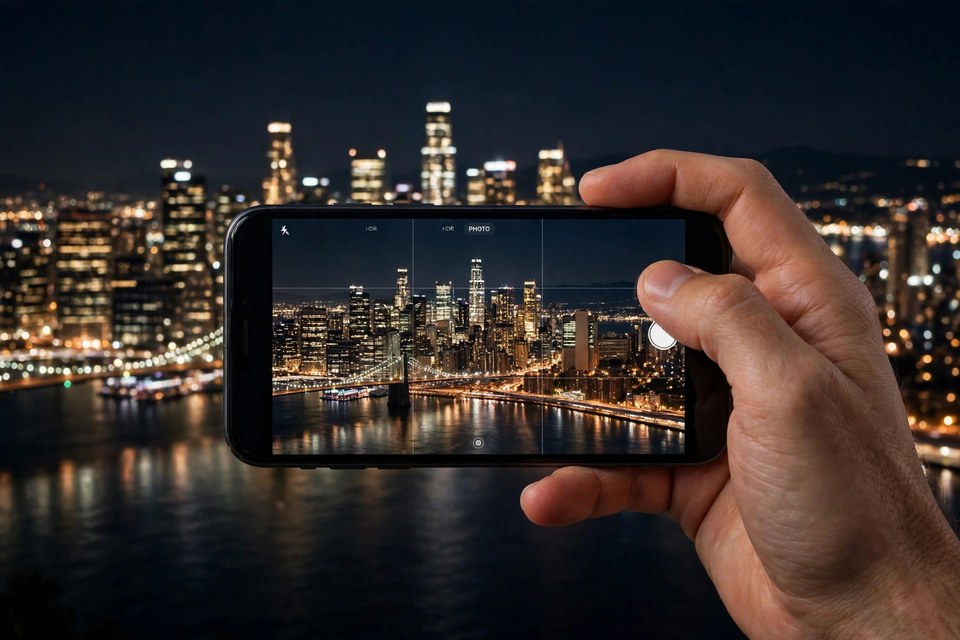
Image: Illustrative image.