
Key Takeaways
- Lumina models a 500-comoving-megaparsec volume using approximately 432 billion resolution elements
- The simulation follows hydrogen and helium reionization, two major transitions in the universe’s history.
- Its large volume helps researchers study galaxy formation, rare quasars and the changing state of intergalactic gas.
A replay of creation, 100 times bigger
For hundreds of millions of years after the Big Bang, the universe was dark: neutral hydrogen gas absorbed light before it could travel. A new simulation called Lumina, published October 26, 2026, in Monthly Notices of the Royal Astronomical Society, replays how the first stars and galaxies burned that darkness away — across a volume 100 times larger than previous best simulations.
Lumina follows a patch of universe 500 megaparsecs across — about 1.6 billion light-years — starting around 45 million years after the Big Bang and running through the first 2 billion years of cosmic evolution.
Half a trillion pieces, one supercomputer
Built by physicists at MIT, Harvard University and partner institutions on top of the IllustrisTNG galaxy-formation model, Lumina tracks half a trillion individual elements, including dark matter particles and gas cells — about 30 times the resolution of IllustrisTNG. It ran on Frontier, the supercomputer at Oak Ridge National Laboratory, peaking at more than 100,000 CPU cores and around 15,000 GPUs working together.
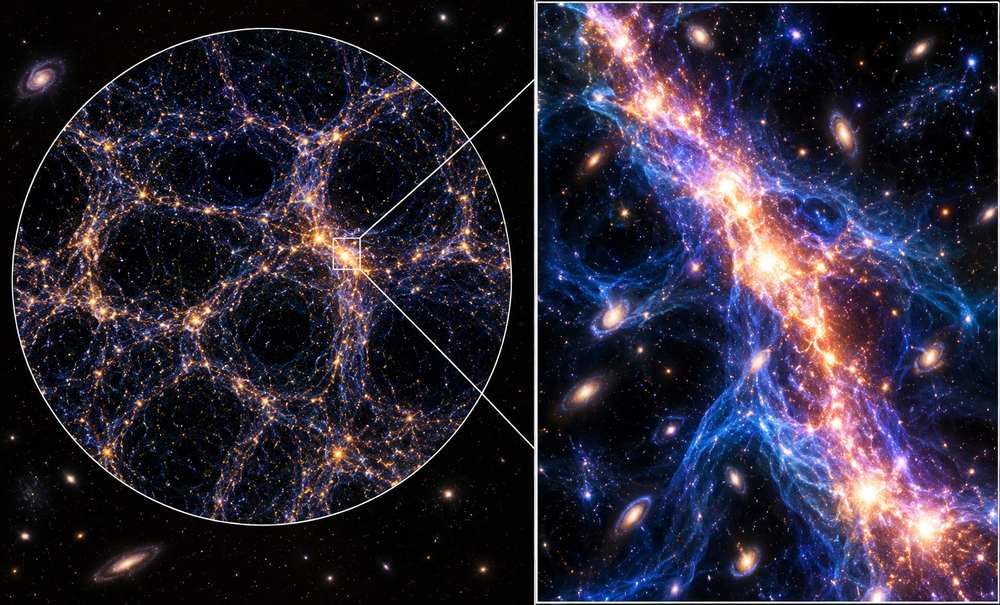
The payoff is range: Lumina can zoom from the full simulated volume down to a single developing galaxy, a spread between largest and smallest scales bigger than in any other simulation.
Two dawns, two different engines
Lumina is the first simulation to capture both of the early universe's great transformations in one model: hydrogen re-ionization, when ultraviolet light stripped electrons from hydrogen and let light travel freely, and the later, higher-energy helium re-ionization.
And it found they had different drivers. Light from early galaxies and stars drove hydrogen re-ionization, while helium was re-ionized by much more energetic light from supermassive black holes in their feeding phases — a distinction smaller simulations could not separate.
The Twikup Take
Simulations earn their keep when telescopes can prove them wrong. The Lumina team is releasing its results to the scientific community just as new telescopes begin photographing the real first galaxies — so this replay of the cosmic dawn is about to face its fact-check.