
The biggest piece of the spacecraft is ready
NASA's NEO Surveyor mission has passed a major hardware milestone: teams have finished integrating the solar array onto the spacecraft's sunshade, the largest component of the asteroid-hunting space telescope, NASA announced on October 26.
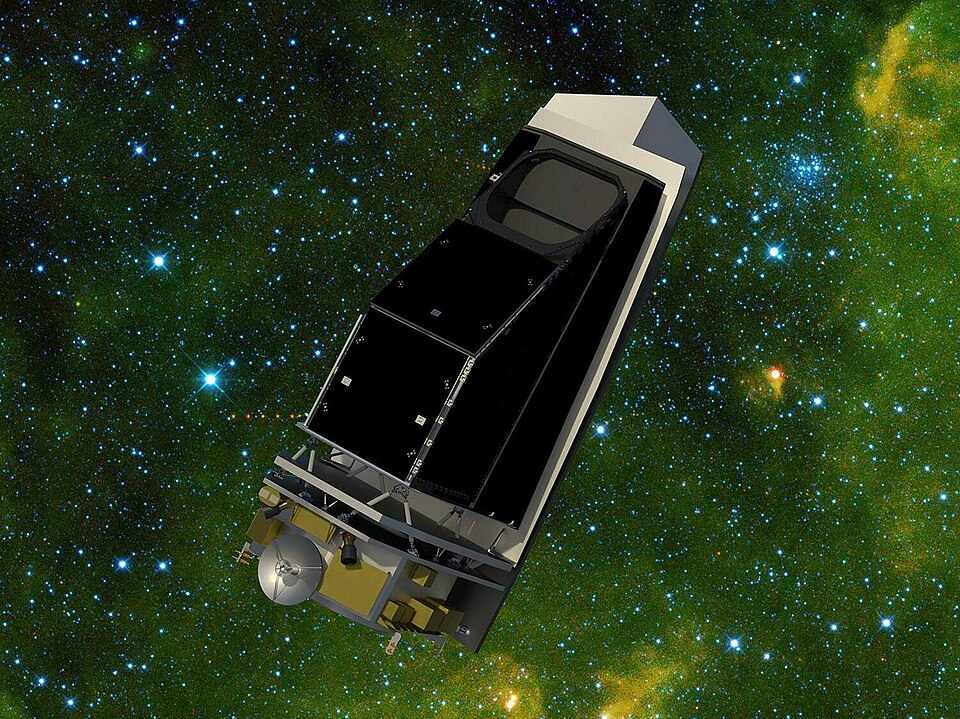
The sunshade stands 20 feet (6 metres) tall and measures 8 feet (2.4 metres) wide at its base, with two flat panels joined at a 23.5-degree angle. Its surface carries 864 interconnected solar cells that can produce up to 2 kilowatts of power — enough to generate all the electricity the spacecraft needs and keep its batteries charged.
A shield against the Sun's glare
The sunshade does double duty. Beyond power, it blocks the Sun's glare and keeps the infrared telescope cool as it searches for near-Earth asteroids and comets — including objects in the direction of the Sun, a region where ground-based optical telescopes have a harder time looking.
The telescope's 20-inch (50-centimetre) aperture collects the infrared emissions given off by asteroids and comets warmed by sunlight. Its pair of infrared detector arrays, each producing a 16-megapixel mosaic of the sky, image the same region in two infrared bands; comparing them yields an object's temperature and an estimate of its size — key information for judging whether a near-Earth object is potentially hazardous.
Built across four states, delivered early
Applied Aerospace built the sunshade structure in Stockton, California, and SolAero Technologies fitted its solar cells in Albuquerque, New Mexico, in January. Environmental testing followed at a thermal vacuum facility in El Segundo, California, in March, and the sunshade was delivered — ahead of schedule — to BAE Systems Space & Mission Systems in Boulder, Colorado, in May. Since then, engineers have added Sun sensors and temperature sensors and completed functional and performance testing of the solar array.
The Twikup Take
Planetary defence has a blind spot exactly where the Sun sits, and NEO Surveyor is being built to stare into it. A finished sunshade sounds mundane, but it is the piece that lets the telescope stay cold, powered and pointed at the one patch of sky our ground telescopes cannot watch.
Photo: NASA/JPL-Caltech/University of Arizona / Wikimedia Commons (Public domain) — in this illustration, NEO Surveyor, NASA's next-generation near-Earth object hunter, floats in an infrared starfield of stars, star clusters, gas and dust.