
Key Takeaways
- Joshua Kutryk is scheduled to make his first two spacewalks, becoming the fifth Canadian Space Agency astronaut to work outside a spacecraft.
- The final two IROSAs will complete the ISS power upgrade, with all eight arrays expected to increase available power by up to 30%.
- Canadarm2 will support one spacewalker, linking Kutryk's work to Chris Hadfield's 2001 installation of the Canadian-built arm.
Two Spacewalks, One Week Apart, One Big Finish
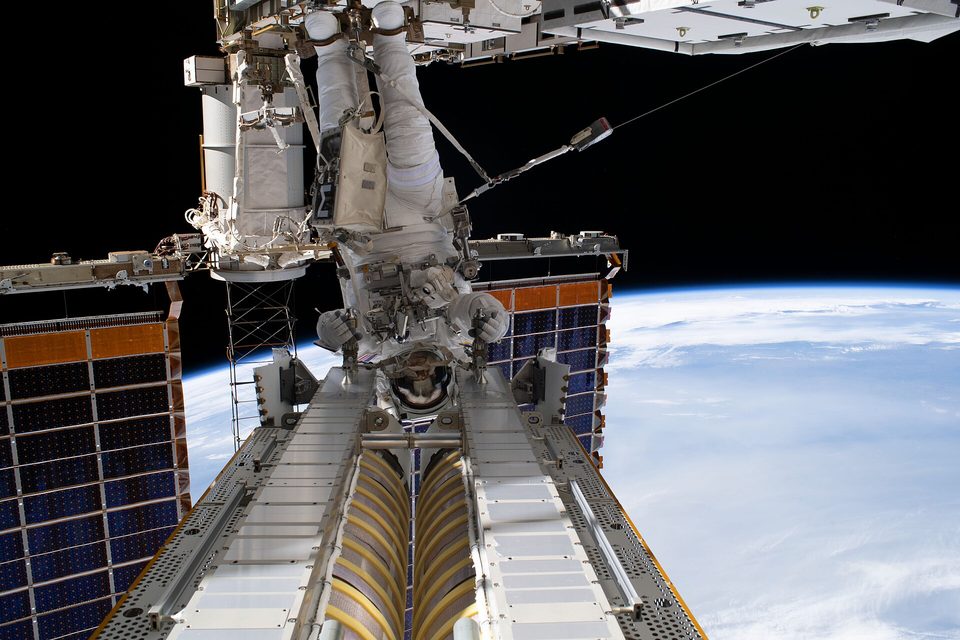
The International Space Station is about to get its last big power upgrade — and a Canadian will be outside in a spacesuit helping to bolt it on. NASA has scheduled two spacewalks, on Thursday, October 29 and Thursday, November 5, in which NASA astronaut Anil Menon and Canadian Space Agency astronaut Joshua Kutryk will exit the Quest airlock to install the final two International Space Station Roll-Out Solar Arrays, known as IROSAs.
The October 29 outing is U.S. spacewalk 100: the pair will install the seventh IROSA on the station's 2A power channel. One week later, on spacewalk 101, they install the eighth and final array on the 3B channel. By NASA's count, these are the 285th and 286th spacewalks ever conducted for station assembly, maintenance and upgrades.
Why the Station Needs More Juice
The new arrays are reinforcements, not replacements. Each IROSA is a thin, flexible panel that unrolls in orbit in front of one of the station's original solar wings, which have spent decades in sunlight slowly losing their edge. The roll-out arrays began arriving in 2021; this final pair completes the set.
Together, NASA says, all eight will lift the station's power by up to 30 percent — from 160 kilowatts to approximately 215 kilowatts. That extra power supports operations through the rest of the station's life, including the safe, controlled deorbit planned for around 2030. The station is, in effect, being given the strength it needs for its own retirement.
A Rookie's First Walk
For Kutryk, this is a debut stacked with milestones. The CSA notes he has been aboard since October 1, arriving with SpaceX Crew-13 on his first spaceflight for a stay of about six months. These will be his first-ever spacewalks, making him only the fifth CSA astronaut to work outside a spacecraft — after Chris Hadfield, Steve MacLean, Dave Williams and David Saint-Jacques — and the first Canadian to do so since Saint-Jacques in April 2019.
The full-circle moment: Canadarm2, the Canadian-built robotic arm, will serve as a platform for one of the spacewalkers. Hadfield helped attach that arm during Canada's first spacewalk in April 2001. A quarter-century later, another Canadian rides it to finish the station's power system.
The Twikup Take
Canada's space legacy was built on exactly this — showing up for the unglamorous, essential work. Kutryk isn't planting a flag; he's finishing a power grid. But when the last array unrolls on November 5, the ISS era's final construction chapter will have Canadian fingerprints on it. That's not a footnote. That's the legacy. Image: NASA Johnson Space Center / Wikimedia Commons (public domain) — NASA astronaut Stephen Bowen works to install and deploy a roll-out solar array on the International Space Station on June 15, 2023.