
The rule amphibians never seemed to break
Whales did it. Sea turtles did it. Penguins did it. Across evolutionary history, mammals, reptiles and birds all produced lineages that returned to the sea.
Amphibians seemed to be the exception. Their permeable skin lets water and gases pass through — but makes salt a problem. No living amphibian spends its entire life in the ocean.
Now, two fossils from China suggest an ancient relative found a way around that barrier 237 million years ago.
Meet Gerrothorax maritimus
In a study published October 26, 2026, in Nature Ecology & Evolution, researchers including Lipin Diao and Ryosuke Motani describe the first known fully marine stem amphibian: Gerrothorax maritimus.
A stem amphibian is an ancient relative outside the group containing today’s frogs, salamanders and caecilians. This one comes from two nearly complete skeletons discovered in Guizhou, China, in rocks dating to the Late Triassic.
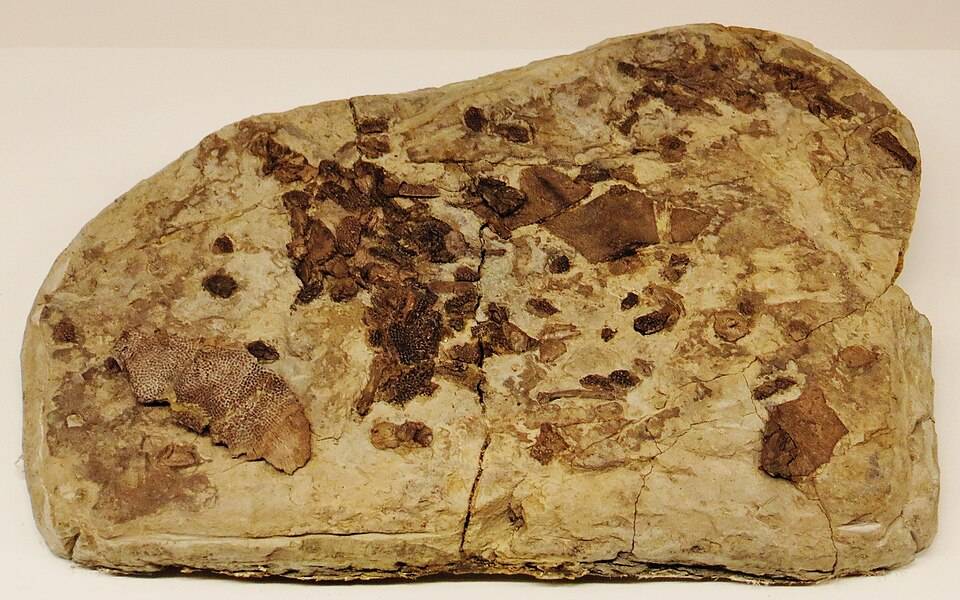
About 74 centimetres long — roughly 2.4 feet — it had a flattened body covered in bony armour. It was built for life near the sea floor, drawing prey into its mouth by suction rather than chasing it through open water.
But finding an amphibian in ocean sediments raises an obvious question: did it live there, or did its body simply wash out to sea?
The evidence goes beyond where it was buried
The skeletons were still largely assembled and lay in sediments deposited far from land. That makes a long journey from a freshwater habitat less likely.
A separate chemical clue strengthened the case: the strontium isotope evidence matched seawater rather than fresh water.
Together, the setting, preservation and chemistry support the researchers’ conclusion that this animal lived at sea full-time.
Its armour may help explain how.
A suit of armour with an unexpected advantage
For most amphibians, permeable skin creates a difficult trade-off: the same surface that helps exchange water and gases also leaves them vulnerable to salt.
The researchers propose that extensive bony armour reduced that exposed surface, limiting exchange through the skin. Greater reliance on gills and the gut may then have made salt regulation possible.
The fossils cannot show that physiology directly. But they preserve a body plan that offers a plausible route past a barrier no living amphibian has fully overcome.
The Twikup Take
The surprise is bigger than an amphibian turning up in the sea. It is that a body covering we might read as protection could also have helped open an entirely new habitat.
For 237 million years, that experiment was hidden in rock. Two skeletons have brought it back into view.
Source: Diao and colleagues, “A fully marine stem amphibian from the Late Triassic of China,” Nature Ecology & Evolution, published October 26, 2026.
Photo: Ghedoghedo / Wikimedia Commons (CC BY-SA 4.0) — fossil skeleton of Gerrothorax pulcherrimus, a close armoured relative of the new marine species, at the Muschelkalkmuseum Ingelfingen, Germany.