
Key Takeaways
- Dreams happen in both REM and non-REM sleep; REM makes up 20–25% of the night, and its longest stretch comes near morning.
- Science has not proven that dreaming serves any single purpose — memory filing and emotional processing are leading theories, not facts.
- About 55% of people report at least one lucid dream in their lifetime, and most dreams are forgotten because remembering one means waking up right after it.
Why do we dream — and why can nobody tell you for sure?
Add it all up, and you will spend years of your life dreaming. Last night alone, your brain ran through cycle after cycle of vivid, emotional, completely invented stories — and by breakfast, nearly all of them were gone. For something every human does every night, dreaming is remarkably unexplained. Here is what science actually knows, and the part it honestly doesn't.
The shape of a dreaming night
Sleep runs in cycles of about 90 to 120 minutes, and each cycle ends in REM sleep — the stage named for the rapid eye movements under your lids. REM makes up 20% to 25% of the night, in four or five stretches that get longer as the night goes on. The first REM period is brief; the last one, near morning, is the longest. That is why the dream you actually remember is usually the one you woke up from at 6 a.m.
Dreams are not exclusive to REM, though. In sleep laboratories, waking people out of REM produces a dream report about 82% of the time, versus roughly 43% from non-REM sleep. REM dreams tend to be longer, stranger and more emotional; non-REM dreams are usually more like ordinary thinking.
Why you forget almost everything
The forgetting is built into the machinery. Remembering a dream mostly depends on waking up during it or within moments of it ending — sleep straight through to a natural waking and the night's stories are simply never recorded. One reason researchers propose: during REM, the brain chemicals that stamp experiences into memory, including serotonin and noradrenaline, are essentially switched off. A 2019 study in mice went further, finding a set of brain cells active in REM that appear to actively suppress memory formation — animal evidence, not proof in humans, but it suggests forgetting your dreams may be a feature, not a bug.
The theories — all of them still theories
Memory filing. Sleep itself demonstrably helps lock in memories. In rats, the brain cells that fired while running a maze fire again during later REM sleep, in the same sequence — the day, replayed. Whether the dream you experience is doing that filing, or is just the noise the filing makes, nobody has proven.
Overnight therapy. One influential model proposes that REM reprocesses emotional memories in the one daily window when the stress chemical noradrenaline is absent — so you keep the memory but lose some of its sting. It is a model its own authors present as a hypothesis.
Threat rehearsal. The threat-simulation theory says dreams are an ancient training ground for danger. It has a problem: at least one study comparing dream reports from a high-crime region and a low-crime one found fewer threat dreams where real threats were higher — the opposite of what the theory predicts.
Story from static. The oldest modern theory, from 1977, holds that the brain invents a story to make sense of signals it generates itself during REM. It has been heavily revised since — treat the "random noise" version as history, not consensus.
The honest answer
After a century of research, there is no proven single function of dreaming, and no scientific consensus that dreaming has one function at all. Some leading researchers conclude the biological function of dreaming remains unknown; others argue it may have none — a by-product of a brain that generates conscious experience whenever it is active, awake or asleep. What is established is that sleep matters. Whether the nightly movie is the mechanism, or just the trailer, is still an open question.
The vivid extras
About 55% of people say they have had at least one lucid dream — knowing they are dreaming while the dream continues — and about 23% report one at least once a month. Nightmares are nearly universal: up to 85% of adults report at least one in a year, and 2–6% have them weekly; if nightmares regularly wreck your sleep, that is worth raising with a doctor. Miss sleep for a few nights and your brain claws REM back, entering it sooner and staying longer — one reason dreams turn intense after a rough week, or after stopping alcohol or certain antidepressants. And sleepwalking, despite the movies, is not acting out a dream: it erupts from deep non-REM sleep, usually early in the night, in about 5% of children and 1.5% of adults in a given year.
Canadians, for the record, are not giving their brains much material to work with: Statistics Canada's 2007–2013 survey data found adults aged 18 to 64 averaged about 7.1 hours of sleep, and roughly one in three got less than seven.
The Twikup Take
Dreaming is the rare universal experience that science can describe in fine detail — the cycles, the chemistry, the forgetting — while remaining unable to say what it is for. The theories are good stories about stories. Until one of them survives a real test, the accurate answer to "why do we dream?" is the one researchers themselves give: we don't know yet, and it might be for nothing at all.
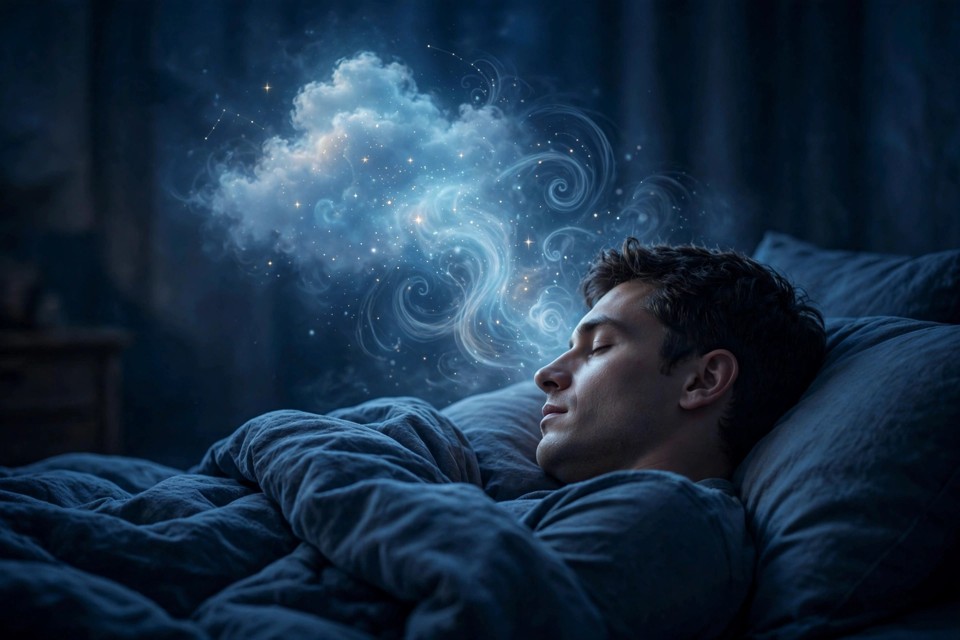
Image: Illustrative image.