
Key Takeaways
- Eruptions are driven by rising magma and trapped gas.
- Runny magma flows; sticky magma explodes.
- Most volcanoes sit on plate boundaries.
Magma: the lighter rock rises
Deep in the Earth, heat slowly melts some rock into magma — a thick, flowing substance. Magma is less dense than the solid rock around it, so it rises and collects in underground magma chambers, until some of it pushes through vents and fissures to the surface. Magma that has erupted gets a new name: lava.
Why some eruptions flow and others explode
The U.S. Geological Survey's core insight is that explosivity depends on the magma's composition:
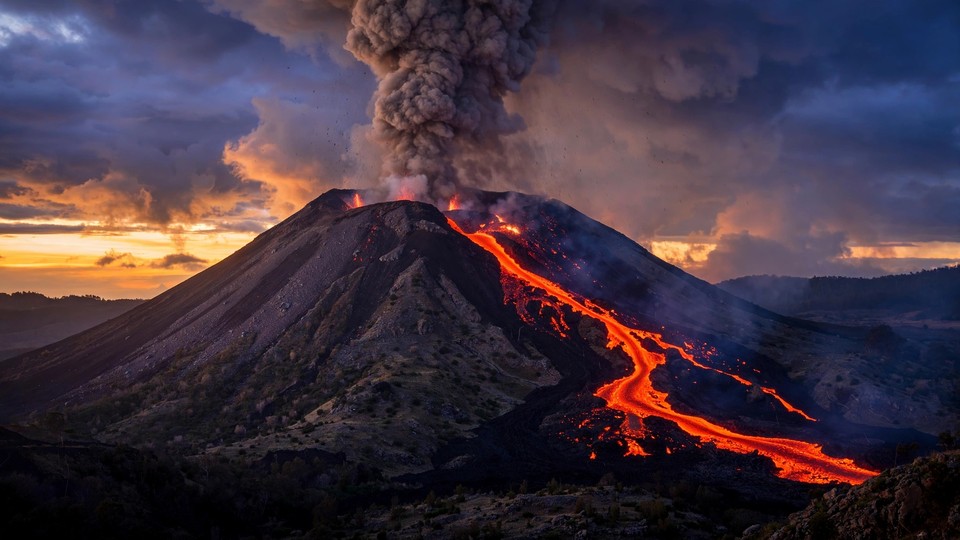
- Thin, runny magma lets dissolved gases escape easily. The result is a gentle, effusive eruption — lava flows like Hawaii's, which rarely kill because they move slowly enough to walk away from.
- Thick, sticky magma traps its gases. Pressure builds until it escapes violently, blasting the magma apart into fragments called tephra — the Mount St. Helens pattern. Gas-rich, highly viscous magmas produce the most explosive eruptions, injecting ash high into the stratosphere.
Eruption style is set by the magma's chemistry, crystal content, temperature and dissolved-gas content — and by whether it meets water on the way up, which can flash to steam.
Where volcanoes live
Volcanoes cluster where Earth's plates interact. At divergent boundaries, plates pull apart and magma rises to fill the gap — most of Earth's volcanoes are actually under the sea along mid-ocean ridges. At convergent boundaries, one plate sinks beneath another (subduction), partially melts, and feeds chains of volcanoes — more than half of the world's active above-sea volcanoes ring the Pacific in the "Ring of Fire." A third kind grows mid-plate over hot spots — the Hawaiian Islands are the classic case.
The shapes they build
- Shield volcanoes — the largest type, broad and low-sloped, built almost entirely of fluid lava (Mauna Loa, Kīlauea).
- Composite cones (stratovolcanoes) — steep, symmetrical mountains of alternating lava and ash, common near subduction zones (Fuji, St. Helens, Rainier).
- Cinder cones — small, steep piles of ejected cinders around a single vent.
- A caldera is the collapse crater left when a volcano empties its magma chamber and falls in on itself — Crater Lake is one.
Scientists rank eruption size with the Volcanic Explosivity Index (VEI), based mainly on the volume of material ejected and the height of the eruption plume. VEI 8 — roughly 1,000 cubic kilometres of deposits — is the informal "super-eruption."
The Twikup Take
Every volcano is the same machine with a different temperament: rock melts, rises, and either exhales or detonates. The difference between a lava flow tourists photograph and a Plinian column that changes the climate is, in the end, chemistry — how much gas the magma holds, and whether it can let go quietly.
Image: Illustrative image.