
Key Takeaways
- Epigenetics changes which genes are read, never the DNA letters themselves
- Identical twins start with near-identical epigenetic marks, then drift apart with age
- A famine study found one gene's mark still different 60 years later — in the exposed people only
Same DNA in every cell — so why isn't a brain cell a skin cell?
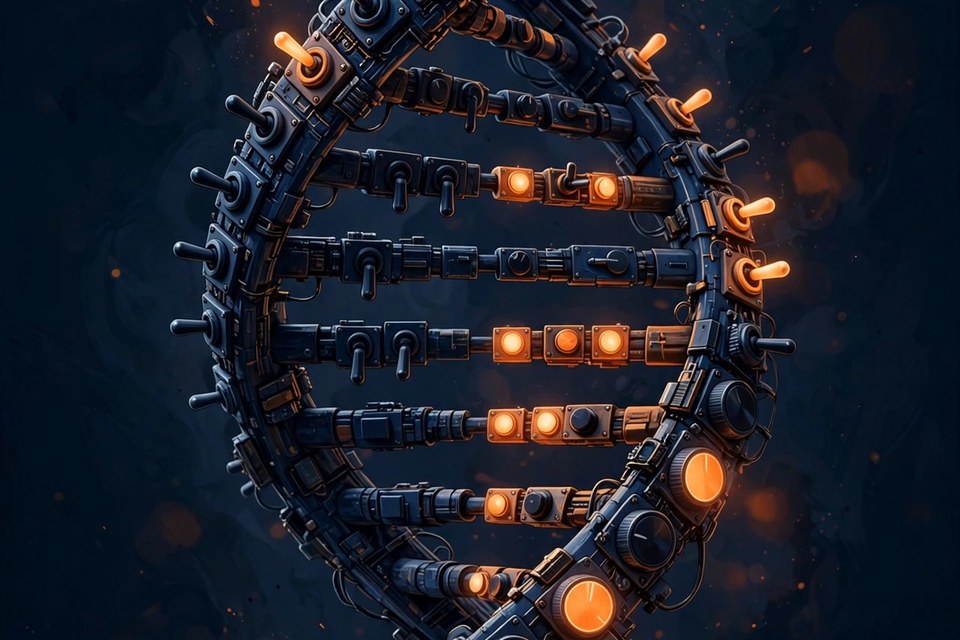
Because genes are not just letters; they are letters with switches. Epigenetics is the layer of chemical marks that decides which genes a cell reads, and how loudly — without changing a single letter of the DNA sequence itself. A neuron and a liver cell carry identical genomes. They differ because development set their switches differently, and each cell copies its switch pattern every time it divides.
Two mechanisms do most of the work:
- DNA methylation — the mute tag. Enzymes attach a small chemical tag (a methyl group) to DNA, usually at sites called CpGs. A tagged control region is generally silenced: the cell's reading machinery cannot get a grip.
- Histone marks — loosening the spool. DNA is wound around proteins called histones. Tags that loosen the winding (acetylation, typically) expose genes to be read; tags that tighten it bury them.
You can see the system in every woman's body: with two X chromosomes, one X in each of her cells is randomly silenced early in development — permanently, by these very marks. Same DNA, two different cell populations, for life.
Identical twins: born matched, then they drift
If epigenetics were fixed at birth, identical twins would keep identical marks. They don't. A landmark 2005 study in PNAS compared 40 pairs of identical twins aged 3 to 74 and found the youngest pairs were epigenetically almost indistinguishable — but about 35% of all pairs showed significant differences, and among twins over 28, more than 60% of pairs had diverged. Twins who had lived more of their lives apart, with more different lifestyles, had drifted the most; gene-activity differences between older pairs were roughly four times those between young pairs.
The study's own caution matters: the drift could come from lifestyle and environment — or partly from random, built-in slippage over a lifetime. It proves marks change; it doesn't isolate which habit changed which mark.
The famine written into one gene
The Dutch Hunger Winter of 1944–45 — a Nazi-imposed food embargo that starved the western Netherlands for one sharply dated winter — gave researchers a tragic natural experiment. In 2008, scientists compared 60 people conceived during the famine with their own unexposed brothers and sisters, measuring DNA methylation roughly six decades later.
Those conceived during the famine had 5.2% less methylation at one imprinted growth gene, IGF2, than their siblings. The timing was everything: exposure around conception — when epigenetic marks are being laid down — left the trace. Exposure late in pregnancy did not.
Read that finding precisely: a small, specific, persistent difference, at one gene region, in blood cells, in the people who were directly exposed. No disease outcome, no genome-wide damage — and, critically, no grandchildren.
What epigenetics has NOT proven
This is where popular coverage runs ahead of the evidence:
- "Trauma is inherited through epigenetics" is unproven in humans. Hunger Winter babies were exposed directly in the womb — even their own developing egg or sperm cells were there. That is direct exposure, not inheritance. Mammals also run an extensive mark-erasing process when eggs and sperm form, which makes passing acquired marks on biologically unlikely. A 2025 review concludes there is no definitive evidence that an ancestor's experience leaves a persistent mark that causes traits in later generations; most human claims collapse into in-womb exposure or family environment.
- No diet, supplement or meditation programme has been proven to deliberately "reprogramme" your epigenome in a targeted, lasting way. Age and early-life conditions demonstrably shift marks; consumer claims go far beyond the data.
- Methylation is not damage. It is the normal operating system of every cell — development, imprinting and X-silencing all depend on it.
The Twikup Take
Epigenetics is real, measurable and stranger than the headlines: your genes are fixed, but their volume knobs are not, and at least one famine left a fingerprint on a single knob sixty years later. What the science does not yet support is the leap to inherited trauma or epigenetic self-help. The marks drift with age — mostly, it seems, whether we plan it or not.
Image: Illustrative image.
Sources
- Fraga et al. — Epigenetic differences arise during the lifetime of monozygotic twins, PNAS 2005 (via Nature news)
- Heijmans et al. — Persistent epigenetic differences associated with prenatal exposure to famine in humans, PNAS 2008
- Int J Mol Sci 2025 — Epigenetic Echoes (review of transgenerational evidence)