
Key Takeaways
- CRISPR is a borrowed bacterial immune system: a guide RNA steers the Cas9 enzyme to one spot in DNA
- Cas9 only cuts — the cell's own repair systems make the actual edit
- The first CRISPR therapy, Casgevy, was authorized in Canada in September 2024 for two blood diseases
The most powerful tool in genetics was invented by bacteria
Long before scientists touched it, bacteria were using CRISPR to survive virus attacks. They store snippets of invading virus DNA in their own genome — a mugshot album of past infections — and use it to recognize and destroy the same virus next time. CRISPR stands for the repeating pattern those stored snippets sit inside.
In 2012, Emmanuelle Charpentier and Jennifer Doudna showed this bacterial defence could be reprogrammed into a general-purpose editing tool. Eight years later, they won the 2020 Nobel Prize in Chemistry for it.
Step by step: a search, a cut, and a repair
1. Aim. In nature, two RNA molecules guide the cutting enzyme Cas9. Charpentier and Doudna fused them into a single guide RNA. Rewrite the guide's code — a targeting sequence of 20 chemical letters — and Cas9 will hunt for that exact address in a genome of billions of letters, cutting only where it finds a short marker sequence (called PAM) next to the target.
2. Cut. Cas9 makes a clean double-strand break, snipping both strands of the DNA. That is all Cas9 does. It is scissors, not a word processor.
3. Repair — this is where the edit actually happens. The cell rushes to fix the break, and it has two repair crews:
- The fast, messy crew (NHEJ) glues the ends back together, usually with small random insertions or deletions. If that happens inside a gene, the gene is scrambled and switched off — a knockout.
- The careful crew (HDR) copies from a template. Hand it a corrected page, and the cell pastes the correction in — a precise edit, though this path is slower and works mainly in dividing cells.
The first CRISPR medicine — and the trick it actually uses
The first approved CRISPR therapy is Casgevy. The UK's medicines regulator (MHRA) authorized it first, on November 16, 2023 — the world's first approval of a CRISPR treatment. The US FDA approved it on December 8, 2023 for sickle cell disease, and Health Canada authorized it on September 23, 2024 for patients 12 and older with sickle cell disease or transfusion-dependent beta thalassemia.
Here is the surprise: Casgevy does not repair the faulty gene behind those diseases. Instead, doctors take the patient's own blood stem cells out of the body, use CRISPR to disable a genetic switch (in a gene called BCL11A) that normally turns off fetal hemoglobin after birth — and put the cells back. The body starts making the fetal form of hemoglobin again, which compensates for the broken adult version. In Health Canada's trial data, 96.7% of sickle cell patients stayed free of severe pain crises for at least 12 straight months, and 92.9% of thalassemia patients achieved at least 12 months without transfusions.
The honest limits
Regulators are careful here, and so should we be. The FDA's label states the risk of off-target editing — Cas9 cutting somewhere similar to the target — cannot be ruled out; Health Canada calls the risk theoretical and is tracking patients long-term. Casgevy is also not a simple injection: it requires collecting stem cells, editing them in a lab, and chemotherapy to prepare the bone marrow. And it edits body (somatic) cells only — the changes die with the patient. Editing eggs, sperm or embryos, which would pass changes to future generations, is illegal in the United States and many other countries.
Newer tools are already arriving: base editing (2016) swaps a single DNA letter without cutting both strands, and prime editing (2019) can write in small corrections directly.
The Twikup Take
CRISPR is best understood as programmable scissors plus the cell's own repair shop. The cutting is easy now; the hard parts are aiming perfectly, delivering the tools to the right cells, and proving the edits stay safe for decades. The first approved therapy cleverly sidesteps the hardest problem — it does not fix the broken gene at all. It switches a healthy backup back on.
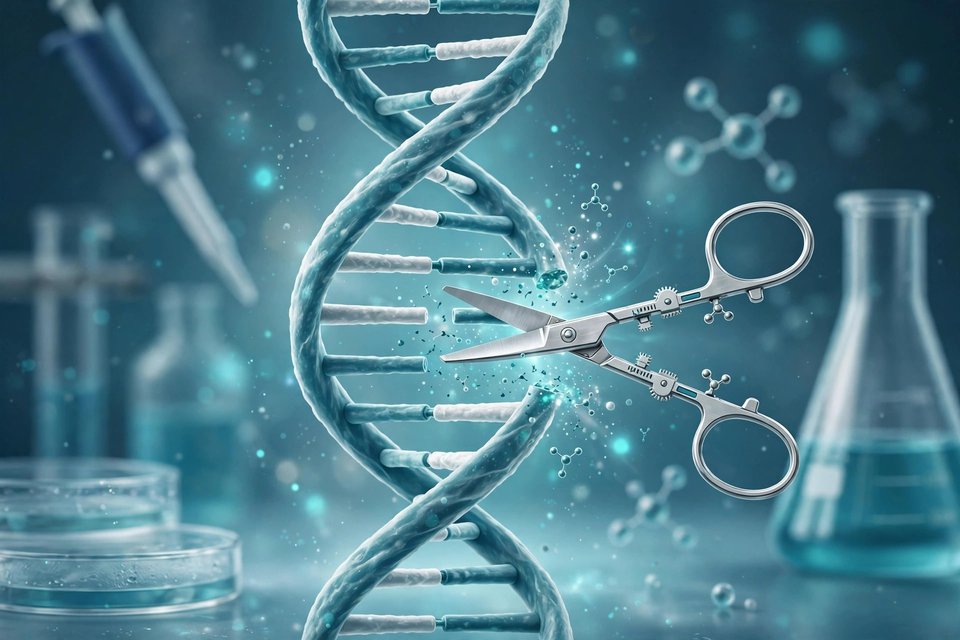
Image: Illustrative image.
Sources
- Nobel Prize Organization — The Nobel Prize in Chemistry 2020 (popular information)
- UK MHRA — MHRA authorises world-first gene therapy (Nov 16, 2023)
- U.S. Food and Drug Administration — FDA Approves First Gene Therapies to Treat Patients with Sickle Cell Disease
- Health Canada — Summary Basis of Decision for Casgevy