
Key Takeaways
- Voyager 1 hits one light-day on Nov. 18.
- It is 25.9 billion km away.
- A signal takes 24 hours to reach it.
The Milestone
Imagine sending a message into space and waiting an entire day just for it to arrive.
That's about to become reality for NASA's Voyager 1.
On Wednesday, November 18, 2026, at 5:16 a.m. EST, Voyager 1 will reach a remarkable milestone: one full light-day from Earth, more than 16 billion miles (25.9 billion kilometres) away, according to NASA's Voyager mission page.
Every radio signal sent from Earth will take 24 hours to reach the spacecraft. And when NASA sends a command and waits for a reply, the entire exchange takes 48 hours.
No human-made object has ever travelled farther. Voyager 1 already holds that record. Now, it is about to reach a distance that takes light an entire day to cross.
NASA is marking it publicly
NASA is marking the milestone with a worldwide event.
On Tuesday, November 17, after sunset, people everywhere are invited to join "Shine Bright for Voyager's Light-Day" — a symbolic wave of golden light around the planet.
NASA has created a website that lets smartphones and tablets flash "VGR" — Voyager's call sign — in Morse code. Participants are encouraged to share photos and videos while tagging NASA.
The celebrations continue Thursday, November 19.
At 12 p.m. EST, Voyager mission members and NASA leadership will discuss the status of Voyager 1 and Voyager 2 at NASA JPL's von Kármán Auditorium. The event will also preview a NASA+ documentary about Voyager planned for 2027, the mission's 50th anniversary.
A 1977 spacecraft, still reporting
Voyager 1 and its twin spacecraft launched in 1977, designed around a planetary alignment that occurs once every 176 years.
Voyager 1 entered interstellar space in 2012, followed by Voyager 2 in 2018. Both spacecraft still return scientific data from beyond the heliosphere.
Built and operated by NASA's Jet Propulsion Laboratory, the probes communicate with Earth through the Deep Space Network.
The Twikup Take
Voyager 1 was built with 1970s technology and a five-year mission plan. Nearly five decades later, it is about to reach a distance where even a message travelling at the speed of light needs 24 hours to arrive.
Humanity built a spacecraft that keeps answering us from a place it takes a full day just to reach.
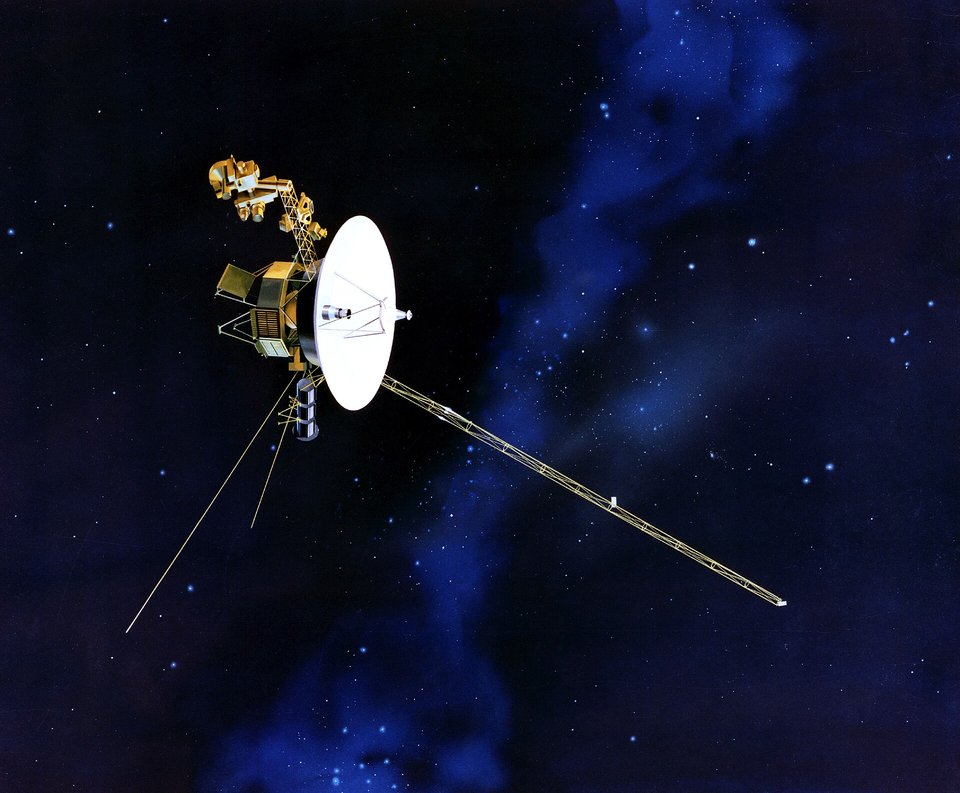
Image: Artist's concept of the Voyager spacecraft in flight by NASA/JPL, public domain, via Wikimedia Commons.