
Key Takeaways
- ETFs can lose money even over several years; their structure does not protect investors from losses in the assets they hold.
- Diversification depends on what is inside the ETF, with broad-market and narrowly concentrated funds carrying very different risks.
- The ticker matters less than the portfolio underneath it: understand a fund’s holdings, concentration and potential downside before investing.
The $10,000 ETF Reality Check
Consider four non-leveraged ETFs over the five years ending June 30, 2026.
| ETF | Main focus | Five-year annualized NAV return | Approximate cumulative return | Approximate value of $10,000 |
|---|---|---|---|---|
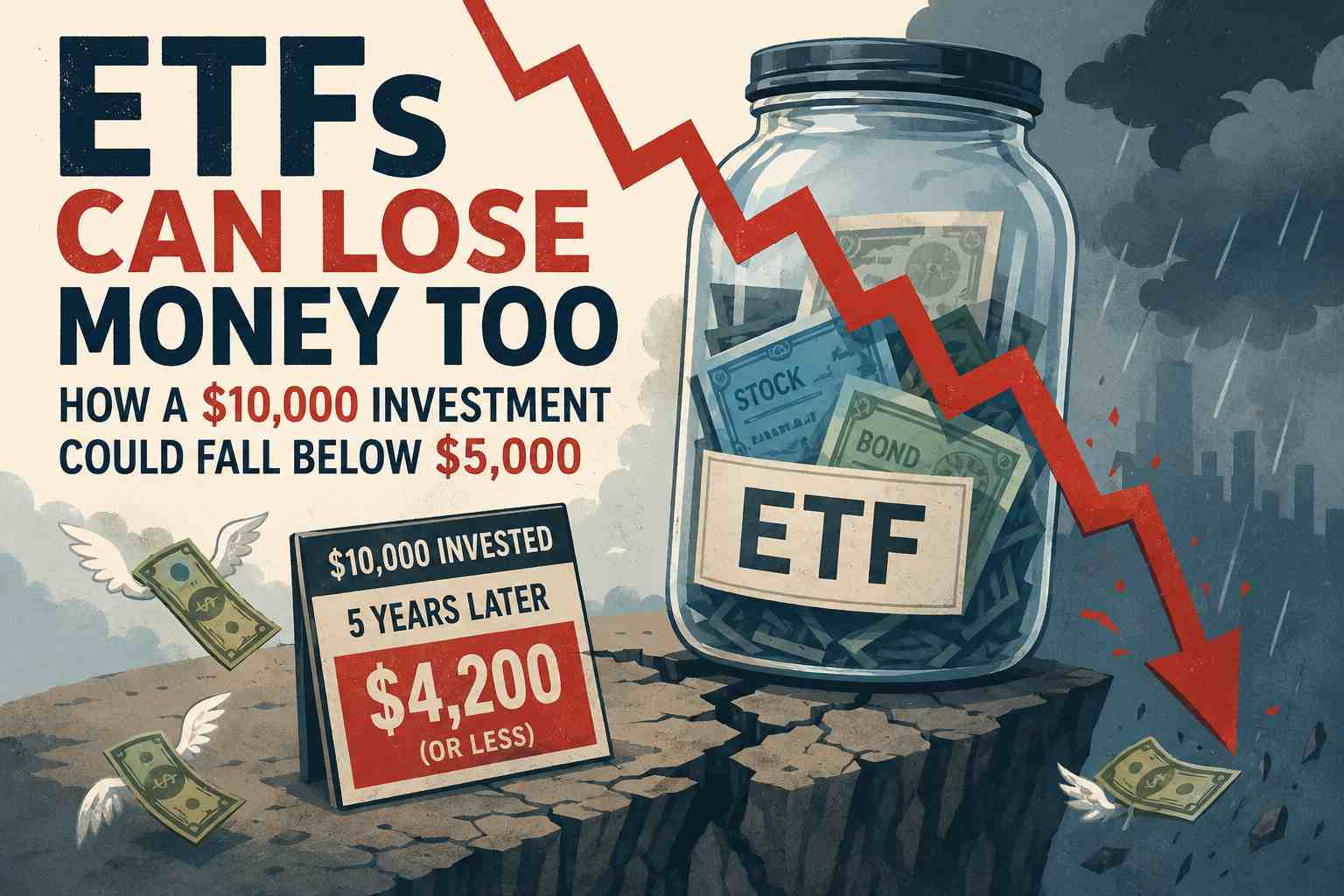
| KWEB | Chinese internet companies | −15.96% | −58.08% | $4,192 |
| ARKG | Genomics-related companies | −14.48% | −54.26% | $4,574 |
| ARKK | Disruptive innovation | −9.05% | −37.77% | $6,223 |
| TLT | Long-term U.S. Treasury bonds | −6.66% | −29.15% | $7,085 |
Ending values are mathematical illustrations based on each fund’s reported five-year annualized NAV total return through June 30, 2026. They assume distributions were reinvested and exclude commissions, taxes and differences between NAV and market price. Figures are rounded.
The first example is particularly striking.
At an annualized return of −15.96%, a hypothetical $10,000 investment would shrink to approximately $4,192 after five years.
The investment did not lose 15.96% just once. Negative returns compounded over the full period.
The calculation is:
$10,000 × (1 − 0.1596)⁵ = approximately $4,192
That is the uncomfortable side of compounding investors sometimes overlook: compounding can magnify losses as well as gains.
Aren’t ETFs Supposed to Be Diversified?
Sometimes they are.
But “ETF” and “diversified portfolio” are not synonyms.
Think of an ETF as a shopping basket.
One basket might contain hundreds or thousands of companies across different industries and countries. Another might contain a much smaller group of companies sharing essentially the same economic story.
Both are baskets. Their contents and risks are completely different.
The U.S. Securities and Exchange Commission explains that ETFs pool money from investors and invest it in stocks, bonds or other assets. The SEC also warns that ETF investors can lose some or all of the money they invest.
The SEC further notes that an ETF will not necessarily provide adequate diversification when it focuses narrowly on one industry or sector.
Buying an ETF changes how an investor owns assets. It does not remove the risks attached to those assets.
Four ETFs, Four Different Ways to Lose Money
These examples are useful not simply because their returns were negative, but because they show how very different investment strategies can all experience extended losses.
1. KWEB: When a Country and Sector Bet Goes Wrong
The KraneShares CSI China Internet ETF, commonly known by its ticker KWEB, focuses on Chinese internet-related companies.
An investor in KWEB is not making a generic stock-market investment. The portfolio can be heavily influenced by conditions affecting Chinese equities, internet businesses, government regulation, economic growth, geopolitics and investor sentiment toward China.
KWEB’s five-year annualized NAV return through June 30, 2026, was −15.96%.
Converted into dollars:
$10,000 → approximately $4,192
That represents a cumulative loss of about 58.08%, assuming distributions were reinvested.
The lesson is not that every regional ETF is a bad investment. It is that owning numerous companies within one country and industry does not necessarily provide the same protection as spreading money across countries, industries and asset classes.
2. ARKG: A Great Story Does Not Guarantee a Great Return
Genomics sounds like the future.
Gene editing, biotechnology, diagnostics and precision medicine could play significant roles in the years ahead.
It is easy to understand the investment story. But a compelling technological story and a profitable investment are not the same thing.
The ARK Genomic Revolution ETF, or ARKG, recorded a five-year annualized NAV return of −14.48% through June 30, 2026.
A hypothetical $10,000 investment compounded at that rate for five years would be worth approximately $4,574.
An investor can be correct that a technology will become important and still lose money investing in companies associated with it.
Valuations matter. Timing matters. Competition matters. Individual businesses matter. The price paid for expected future growth also matters.
Being right about a technology’s importance does not automatically make a particular investment profitable.
3. ARKK: Even Innovation Can Produce Brutal Drawdowns
The ARK Innovation ETF, or ARKK, provides another version of the same lesson.
Its strategy focuses on disruptive innovation, but its five-year annualized NAV return through June 30, 2026, was −9.05%.
That corresponds to a cumulative decline of approximately 37.77% over five years.
A hypothetical $10,000 investment would become roughly $6,223.
Consider the investor experience.
Someone buys the fund believing technological change will accelerate. Five years pass, and artificial intelligence, automation and other technologies continue developing.
Yet the investment remains down.
Markets do not consider only whether a technology is important. They also consider how much future growth was already reflected in the prices of the companies associated with it.
A promising industry can still produce disappointing investment returns when expectations and valuations become too high.
4. TLT: “Safe” Assets Can Still Produce Painful ETF Losses
Perhaps the most educational example is not a technology ETF at all.
The iShares 20+ Year Treasury Bond ETF, or TLT, holds long-term U.S. Treasury securities.
U.S. Treasury securities are backed by the U.S. government. That does not mean an ETF holding long-term Treasuries cannot decline substantially in market value.
TLT’s five-year annualized total return through June 30, 2026, was −6.66%. That corresponds to a cumulative return of approximately −29.15%.
A hypothetical $10,000 investment would therefore be worth approximately $7,085.
One major reason such a decline can happen is interest-rate risk.
Bond prices and market interest rates generally move in opposite directions. Long-term bonds are usually more sensitive to changing interest rates than shorter-term bonds.
Investors therefore need to distinguish between two questions:
Will the U.S. government repay its Treasury obligations?
And:
Can the market price of a long-term Treasury ETF fall substantially before those bonds mature?
Those are different questions.
A Treasury bond’s relatively low credit risk does not eliminate interest-rate risk, duration risk or fluctuations in an ETF’s market value.
This example demonstrates that investment risk is not limited to exciting technology stocks. Risk can also exist inside investments that appear comparatively boring or conservative.
An ETF Is a Container, Not a Safety Label
This may be the most useful way to think about ETFs.
Imagine two boxes.
The first contains thousands of stocks spread across industries and countries.
The second contains 30 companies exposed to one narrow economic theme.
Both boxes can have ETF written on the outside.
That label alone does not tell investors whether the two funds carry similar risks.
Before buying an ETF, the better question is not simply:
“Is this an ETF?”
It is:
“What exactly does this ETF own?”
That small change in thinking can completely alter how an investor evaluates a fund.
Broad ETFs and Thematic ETFs Should Not Be Treated the Same
A broadly diversified index ETF can still fall sharply during a market crash. Diversification reduces certain risks; it does not eliminate market risk or guarantee against losses.
But there is an important difference between owning a broad cross-section of the market and concentrating money in one theme, country or narrow industry.
This also explains why long-term ETF projections need context.
For example, TwikUp previously examined what could happen to $100,000 invested in XEQT over 10, 20 and 30 years.
Those scenarios can help investors understand compounding, but projections should never be confused with guarantees.
The actual investing journey can include recessions, crashes, bear markets and extended periods of disappointing returns.
Could ETFs Still Be Used to Build $1 Million?
Yes, but the phrase “using ETFs” hides an enormous amount of detail.
Which ETF?
How much is being contributed?
For how long?
What rate of return is assumed?
How diversified is the portfolio?
What happens if the market falls 30% shortly before the investor needs the money?
Those variables are why our analysis of how fast a Canadian could potentially build $1 million using ETFs uses scenarios rather than presenting one guaranteed timeline.
A spreadsheet can produce a beautiful compounding curve.
Markets are under no obligation to follow it.
A TFSA Does Not Protect Investors From Market Losses
For Canadians, there is another layer to this discussion.
Holding an eligible ETF inside a Tax-Free Savings Account changes the tax treatment of the investment. It does not turn a risky investment into a safe one.
If a speculative or concentrated investment collapses inside a TFSA, the account’s tax advantages do not reverse the market loss.
That is one reason understanding the biggest TFSA investing mistake Canadians can make matters before focusing exclusively on potential returns.
Tax efficiency and investment quality are separate considerations.
The Investor Can Become Another Source of Risk
Sometimes the ETF is not the only problem.
Investor behaviour can also affect the final result.
Imagine an ETF surges 60%. People notice the chart, social media attention increases and more investors buy after the rise.
The fund then drops 40%. Some of the investors who bought near the top become frightened and sell near the bottom.
The ETF’s published long-term return and the return experienced by an individual investor can therefore differ depending on when that investor bought, added money and sold.
That behavioural gap is explored further in why most ETF investors can underperform their own ETFs.
Patience and diversification can help manage risk. Neither removes the need to understand what the investor actually owns.
What About Leveraged and Inverse ETFs?
The examples above are particularly useful because KWEB, ARKG, ARKK and TLT are not leveraged or inverse ETFs.
Leveraged and inverse ETFs introduce additional risks and complexity.
The SEC warns that most leveraged and inverse ETFs use daily investment objectives. Their returns over weeks, months or years can differ significantly from simply multiplying an index’s longer-term return by two or three.
This divergence can become more pronounced in volatile markets.
That makes the idea of holding such a fund indefinitely until it “comes back” especially dangerous when the investor does not fully understand the product.
What Should Investors Check Before Buying an ETF?
Instead of judging a fund by its ticker, recent chart or popularity, start by looking underneath the wrapper.
Ask:
- What does the ETF actually own?
- How many holdings does it contain?
- How concentrated are its largest positions?
- Does it focus on one country, industry or investment theme?
- Is it actively managed or index-based?
- Does it own stocks, bonds, commodities or derivatives?
- How volatile has it historically been?
- What fees does it charge?
- How liquid is it, and how wide is its typical bid-ask spread?
- What risks are described in its prospectus?
- Does its strategy match the investor’s goals and time horizon?
And perhaps most importantly:
Would you still be comfortable owning it if it fell 30%, 40% or 50%?
That question feels theoretical when markets are rising.
It becomes very real when $10,000 turns into $6,000—or less than $5,000.
TwikUp Insight
The biggest misconception may not be simply that ETFs always make money.
It may be the belief that “ETF” itself describes an investment strategy.
It does not.
ETF describes an investment structure. Inside that structure could be thousands of global companies, one industry, one country, long-term government bonds or a highly specialized investment theme.
Asking whether ETFs are safe is a little like asking whether food in a box is healthy.
You need to open the box.
For investors, the label on the outside matters far less than what is sitting inside.
The Bottom Line
Yes, ETFs can lose substantial amounts of money.
Investors do not necessarily need leverage, options or an obscure financial product to experience a major decline.
Over the five years ending June 30, 2026, the four non-leveraged ETFs examined here produced cumulative losses ranging from approximately 29% to 58%, based on their reported annualized NAV total returns.
In two cases, a hypothetical $10,000 investment with distributions reinvested would have fallen below $5,000.
That does not mean ETFs are inherently bad investments.
It means investors should not buy a fund simply because it is an ETF.
Understand its portfolio, concentration, strategy, costs, time horizon and risks first.
Diversification can be powerful—but only when investors understand what is inside the basket.
Investing disclaimer: This article is for educational and informational purposes only and does not constitute financial, investment, tax or legal advice. Examples are historical illustrations and are not recommendations to buy or sell any security. Past performance does not guarantee future results. Investors should evaluate their financial circumstances, objectives and risk tolerance and consider consulting an appropriately qualified professional.
Sources
- what could happen to $100,000 invested in XEQT over 10, 20 and 30 years
- how fast a Canadian could potentially build $1 million using ETFs
- the biggest TFSA investing mistake Canadians can make
- why most ETF investors can underperform their own ETFs
- KraneShares — KraneShares CSI China Internet ETF (KWEB)
- ARK Invest — ARK Genomic Revolution ETF (ARKG)
- ARK Invest — ARK Innovation ETF (ARKK)