
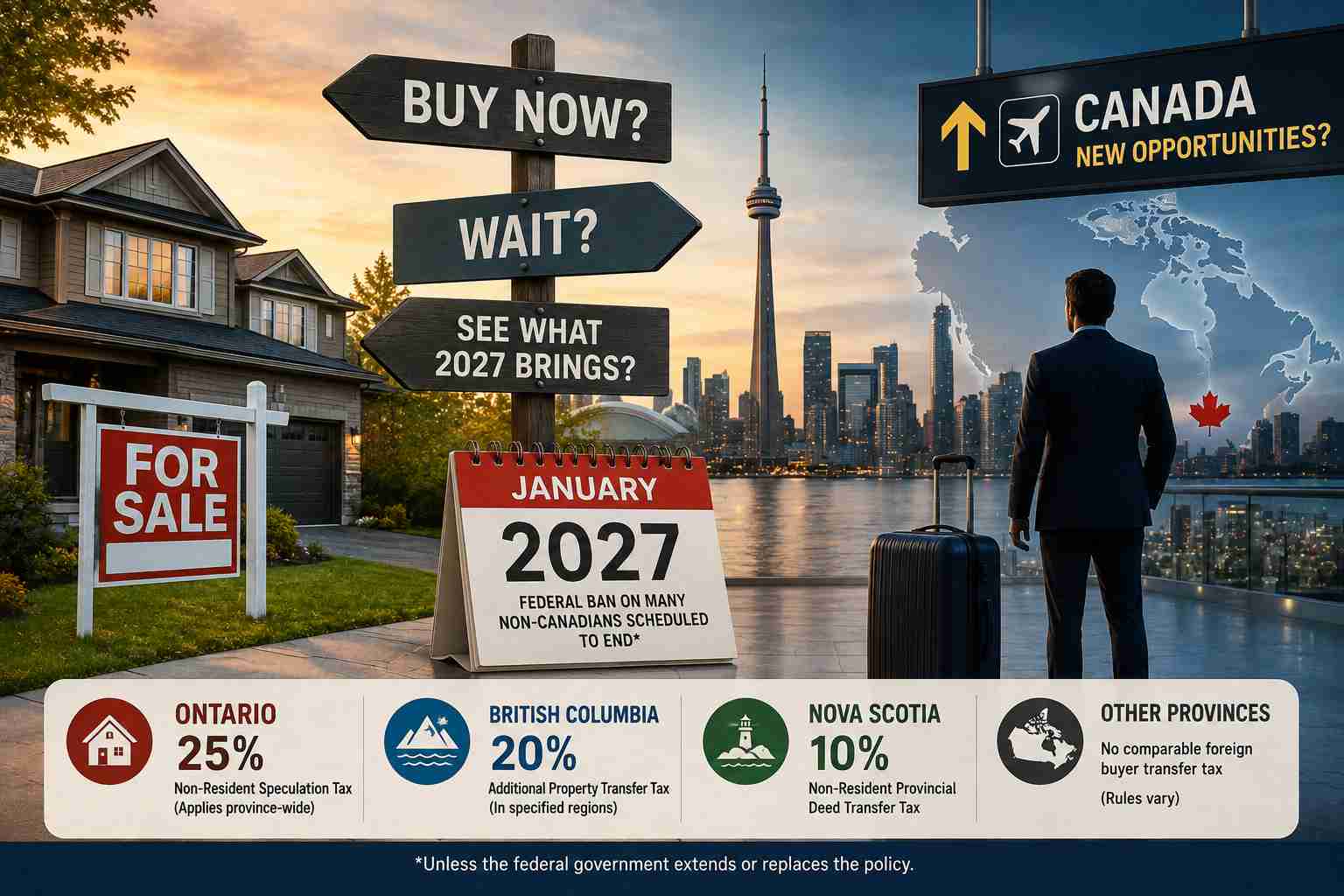
Canada’s foreign-buyer ban is currently scheduled to end on January 1, 2027.
But the most interesting part of that deadline may not be what foreign investors do after the restriction expires.
It may be what Canadian homebuyers do before it happens.
Imagine two buyers watching the same house in late 2026. Both have spent months waiting for a better price, a lower mortgage rate, or simply more confidence that the market has bottomed.
Then the conversation changes:
“Some foreign buyers could regain access next year.”
Neither buyer knows whether Ottawa will let the prohibition expire. Neither knows how much foreign demand actually exists. But waiting suddenly carries a new perceived cost: the possibility of more competition later.
That is how Canada’s 2027 foreign-buyer deadline could become a housing-market story before 2027 even begins.
Why January 1, 2027 Matters
Canada’s federal foreign-buyer prohibition took effect on January 1, 2023.
It was introduced as a temporary measure intended to reduce certain forms of foreign demand and address concerns about Canadian homes being treated as speculative financial assets.
The prohibition was originally scheduled to last two years. Ottawa subsequently extended it, moving its expiry from January 1, 2025 to January 1, 2027.
Unless the federal government changes course again, the legislation is scheduled to be repealed on that date.
But “scheduled to expire” does not mean “foreign buyers are definitely returning.”
Ottawa has already extended the policy once. It could do so again, introduce a replacement measure or change the rules before the deadline.
There is another important qualification: Canada’s policy is not a universal ban on every purchase by every non-Canadian.
Depending on the circumstances, exceptions can include:
- certain temporary residents and protected persons
- eligible spouses or common-law partners
- residential property outside a census metropolitan area or census agglomeration
- buildings containing four or more dwelling units
- vacant land
- purchases made for development
The most accurate way to describe the 2027 possibility is this:
If the federal prohibition expires, non-Canadians who are currently prohibited could regain access to affected residential properties.
That is less dramatic than saying Canada will suddenly throw open every front door. It is also much closer to how the law actually works.
The First Buyers to React May Be Canadian
Housing markets run on numbers: mortgage payments, incomes, inventory, interest rates and construction.
They also run on expectations.
A buyer who expects prices to fall may wait.
A buyer who expects mortgage rates to decline may wait.
A buyer who sees listings sitting for weeks may decide there is no reason to hurry.
But patience becomes harder when buyers begin to believe today’s negotiating advantage may disappear next year.
Consider someone looking at a $700,000 home.
Throughout 2026, that buyer may be thinking:
“There are plenty of listings. Why rush?”
Then autumn arrives and the headlines change:
“Federal foreign-buyer prohibition could expire in January.”
The house has not changed.
The buyer’s salary has not changed.
The mortgage payment has not changed.
What has changed is the buyer’s perception of future competition.
That does not guarantee a bidding war. It does not prove prices will rise. It simply removes one possible reason to remain on the sidelines.
Housing sentiment can turn before the underlying data catches up.
Could Buyers Try to Get Ahead of 2027?
Potentially.
Suppose a household already expects to buy within the next 12 months. Its real decision is whether to purchase in late 2026 or wait until spring 2027.
If that household believes more purchasers could enter the market after January, its calculation changes.
Instead of asking:
“Could I get a slightly better price if I wait?”
it may start asking:
“Will I have more competition if I wait?”
That distinction matters.
A similar tension can appear when mortgage rates fall. Lower rates improve affordability for one buyer, but every competing buyer receives access to those rates too. More purchasing power can bring more people back into the market.
The expiry of a purchasing restriction could produce a comparable expectations effect, although its size is impossible to predict confidently.
The critical word is could.
There is no reliable evidence that Canadian buyers will rush into the market simply because January 2027 is approaching. The deadline is one variable among many, and affordability will continue to matter more than any headline.
Still, for buyers already close to making a purchase, the possibility of future competition could influence timing.
Ontario’s 25% Barrier Would Remain
The expiry of the federal prohibition would not make every province equally accessible or equally attractive.
Ontario has its own major barrier.
The province’s Non-Resident Speculation Tax, or NRST, is 25%. It applies to qualifying purchases of residential property anywhere in Ontario by foreign nationals, foreign corporations and taxable trustees.
It operates separately from the federal prohibition and applies in addition to Ontario’s ordinary land-transfer tax.
Consider an applicable foreign purchaser buying a $1-million Ontario home outside Toronto:
Purchase price: $1,000,000
Ontario NRST at 25%: $250,000
That $250,000 is payable before ordinary land-transfer tax and other transaction costs are considered.
The NRST does not have a January 1, 2027 expiry tied to the federal law. If the federal prohibition disappears but Ontario’s tax remains, the province would still impose a considerable additional cost on many foreign purchasers.
Toronto Adds Another 10%
Toronto has an additional layer that is easy to miss.
Since January 1, 2025, the city has imposed a 10% Municipal Non-Resident Speculation Tax, or MNRST, on qualifying residential purchases by foreign buyers.
It applies in addition to Toronto’s ordinary municipal land-transfer tax.
For an applicable foreign purchaser buying a $1-million Toronto home, the simplified calculation could look like this:
Purchase price: $1,000,000
Ontario NRST at 25%: $250,000
Toronto MNRST at 10%: $100,000
Combined speculation taxes: $350,000
That is before the regular Ontario and Toronto land-transfer taxes and other closing costs.
In other words, the federal door could reopen while Toronto keeps a very expensive toll booth outside.
This makes the popular prediction—
“Foreign investors return in 2027 and Toronto takes off”
—far too simplistic.
A qualifying foreign buyer would have to believe Toronto offers enough potential value to overcome a combined 35% in provincial and municipal speculation taxes.
Canadian citizens and permanent residents do not incur Ontario’s NRST merely because they live abroad, so residency, immigration status and tax rules should not be blurred together under the label “foreign buyer.”
The more plausible short-term Toronto story may be anticipation among domestic buyers. A Canadian deciding between purchasing a condo in late 2026 and waiting until 2027 could react to the possibility of greater competition, even if the eventual number of additional foreign purchases remains small.
Anyone following the condo market can see why that distinction matters in our analysis of whether falling Toronto condo prices have made 2026 a better time to buy.
British Columbia Has Its Own Toll Booth
British Columbia presents a similar challenge.
Qualifying foreign nationals, foreign corporations and taxable trustees face an additional property transfer tax of 20% on their proportionate interest in applicable residential property in specified regions.
Those regions include:
- Metro Vancouver Regional District
- Capital Regional District
- Fraser Valley Regional District
- Regional District of Central Okanagan
- Regional District of Nanaimo
For a foreign purchaser acquiring 100% of an applicable $1-million residential property:
Property value: $1,000,000
Additional tax at 20%: $200,000
The regular B.C. property-transfer tax can apply separately.
Vancouver would therefore not become a tax-neutral destination simply because the federal prohibition expired.
Toronto could carry combined provincial and municipal speculation taxes of 35%, while an applicable property in a specified B.C. region could carry B.C.’s 20% additional tax.
That difference alone does not predict where anyone will buy, but six-figure tax bills have a way of joining the conversation.
Nova Scotia Is Different Again
Nova Scotia also imposes an additional purchase tax, but describing it simply as a foreign-buyer tax would be misleading.
The province’s Non-Resident Provincial Deed Transfer Tax increased from 5% to 10% effective April 1, 2025 for applicable transactions.
Its rules focus on whether the purchaser is a resident of Nova Scotia, not simply whether the person is a Canadian citizen.
That means the tax can potentially affect a Canadian purchasing Nova Scotia property while living in another province.
The calculation is also based on the applicable non-resident ownership interest and the higher of the purchase price or assessed value. Exemptions or relief may be available in certain circumstances, including for qualifying individuals who move to Nova Scotia within the required period.
Nova Scotia therefore belongs in the comparison, but it should not be placed in precisely the same category as Ontario’s or British Columbia’s foreign-purchaser tax.
Could Other Provinces Receive More Attention?
This may become one of the more interesting questions if the federal prohibition expires.
Imagine an international buyer comparing several Canadian markets. One location imposes a 20%, 25% or 35% additional tax. Another does not have a directly comparable surcharge.
The second market will probably earn a longer look.
That does not mean foreign capital will automatically pour into Calgary, Edmonton, Montreal, Winnipeg, Saskatoon or smaller Canadian markets.
Real-estate decisions involve far more than transfer taxes. Buyers also consider:
- expected appreciation
- rental demand
- employment and population growth
- financing availability
- property taxes
- local ownership restrictions
- rent and vacancy rules
- transaction costs
- economic conditions
- available inventory
Provincial and municipal rules can also change before 2027, and buyers must verify the rules applying to a specific property and transaction.
Still, differences in acquisition costs could become much more visible once the federal prohibition is no longer the dominant national restriction.
Canada should not be treated as one uniform housing market. Toronto, Vancouver, Calgary, Edmonton, Ottawa and Montreal can respond very differently to the same national headline.
Our broader Canada housing market outlook by city through 2031 examines why local conditions matter more than a single Canada-wide forecast.
What About Canadians Who Are Renting?
This conversation is not limited to investors.
A renter considering homeownership is already balancing two large and very different sets of costs.
Imagine someone paying $2,500 per month in rent while considering a $600,000 property.
The decision involves:
- the down payment
- mortgage payments
- maintenance and repairs
- property taxes
- insurance
- closing costs
- the expected length of ownership
- the opportunity cost of invested savings
Now add another question:
“Will the buying environment be more competitive next year?”
That does not suddenly make buying the correct choice.
Fear of future competition is a poor reason to overextend financially. A policy deadline cannot repair an unaffordable mortgage payment.
But for a household already financially prepared and close to buying, the approaching 2027 deadline could become another factor in deciding when to act.
We examine the underlying numbers separately in our comparison of $2,500 rent versus buying a $600,000 home in Canada.
What Could Stop This Scenario?
Several things could prevent the 2027 deadline from having any noticeable market effect.
Ottawa could extend the prohibition again
This is the clearest risk to the entire theory.
The prohibition was previously scheduled to expire in 2025 before Ottawa extended it to 2027. Another extension or replacement policy could quickly remove expectations of a broader reopening.
Foreign demand could be weaker than expected
Permission to buy does not create demand by itself.
Canadian real estate must still compete with property and financial investments elsewhere. Taxes, financing costs, currency movements and expected returns could keep demand limited.
Provincial or municipal governments could change their rules
Ontario, British Columbia, Nova Scotia, Toronto and other governments can modify their tax and housing policies.
The regulatory map in January 2027 may not look exactly like it does today.
Affordability could remain the dominant constraint
Buyers still need down payments, adequate income and mortgage approval.
Market excitement cannot persuade a lender to ignore the numbers.
Inventory could absorb additional demand
More buyers do not automatically mean rapidly rising prices. If listings are plentiful, the market may absorb additional demand without dramatic bidding wars.
Buyers may not believe the story
An expectations effect works only when enough people consider the expected change credible and meaningful.
If domestic buyers conclude that provincial taxes will keep additional foreign demand small, they may see no reason to change their plans.
The Market May React Before January
If the prohibition expires on January 1, 2027, the housing market does not have to wait until New Year’s Day to react.
Buyers, sellers, developers and investors make decisions based partly on what they expect to happen next.
The more important moment could be when the public becomes confident about what Ottawa intends to do.
A clear announcement in late 2026 confirming the expiry could affect sentiment before the legal change takes effect.
An extension could puncture the entire narrative just as quickly.
January 1 may be the date printed on the calendar. The government announcement preceding it may be the date that changes behaviour.
What Buyers Should Watch
Rather than assuming foreign investment will drive prices higher, buyers can follow several concrete signals.
1. Ottawa’s official position
Does the federal government confirm the expiry, extend the prohibition or announce a replacement?
2. Provincial and municipal taxes
Do Ontario’s 25% NRST, Toronto’s 10% MNRST or B.C.’s 20% additional property-transfer tax change?
3. Active listings
Are homes continuing to sit on the market, or is available inventory tightening?
4. Sales activity
Are transactions increasing before prices begin to move?
5. Days on market
Are properties selling faster, or do buyers still hold the negotiating advantage?
6. Mortgage conditions
Even strong sentiment cannot create sustainable demand if financing remains unaffordable.
7. Local market data
Toronto and Calgary can move in opposite directions at the same time. A national headline should never replace neighbourhood and property-level analysis.
TwikUp Insight
One possible mistake is assuming that any market reaction would begin only on January 1, 2027.
If Ottawa confirms that the federal prohibition will expire, the first meaningful change could occur months earlier.
Not because thousands of foreign investors have suddenly appeared.
Because some Canadian buyers believe more competition may be coming.
A household that already planned to buy may move its decision forward. An investor may begin comparing markets earlier. A seller may become less willing to accept a weak offer if stronger future demand seems plausible.
None of those behaviours requires a single additional foreign purchase to have closed.
But the counterargument is just as important.
Ontario’s 25% NRST, Toronto’s additional 10% MNRST and British Columbia’s 20% tax in specified regions make an immediate Toronto or Vancouver investment wave far from inevitable.
Canada could reopen at the federal level while remaining fragmented—and expensive—at the provincial and municipal levels.
If that happens, the story will not simply be:
“Foreign buyers are back.”
The more useful questions will be:
Which buyers regain access?
Which properties can they purchase?
Where do the numbers still make sense?
And will Canadian buyers move before they do?
Those are the questions worth watching as 2027 approaches.
This article is for informational and analytical purposes only. It is not financial, legal, tax or real-estate advice. Housing policies, eligibility rules and tax rates can change. Buyers should confirm the current requirements for their transaction with the relevant government authorities and qualified professionals.
Sources
- whether falling Toronto condo prices have made 2026 a better time to buy
- Canada housing market outlook by city through 2031
- whether to buy a Toronto condo now or wait until 2027
- $2,500 rent versus buying a $600,000 home in Canada
- Department of Finance Canada — Government Announces Two-Year Extension to Ban on Foreign Ownership of Canadian Housing
- Department of Finance Canada — Budget Implementation Act 2024 / Extension of Prohibition on Purchase of Residential Property by Non-Canadians
- Housing, Infrastructure and Communities Canada — Canada's Housing Plan
- Government of Ontario — Non-Resident Speculation Tax