
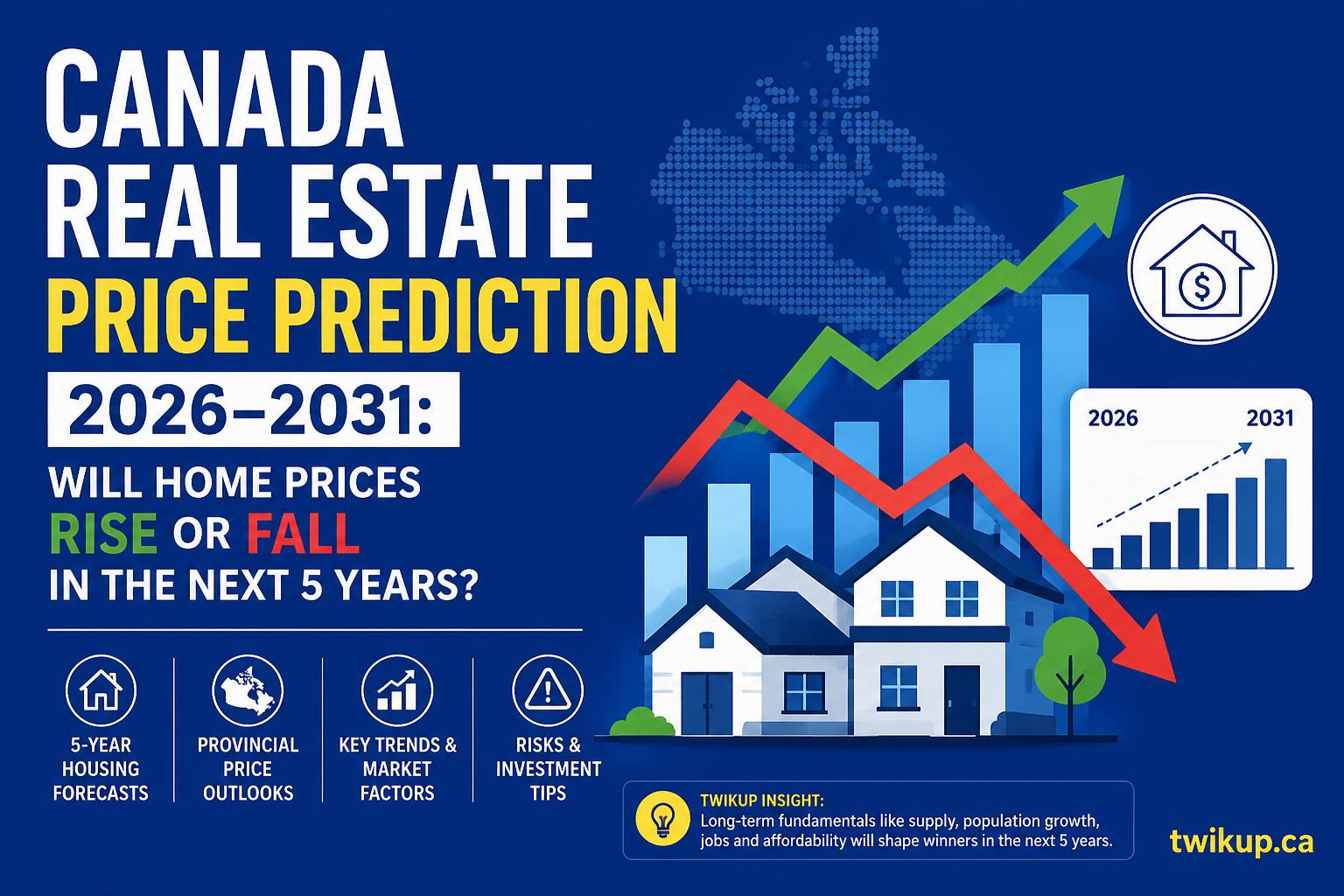
Canada Real Estate Price Prediction 2026–2031: Will Home Prices Rise or Fall in the Next 5 Years?
Canadian real estate remains one of the most debated investment topics in the country.
After years of rapid price growth, higher interest rates and affordability pressure, many buyers are asking the same question:
Will home prices in Canada rise or fall between 2026 and 2031?
The honest answer is: prices may rise over the long term, but not evenly, not everywhere and not without risk.
According to CMHC’s 2026 Housing Market Outlook, national home prices are expected to stabilize and then rise modestly over the forecast period, while Ontario may remain weaker in 2026 before recovering later. CREA also expects the national average home price to remain close to the $700,000 range, with only modest growth into 2027.
Quick Answer: Canada Real Estate Price Prediction 2026–2031
Our base-case outlook:
Canadian home prices are more likely to rise gradually from 2026 to 2031, but the next five years may look very different from the 2020–2022 boom.
Instead of a sharp national surge, Canada may see:
- Slower price growth
- More regional differences
- Stronger performance in affordable, high-migration markets
- Continued weakness in expensive markets if affordability remains stretched
- Better opportunities for patient buyers and long-term investors
Where Canada’s Housing Market Stands in 2026
Canada’s housing market in 2026 is being shaped by three major forces:
- Interest rates are lower than peak levels but still important for affordability.
- Housing supply remains a long-term challenge.
- Buyers are more cautious than during the pandemic boom.
The Bank of Canada’s policy rate was 2.25% as of June 10, 2026, after multiple rate cuts in 2025.
RBC also reported that housing affordability improved for eight consecutive quarters by late 2025, although affordability remained stretched in many markets.
TwikUp Insight
Canada’s housing market is no longer one national story.
From 2026 to 2031, the biggest winners may not simply be Toronto and Vancouver. More affordable markets with job growth, population inflows, rental demand and infrastructure investment may outperform.
The key question is not only “Will prices rise?”
The better question is:Will the local market you are buying in have enough income growth, rental demand and population growth to support today’s price?
Canada Real Estate Forecast 2026–2031: Three Scenarios
1. Base Case: Gradual Price Growth
This is the most realistic scenario.
In this case:
- Interest rates remain relatively stable
- Inflation stays manageable
- Immigration and population growth continue
- Housing supply improves slowly
- Buyers return gradually as confidence improves
Prediction:
Canadian home prices may rise slowly over five years, but growth may be moderate rather than explosive.
This could mean national prices move higher by 2031, but with many pauses, corrections and regional differences along the way.
2. Bull Case: Stronger Price Growth
Home prices could rise faster if:
- Mortgage rates fall more than expected
- Buyer confidence returns quickly
- Immigration remains strong
- Housing supply fails to keep up
- Investors re-enter the market aggressively
Prediction:
In this scenario, high-demand cities and affordable growth markets could see stronger appreciation.
Calgary, Edmonton, Ottawa, Montreal, Halifax and select Ontario secondary markets could attract more attention from buyers priced out of Toronto and Vancouver.
3. Bear Case: Flat or Falling Prices
Prices could remain flat or fall if:
- Canada enters a recession
- Unemployment rises
- Mortgage rates stay high
- Household debt pressure increases
- New housing supply arrives faster than demand
- Investor demand weakens
Prediction:
Expensive markets could remain under pressure, especially where buyers already face major affordability challenges.
Ontario’s expensive urban markets are especially sensitive to affordability and inventory levels.
Will Canadian Home Prices Rise by 2031?
Most likely, yes nationally, but not in a straight line.
The better forecast is:
2026: Stabilization and uneven recovery
2027: Modest price growth in many regions
2028: Stronger demand if affordability improves
2029: Regional markets separate further
2030–2031: Long-term supply and population trends become more important
Province-by-Province Real Estate Outlook
Ontario Real Estate Forecast 2026–2031
Outlook: Mixed to moderate growth
Ontario may remain one of Canada’s most divided markets.
Toronto and the GTA could face affordability pressure, while cities such as London, Windsor, Ottawa, Kingston, Kitchener-Waterloo and smaller communities may see more balanced demand.
CMHC expects Ontario prices to remain weaker in 2026 before recovering later.
British Columbia Real Estate Forecast 2026–2031
Outlook: Moderate growth with affordability pressure
British Columbia remains supply-constrained, especially in Metro Vancouver and desirable lifestyle markets.
However, affordability remains a major barrier.
Prices may rise over the long term, but growth could be slower unless incomes improve or borrowing costs decline meaningfully.
Alberta Real Estate Forecast 2026–2031
Outlook: Strong relative growth
Alberta may remain one of Canada’s most attractive provinces for buyers seeking affordability.
Calgary and Edmonton benefit from:
- Lower home prices than Toronto and Vancouver
- Interprovincial migration
- Employment opportunities
- Investor interest
- Better affordability
If migration continues, Alberta could outperform many expensive Canadian markets.
Quebec Real Estate Forecast 2026–2031
Outlook: Moderate growth
Montreal and surrounding regions may continue seeing steady demand, especially if affordability remains better than Toronto and Vancouver.
Quebec may not see extreme price growth, but long-term fundamentals remain stable.
Atlantic Canada Real Estate Forecast 2026–2031
Outlook: Mixed but positive in select cities
Halifax and other growing Atlantic markets may continue benefiting from migration, affordability and lifestyle demand.
However, after strong growth in recent years, some areas may normalize.
Saskatchewan and Manitoba Forecast 2026–2031
Outlook: Stable growth
Saskatchewan and Manitoba may offer steady, less volatile housing markets.
These provinces could attract buyers looking for affordability, but price growth may depend heavily on local job creation and population growth.
Key Factors That Will Decide Canada’s Housing Market
1. Interest Rates
Interest rates remain one of the biggest drivers of home prices.
Lower rates usually improve affordability and increase buyer demand. Higher rates reduce purchasing power and can slow price growth.
2. Housing Supply
Canada still needs more housing.
If construction does not keep pace with demand, prices may remain supported over the long term.
CMHC has also reported that rental construction has been elevated, with rental units under construction almost twice the 10-year average in 2025.
3. Immigration and Population Growth
Population growth increases demand for both ownership and rental housing.
However, demand alone does not guarantee price growth if affordability remains weak.
4. Employment and Wages
A healthy job market supports housing demand.
If wages rise and unemployment stays low, more buyers can qualify for mortgages.
If unemployment rises, housing demand could weaken.
5. Investor Demand
Real estate investors may return if:
- Mortgage rates decline
- Rents remain strong
- Cash flow improves
- Prices stabilize
But investors should be careful. A property that depends only on price appreciation can become risky if carrying costs rise.
What Buyers Should Do Before Purchasing
Before buying a home in Canada between 2026 and 2031, consider:
- Your job stability
- Monthly mortgage affordability
- Property taxes
- Insurance costs
- Maintenance costs
- Emergency savings
- Mortgage renewal risk
- Local resale demand
Do not buy only because you believe prices will rise.
Buy because the property fits your long-term financial situation.
What Investors Should Watch
Real estate investors should look beyond price predictions.
Important factors include:
- Rental demand
- Vacancy rate
- Cash flow
- Cap rate
- Maintenance costs
- Condo fees
- Local job growth
- Population trends
- Transit and infrastructure
- Future supply nearby
A property with strong rental demand and manageable debt may be safer than a property bought only for appreciation.
Biggest Risks in Canadian Real Estate
Real estate is not risk-free.
Major risks include:
- Home prices may fall
- Interest rates may rise again
- Rental income may not cover expenses
- Tenants may leave
- Repairs may be expensive
- Government rules may change
- Selling a property can take time
- Local markets may underperform
This is why every buyer and investor should run multiple scenarios before purchasing.
Investment Disclaimer
This article is for educational and informational purposes only. It is not financial, investment, legal, mortgage or tax advice.
Real estate investments are subject to risk. Property values can rise, fall or remain flat. Rental income is not guaranteed, and past performance does not guarantee future results.
Before buying, selling or investing in real estate, speak with a qualified financial advisor, mortgage professional, real estate agent, accountant and/or lawyer to understand whether the purchase fits your personal financial situation and risk tolerance.
Final Verdict: Will Canada Home Prices Rise or Fall by 2031?
Canada home prices are likely to rise gradually by 2031 in the base-case scenario, but the next five years may be slower and more selective than past boom cycles.
The strongest markets may be those with:
- Population growth
- Job growth
- Infrastructure investment
- Limited supply
- Strong rental demand
- Better affordability
The weakest markets may be those where prices remain disconnected from local incomes.
For buyers, the goal should not be to perfectly time the market.
The goal should be to buy wisely, stay within budget and understand the risks before making a major financial commitment.
FAQs
Will Canadian home prices crash by 2031?
A national crash is not the base-case outlook, but some local markets could see price declines if affordability remains weak or unemployment rises.
Is 2026 a good time to buy a house in Canada?
It depends on your income, savings, mortgage approval, location and long-term plans. Buyers may have more negotiating power in some markets than during the pandemic boom.
Which Canadian provinces may perform best?
Alberta may show strong relative growth due to affordability and migration. Select markets in Quebec, Atlantic Canada and Ontario secondary cities may also perform well.
Will Toronto home prices rise by 2031?
Toronto may recover over time, but affordability remains a major challenge. Price growth may be slower than in more affordable markets.
Should I invest in Canadian real estate now?
Only after reviewing cash flow, debt risk, rental demand and your personal financial situation with qualified professionals.
Sources and Helpful References
-
Canada Mortgage and Housing Corporation (CMHC) – Housing Market Outlook (2026)
https://www.cmhc-schl.gc.ca/professionals/housing-markets-data-and-research/market-reports/housing-market/housing-market-outlook -
Canadian Real Estate Association (CREA) – Quarterly Housing Market Forecasts
https://www.crea.ca/housing-market-stats/canadian-housing-market-stats/quarterly-forecasts/ -
Bank of Canada – Policy Interest Rate
https://www.bankofcanada.ca/core-functions/monetary-policy/key-interest-rate/ -
Bank of Canada – Real Estate Market Indicators
https://www.bankofcanada.ca/rates/indicators/capacity-and-inflation-pressures/real-estate-market-definitions/ -
RBC Economics – Canadian Housing Research & Forecasts
https://www.rbc.com/en/economics/canadian-analysis/canadian-housing/ -
Statistics Canada – Housing, Population and Dwelling Statistics
https://www.statcan.gc.ca/en/subjects-start/housing -
Statistics Canada – Population Estimates
https://www.statcan.gc.ca/en/subjects-start/population_and_demography -
Office of the Superintendent of Financial Institutions (OSFI) – Residential Mortgage Guidance & Risk
https://www.osfi-bsif.gc.ca/ -
CMHC – Housing Supply Report
https://www.cmhc-schl.gc.ca/professionals/housing-markets-data-and-research/market-reports/housing-market/housing-supply-report -
Government of Canada – Housing Plan
https://housing-infrastructure.canada.ca/ -
TD Economics – Canadian Housing Outlook
https://economics.td.com/ca-provincial-housing-outlook -
BMO Economics – Housing Market Reports
https://economics.bmo.com/
Disclaimer: The forecasts and analysis presented in this article are based on publicly available data, historical trends and market outlooks from reputable organizations. They represent informed opinions rather than guarantees of future performance. Real estate markets are influenced by interest rates, economic conditions, government policies, population growth and unforeseen global events. Always conduct your own research and consult a qualified financial advisor, mortgage professional or real estate expert before making any investment or home-buying decision.