
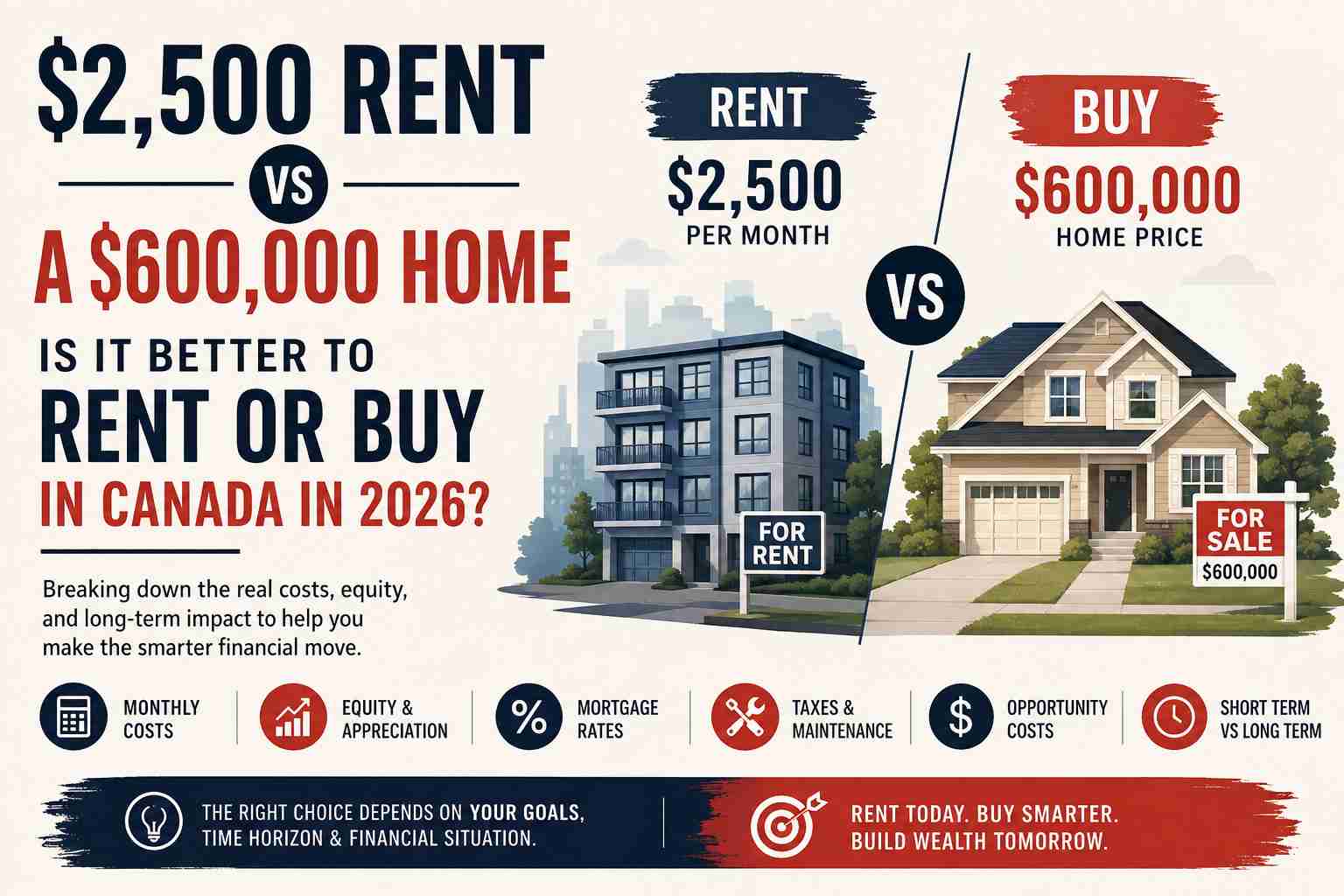
Imagine two households living on the same street.
One rents a comparable home for $2,500 a month.
The other is considering buying a similar property listed for $600,000.
At first glance, buying seems like the obvious long-term winner. The renter sends $2,500 to a landlord every month, while the homeowner gradually builds equity in an asset.
Then the buyer opens a mortgage calculator.
The minimum down payment is $35,000. Mortgage default insurance may need to be added to the loan. The monthly mortgage payment can climb well above the rent. Then come property taxes, insurance, repairs, maintenance and closing costs.
Suddenly, the question becomes much more interesting:
If you can rent for $2,500, does buying a $600,000 home in Canada actually make financial sense in 2026?
The answer is not automatically yes.
Under a realistic illustrative scenario, renting can require substantially less cash every month. Buying can still create more wealth over time—but the outcome depends heavily on how long you stay, what happens to the home's value, your mortgage rate, your down payment and, crucially, what the renter does with the money saved.
Quick Answer
If you can rent a comparable home for $2,500 per month while buying it would cost roughly $600,000, renting can be the financially stronger short-term option—particularly for a buyer using the minimum down payment.
A $600,000 purchase with the minimum required $35,000 down payment would leave a $565,000 base mortgage and would generally require mortgage default insurance.
Using an illustrative 4.5% mortgage rate and 25-year amortization, and assuming a 4% CMHC insurance premium is added to the mortgage, the insured loan would be approximately $587,600.
That produces a monthly mortgage payment of roughly $3,266 in this illustration.
And that is before property taxes, home insurance, maintenance and repairs.
Buying becomes more compelling when you expect to remain in the property for many years, have a larger down payment, retain strong emergency savings and can comfortably absorb the full cost of ownership.
So the real question is not:
“Is renting throwing money away?”
It is:
“What will each choice do to my net worth five, 10 or 15 years from now?”
Rent may make more sense when:
- you have only a small down payment
- you may move within several years
- comparable rent is significantly cheaper than ownership
- buying would stretch your monthly budget
- you can consistently invest some of the money you save
Buying may make more sense when:
- you plan to stay for many years
- you have a strong down payment
- your income is stable
- you still have emergency savings after closing
- the full ownership cost remains comfortable
- you value stability, control and long-term equity building
That distinction matters because the same $600,000 home can be a very different financial decision for two different households.
The $600,000 Home Changes the Calculation Immediately
Start with the purchase price:
Home price: $600,000
Canada's minimum down-payment rules require:
- 5% on the first $500,000
- 10% on the portion between $500,000 and $1.5 million
For a $600,000 property:
5% × $500,000 = $25,000
plus:
10% × $100,000 = $10,000
That produces a minimum down payment of:
$35,000
The buyer therefore needs to borrow:
$600,000 − $35,000 = $565,000
Because the buyer has put down less than 20%, mortgage loan insurance would generally be required.
At this loan-to-value ratio, CMHC's homeowner premium schedule lists a 4% premium.
For illustration:
$565,000 × 4% = $22,600
If that premium is added to the mortgage rather than paid upfront, the mortgage balance becomes approximately:
$587,600
That creates an important reality for first-time buyers:
You can buy a $600,000 house, put $35,000 down and begin with a mortgage approaching $588,000.
That does not make buying a bad decision.
It means the comparison with $2,500 rent must include the real financing structure rather than simply comparing the home's purchase price with monthly rent.
Now Compare the Monthly Numbers
Suppose the renter pays:
Renting
Monthly rent: $2,500
Annual rent:
$30,000
Now consider the buyer.
For comparison purposes, assume:
- Purchase price: $600,000
- Down payment: $35,000
- Base mortgage: $565,000
- Illustrative mortgage-insurance premium: $22,600
- Total insured mortgage: $587,600
- Illustrative mortgage rate: 4.5%
- Amortization: 25 years
The resulting mortgage payment would be approximately:
$3,266 per month
The mortgage alone is already roughly:
$766 more per month than the rent.
But comparing only mortgage versus rent still understates the true difference.
The Homeowner's Real Monthly Cash Requirement Is Higher
Suppose our buyer is named Maya.
She has been renting for $2,500 and decides to purchase the $600,000 home.
Her first mortgage payment arrives: approximately $3,266.
She expected that.
Then the property-tax bill arrives.
Then home insurance.
Several months later, the dishwasher fails.
The following spring, part of the fence needs repair.
Eventually, the roof, furnace, windows or appliances may need attention.
None of those costs appears in the advertised mortgage payment.
For an illustrative comparison, suppose Maya's property carries:
- $400/month equivalent in property taxes
- $125/month in home insurance
- $500/month average maintenance and repair allowance
These are assumptions, not universal Canadian costs. Property taxes, insurance premiums and maintenance expenses vary significantly by municipality, property type, age, condition and household.
Under this example:
Mortgage: $3,266
Property tax: $400
Home insurance: $125
Maintenance reserve: $500
Approximate monthly cash requirement: $4,291
Compare that with:
Rent: $2,500
Difference:
$1,791 per month
That is more than $21,000 per year of additional cash flow.
At this point, renting looks dramatically cheaper.
But this is where simplistic rent-versus-buy comparisons often fail.
The homeowner's entire $4,291 is not money that disappears.
Part of the mortgage payment builds equity.
Your Mortgage Payment Is Part Cost and Part Wealth Building
A mortgage payment has two major components:
Interest
Interest is the cost of borrowing money.
It does not become home equity.
Principal
Principal repayment reduces the amount you owe.
That increases your equity in the property.
Using the illustrative $587,600 mortgage at 4.5% over 25 years, the remaining balance after approximately five years would be around:
$516,000
That means roughly:
$71,000 of mortgage principal
would have been repaid during those five years.
So comparing the entire $3,266 mortgage payment directly with $2,500 rent is misleading.
Part of Maya's mortgage payment is a financing cost.
But another part is effectively moving money from her monthly cash flow into home equity.
The Renter Has a Wealth-Building Tool Too: Invest the Difference
Now meet Daniel.
Daniel decides not to buy.
He continues renting for $2,500.
The important question is what happens next.
If Daniel says:
“Renting saves me nearly $1,800 a month.”
but then spends the entire difference on cars, restaurants, travel and subscriptions, his theoretical financial advantage disappears.
But suppose he does something different.
He invests the money.
That changes the entire comparison.
A disciplined renter can build substantial assets outside real estate.
That means the true contest is not:
Rent versus mortgage.
It is closer to:
Homeowner
Home equity from principal repayment
- property appreciation
− mortgage interest
− property taxes
− insurance
− maintenance
− transaction costs
− opportunity cost of invested capital
versus:
Renter
Investment portfolio
- investment growth
- flexibility
− rent
− future rent increases
That is the financial comparison Canadians should actually be making.
The Five-Year Test: What Could Each Household Actually Own?
This is where the comparison becomes much more useful.
Take the same two households and move them five years into the future.
These figures are illustrative scenarios, not forecasts.
Assume:
- $600,000 home
- $35,000 buyer down payment
- approximately $587,600 insured mortgage
- 4.5% mortgage rate
- 25-year amortization
- approximately $4,291 monthly ownership cash requirement
- $2,500 monthly rent
- renter invests the $1,791 monthly difference
- renter also keeps the equivalent $35,000 initial capital invested
- investments earn an illustrative 5% annually
- home appreciates an illustrative 3% annually
- selling costs, closing costs, taxes on investments and rent increases are excluded from this simplified comparison
After Five Years: The Renter
Daniel begins with $35,000 invested instead of using it as a down payment.
If that money grew at an illustrative 5% annual return, while Daniel also invested approximately $1,791 every month, his portfolio could grow to roughly:
$167,000
Again, 5% is only an assumption. Actual investment returns could be substantially higher, lower or negative.
After Five Years: The Buyer
If Maya's $600,000 home appreciated by an average of 3% per year, its value after five years would be approximately:
$696,000
Her mortgage balance could meanwhile decline to approximately:
$516,000
Her gross home equity would therefore be around:
$180,000
At first glance:
Buyer: ~$180,000 gross home equity
versus
Renter: ~$167,000 investment portfolio
That looks surprisingly close.
And it demonstrates why neither side should declare victory too quickly.
The homeowner could face selling commissions and other transaction costs if the property were sold.
The renter's actual investment return could differ significantly from 5%.
Rent could rise over those five years.
Property taxes, insurance and maintenance could also increase.
Home prices could appreciate by more—or less—than 3%.
This is not a prediction of which strategy wins.
It is proof of something more important:
Small changes in assumptions can completely change the winner.
A rent-vs-buy calculator for Canada can help model these scenarios, but its answer is only as useful as the assumptions entered for mortgage rates, home appreciation, maintenance, rent increases and investment returns.
What If You Have a 20% Down Payment?
Now change only one variable.
Instead of putting $35,000 down, suppose Maya has:
$120,000
That is 20% of the $600,000 purchase price.
Her mortgage becomes:
$480,000
Mortgage default insurance would generally no longer be required.
Using the same illustrative 4.5% mortgage rate and 25-year amortization, the mortgage payment falls to approximately:
$2,668 per month
Now the mortgage itself is only around:
$168 per month more than $2,500 rent.
Property taxes, insurance and maintenance still make ownership more expensive on a monthly cash-flow basis.
But the gap has narrowed dramatically.
That demonstrates why blanket statements such as “renting is better” or “buying is always better” are so weak.
Your starting capital can completely change the answer.
A $600,000 property purchased with $35,000 down is fundamentally different from the same property purchased with $120,000 down.
But a Bigger Down Payment Has an Opportunity Cost
Suppose you have $120,000 available.
If you buy the home, that money becomes home equity.
If you continue renting, the same $120,000 could potentially remain invested.
That does not mean investing will outperform Canadian real estate.
It might.
It might not.
Investment returns are uncertain.
Home-price growth is uncertain too.
The point is simply that capital has alternative uses.
A down payment is not a traditional expense because you receive equity in return.
But it is capital that becomes concentrated in one property and may no longer be as liquid or available for other investments.
The larger the down payment, the more important that opportunity-cost discussion becomes.
What Happens If Home Prices Rise, Stay Flat or Fall?
Homeownership becomes especially interesting because a relatively small down payment controls a much larger asset.
That is leverage.
It can work extremely well when prices rise.
It can also magnify risk when prices fall.
Scenario 1: The Home Appreciates 3% Annually
Suppose the $600,000 property appreciates by an average of 3% per year.
Again, this is hypothetical.
After five years, its value would be approximately:
$696,000
After 10 years:
$806,000
Combined with mortgage principal repayment, that could create substantial home equity.
Scenario 2: The Home Stays at $600,000
Suppose five years pass and the property is still worth:
$600,000
Maya has not gained anything from appreciation.
But she has still reduced her mortgage balance.
She therefore still builds equity through principal repayment.
Her overall financial return, however, becomes less impressive after accounting for:
- mortgage interest
- property taxes
- insurance
- maintenance
- buying costs
- eventual selling costs
Scenario 3: The Home Falls to $550,000
Now imagine the property declines from $600,000 to:
$550,000
The mortgage balance does not decline simply because the market value of the property has fallen.
A homeowner expecting to remain for another decade might treat that decline as temporary market noise.
Someone forced to sell because of a relocation, job loss, divorce or other life event could face a much more serious problem.
That is why buying should never be based solely on the belief that:
“Canadian real estate always goes up.”
Time horizon matters because leverage works in both directions.
Canada's 2026 Interest-Rate Environment Matters
The Bank of Canada maintained its policy interest rate at 2.25% on July 15, 2026.
That is well below the restrictive-rate environment Canadians experienced earlier in the decade.
But there is an important distinction:
The Bank of Canada policy rate is not your mortgage rate.
Fixed mortgage rates are influenced by broader financial-market conditions, including bond yields.
Variable mortgage rates are more directly affected by changes in lenders' prime rates and monetary policy.
That is why the 4.5% mortgage rate used throughout this article is deliberately an illustrative assumption.
It is not a claim that every Canadian borrower can obtain 4.5%.
Before deciding whether $2,500 rent beats a $600,000 purchase, buyers should repeat the calculation using the mortgage rate they can actually obtain.
Even a relatively small rate change can materially alter the monthly payment and long-term interest cost.
The $2,500 Question Is Really a Price-to-Rent Question
There is another useful way to look at the example.
Annual rent:
$2,500 × 12 = $30,000
Home price:
$600,000
Now divide the purchase price by annual rent:
$600,000 ÷ $30,000 = 20
The home costs approximately:
20 times one year's rent
That ratio does not tell you automatically whether to buy.
But it helps explain the trade-off.
When equivalent homes are extremely expensive relative to rent, renting can become financially attractive because households are obtaining similar housing without committing as much capital.
When rents are very high relative to purchase prices, buying may become comparatively more attractive.
The key word is:
Equivalent.
Comparing $2,500 rent for a one-bedroom apartment with a $600,000 detached home provides almost no useful information.
The rental and purchase options must provide reasonably similar housing.
Toronto Condo Buyers Face an Extra Layer
Condos introduce another major monthly expense:
Maintenance fees.
A buyer may find a Toronto condo whose mortgage appears manageable only to discover another $600, $800 or even $1,000+ monthly obligation associated with the unit.
Some of those fees pay for services that owners of detached homes would otherwise fund separately, so condo fees should not automatically be labelled wasted money.
But they absolutely affect affordability and the rent-versus-buy calculation.
For readers evaluating Toronto specifically, TwikUp's Toronto Condo Prices Are Down — Is 2026 Finally a Good Time to Buy a Condo? examines the current condo decision in greater detail.
The Five-Year Question Every Buyer Should Ask
Before purchasing the $600,000 property, ask yourself:
Could I realistically still live here five years from now?
If the answer is:
“Probably not.”
renting deserves serious consideration.
Buying and selling real estate involves friction.
Depending on the property and location, buyers and sellers may encounter:
- legal fees
- inspections
- land-transfer taxes
- moving costs
- mortgage-related costs
- selling commissions and other disposition expenses
The longer you own a home, the more time you have to spread those costs across years of ownership and build equity through mortgage repayment.
If your career, city, family size, relationship or other circumstances could change considerably, flexibility itself has financial value.
The 10-Year Calculation Looks Different
Now suppose you confidently expect to remain in the same community for 10 or 15 years.
The equation begins to shift.
A longer ownership period gives you more time to:
- repay mortgage principal
- recover from short-term housing-market declines
- benefit if the property appreciates
- spread transaction costs across many years
- gradually reduce leverage
Meanwhile, a renter continues paying for housing and may face future rent increases.
That does not guarantee buying wins.
But a long holding period reduces one of the biggest risks associated with homeownership:
Being forced to sell at the wrong time.
Renting Is Not Automatically “Throwing Money Away”
One phrase has probably influenced generations of would-be buyers:
“Rent is just paying someone else's mortgage.”
It sounds powerful.
It is also incomplete.
Homeowners pay plenty of money that never becomes equity.
Mortgage interest does not become equity.
Property tax does not become equity.
Home insurance does not become equity.
A broken furnace does not necessarily increase the home's value dollar-for-dollar.
Legal fees do not become equity.
Selling costs do not become equity.
And renters are not receiving nothing in return for their monthly payment.
They are receiving:
Housing.
The correct question is therefore not whether rent disappears.
It is whether the total cost of obtaining housing by renting creates a better or worse long-term financial outcome than the total cost of housing through ownership.
Buying Does Have One Powerful Behavioural Advantage
There is a reason homeownership has helped many households accumulate wealth.
A mortgage creates forced consistency.
Every month, the homeowner must make the payment.
Part of that payment reduces debt.
The renter does not automatically receive the same forced-saving mechanism.
Daniel may calculate that renting saves him $1,500 or more each month.
But if he spends every dollar, the mathematical advantage disappears.
Years later, Maya may own a valuable property with a significantly smaller mortgage.
Daniel may have little to show for his lower housing costs.
That is why the strongest version of the renting strategy is:
Rent + invest the difference.
Not:
Rent + spend the difference.
First-Time Buyers Have Another Tool: The FHSA
Eligible Canadians preparing for their first home purchase can also consider the First Home Savings Account, or FHSA.
The FHSA can be particularly useful because qualifying contributions can generally provide an income-tax deduction, while qualifying withdrawals used toward a first home can be tax-free.
That means delaying a purchase does not necessarily mean doing nothing.
A prospective buyer may use additional time to:
- increase the down payment
- contribute to an FHSA
- strengthen emergency savings
- reduce higher-cost debt
- improve mortgage qualification
- avoid rushing into the wrong property
For some households, the best rent-versus-buy strategy may be:
Rent now so you can buy better later.
But Waiting Until 2027 Has Risks Too
There is no guarantee today's $600,000 property will still cost $600,000 next year.
Home prices could rise.
They could fall.
Mortgage rates could change.
Your income could increase.
Your rent could increase.
The perfect buying opportunity is therefore not necessarily the moment when Canada reaches an absolute housing-market bottom.
Nobody consistently knows that point in advance.
A more useful framework is determining when three things align:
The right property. The right financing. The right personal finances.
If your biggest question is whether delaying the purchase itself makes sense, read TwikUp's Should You Buy a Home Now or Wait Until 2027? Canada Housing Market Outlook for Buyers.
Location Can Completely Reverse the Answer
A $600,000 budget does not buy the same property everywhere in Canada.
The rent-versus-buy equation can therefore look completely different in:
Toronto.
Vancouver.
Calgary.
Edmonton.
Ottawa.
Montréal.
Or smaller Canadian communities.
In one market, $600,000 may buy a condo.
In another, the same budget may purchase substantially more space.
Local housing supply, population changes, employment, construction activity and affordability can also influence long-term market performance.
Readers comparing where a $600,000 budget could have different long-term implications can explore TwikUp's Canada Housing Market by City 2026–2031: Price Predictions for Toronto, Vancouver, Calgary, Ottawa, Montreal and More.
Who Should Lean Toward Renting the $2,500 Home?
Renting may be particularly compelling when:
- a comparable property costs around $600,000
- you only have the minimum down payment
- ownership would significantly stretch your monthly budget
- you may move within several years
- you have substantial other debt
- your emergency savings are limited
- the property could require significant maintenance
- you can consistently invest part of the monthly savings
- flexibility has meaningful value for your career or family
In those circumstances, renting is not necessarily delaying adulthood or missing the housing market.
It may be a deliberate capital-allocation decision.
Who Should Seriously Consider Buying the $600,000 Home?
Buying may become more compelling when:
- you expect to remain for many years
- you have a strong down payment
- your income is stable
- you retain emergency savings after closing
- the mortgage remains comfortable even if expenses rise
- you value control and housing stability
- you want protection from having to find another rental
- you are prepared for repairs and maintenance
- you understand the property's local market
- you value the forced-saving effect of principal repayment
Most importantly:
Buying should not leave you house-rich and cash-poor.
Owning a $600,000 property becomes considerably less appealing when every unexpected $2,000 repair becomes a financial emergency.
TwikUp Insight: The Winner Isn't Determined by the Monthly Payment
The $2,500-versus-$600,000 example reveals something deeper than whether renting or buying wins.
The two households are purchasing different financial products.
The renter is purchasing:
Housing + flexibility.
The homeowner is purchasing:
Housing + a leveraged asset.
That leveraged asset can build substantial wealth when the homeowner stays long enough, reduces the mortgage and benefits from rising property values.
But it also requires more upfront capital, greater monthly cash flow and exposure to housing-market risk.
In our minimum-down-payment scenario, the renter's $2,500 payment sits far below the homeowner's illustrative $4,291 monthly cash requirement.
That makes renting difficult to dismiss.
Yet our five-year illustration shows why homeownership cannot be dismissed either.
With 3% annual home appreciation, Maya could theoretically reach around $180,000 in gross home equity after five years.
If Daniel invested the equivalent $35,000 upfront plus the roughly $1,791 monthly difference at an illustrative 5% return, he could reach approximately $167,000 in investments.
Change the home-appreciation assumption.
Change the investment return.
Change the mortgage rate.
Change the rent.
Change the maintenance bill.
And the winner can change.
That is the central lesson.
The rent-versus-buy debate is not really about rent versus mortgage payments.
It is about what each strategy does to your balance sheet over time.
A homeowner builds wealth primarily through equity.
A disciplined renter can build wealth through financial assets.
Both strategies can succeed.
Both strategies can fail when stretched too far.
So instead of asking:
“Should I rent or buy?”
ask:
“If I choose either option, what will my balance sheet look like 10 years from now?”
That is the calculation that matters.
Key Takeaways
- A $600,000 home requires a minimum $35,000 down payment under current federal minimum-down-payment rules.
- With less than 20% down, mortgage loan insurance would generally be required.
- A $565,000 base mortgage with an illustrative 4% CMHC premium added to the loan would result in approximately $587,600 of insured borrowing.
- At an illustrative 4.5% mortgage rate over 25 years, the mortgage payment would be roughly $3,266 per month.
- That mortgage payment alone is approximately $766 above $2,500 rent.
- Illustrative property taxes, insurance and maintenance could push the homeowner's monthly cash requirement above $4,000.
- Mortgage principal repayment builds equity, so the entire mortgage payment should not be treated as an expense.
- A 20% down payment substantially improves monthly ownership economics but also ties up more capital.
- Renting can be financially powerful when comparable rent is inexpensive relative to the purchase price and the renter invests the difference.
- Buying becomes increasingly attractive when the owner has a long time horizon, stable finances and a property that performs well.
- A five-year comparison can produce surprisingly close outcomes depending on assumptions for home appreciation and investment returns.
- Neither renting nor buying guarantees greater wealth.
- The strongest comparison is future net worth versus future net worth, not rent versus mortgage payment.
Important Note
The mortgage calculations, property-tax assumptions, insurance estimates, maintenance allowance, investment returns and home-appreciation scenarios in this article are illustrative examples designed to show how a rent-versus-buy calculation works.
The five-year renter-versus-buyer comparison is not a forecast and deliberately simplifies several variables. Actual mortgage rates, qualification requirements, closing costs, selling costs, property taxes, insurance, maintenance expenses, investment returns, rent increases and home-price changes vary.
Readers should calculate their own costs using current quotes and consider qualified financial, mortgage, tax or legal advice where appropriate.
Sources
Financial Consumer Agency of Canada — How much you need for a down payment
https://www.canada.ca/en/financial-consumer-agency/services/mortgages/down-payment.html
Canada Mortgage and Housing Corporation — Mortgage Loan Insurance Premium Information
https://www.cmhc-schl.gc.ca/professionals/project-funding-and-mortgage-financing/mortgage-loan-insurance/mortgage-loan-insurance-homeownership-programs/premium-information-for-homeowner-and-small-rental-loans
Bank of Canada — July 15, 2026 interest-rate decision
https://www.bankofcanada.ca/2026/07/fad-press-release-2026-07-15/
Bank of Canada — Policy interest rate
https://www.bankofcanada.ca/core-functions/monetary-policy/key-interest-rate/
Canada Revenue Agency — First Home Savings Account: Opening an FHSA
https://www.canada.ca/en/revenue-agency/services/tax/individuals/topics/first-home-savings-account/opening-your-fhsas.html
Bank of Canada — Market Participants Survey, Second Quarter 2026
https://www.bankofcanada.ca/2026/07/market-participants-survey-second-quarter-of-2026/