
For years, the Toronto condo conversation was dominated by one fear: if you wait, prices will run away from you.
In 2026, the fear has almost reversed.
A buyer opens a listing app on Sunday night. A downtown condo that might once have triggered a bidding-war mentality has been sitting for weeks. Another unit in the same building has reduced its asking price. A third looks cheaper—but carries a higher monthly maintenance fee.
The buyer starts wondering:
“If Toronto condo prices have already fallen this much, should I buy now—or wait for them to fall even further?”
That may be one of the most important questions in Toronto real estate in 2026.
Prices remain substantially below year-ago levels in the condo segment, borrowing costs have declined from their previous highs, and buyers have more negotiating leverage than they had during Toronto's frenzy years.
But that does not automatically make every condo a bargain.
The better question is whether today's combination of lower prices, financing costs, inventory, condo fees and negotiating power makes sense for your finances and the specific building you're considering.
Quick Answer
2026 may be one of the more favourable Toronto condo buying environments in recent years for financially prepared buyers who expect to own for several years—but it is not necessarily the market bottom.
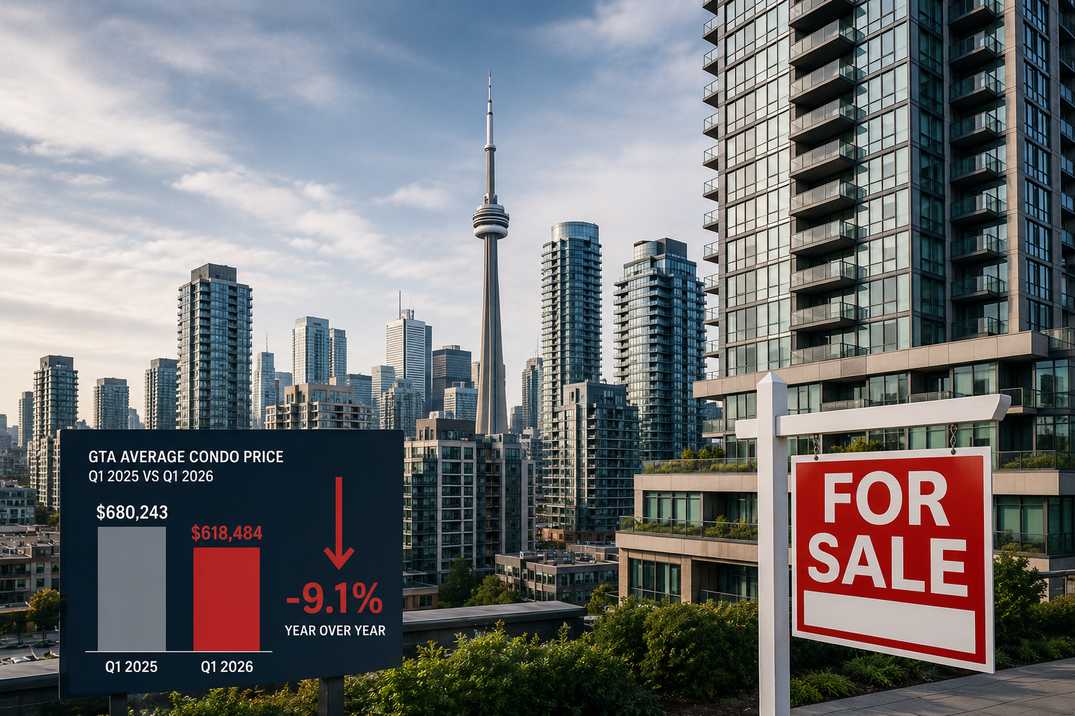
Toronto Regional Real Estate Board data show how dramatically conditions have changed. In the City of Toronto, the average condo apartment sold for $649,330 in Q1 2026, down from $711,258 in Q1 2025. Across the GTA, the average fell 9.1% year over year to $618,484.
By June, the GTA condo apartment average stood at $630,688, while the City of Toronto average was $665,760.
At the same time, the Bank of Canada's policy rate stood at 2.25% as of July 15, 2026, substantially below its earlier-cycle highs. That combination has improved the buying equation.
But improved affordability is not the same thing as cheap housing.
Key Takeaways
- Toronto condo prices remain significantly below year-ago levels.
- Buyers have considerably more choice than during Toronto's pandemic-era housing boom.
- Lower prices and lower borrowing costs have improved affordability, but condo fees, property taxes and closing costs still matter.
- The market may be beginning to stabilize, meaning waiting for the absolute bottom carries its own risk.
- A discounted condo in a financially weak building can be a worse purchase than a more expensive unit in a healthy building.
- Buyers planning to stay for several years are in a fundamentally different position from investors hoping for a quick rebound.
- Instead of asking whether Toronto condos are a good buy, buyers should ask whether a specific unit, building and price make sense.
Toronto's condo market has undergone a real reset
The numbers tell a very different story from the Toronto condo market buyers became accustomed to.
TRREB reported 3,361 GTA condo apartment sales in Q1 2026, down 11.3% from the same quarter of 2025.
Meanwhile, 6,688 condo apartments remained actively listed at the end of the quarter.
The result was exactly what buyers would expect when supply is plentiful relative to demand: more choice and more negotiating power.
Prices responded.
The GTA average condo apartment selling price declined from $680,243 in Q1 2025 to $618,484 in Q1 2026.
Inside Toronto itself, the decline was from $711,258 to $649,330.
That's roughly $62,000 less on the average GTA condo transaction than one year earlier.
For someone who spent 2021 or 2022 watching listings disappear almost immediately, today's market can feel unfamiliar.
And that's precisely why 2026 deserves attention.
Imagine two buyers looking at the same $650,000 condo
This is where the story gets more interesting.
Imagine Maya and Daniel are both considering the same Toronto condo listed at $650,000.
Maya remembers watching Toronto prices climb years earlier. She sees today's lower price and thinks:
“This must be the opportunity.”
Daniel sees exactly the same listing but asks different questions.
How long has it been listed?
What did comparable units actually sell for?
How much are the monthly condo fees?
Is parking included?
What does the reserve fund look like?
Are major repairs approaching?
Has the corporation imposed a special assessment?
Could he comfortably make the payments if his expenses increased?
The listing price is identical.
The investment decision isn't.
That distinction matters enormously in the 2026 market.
The opportunity isn't simply that prices fell
Falling prices alone don't create a good buying opportunity.
A market becomes more attractive when several things begin working in the buyer's favour simultaneously.
Toronto currently has at least three of them.
1. Prices are lower
The most obvious advantage is the reset in condo values.
A buyer entering at a lower purchase price needs a smaller mortgage than someone buying the identical property at a higher valuation, assuming the same down-payment percentage.
2. Borrowing conditions have improved
The Bank of Canada's overnight rate was 2.25% on July 15, 2026. Its next scheduled rate announcement is September 2.
That doesn't mean every mortgage rate is 2.25%—it isn't. Variable and fixed mortgage rates are priced differently, and fixed rates are influenced heavily by bond markets and lender funding costs.
But the broader financing environment has improved considerably from the most restrictive part of the previous rate cycle.
3. Buyers can negotiate again
Perhaps the least appreciated advantage is time.
During a frenzy, buyers can be forced to decide quickly.
In a softer market, buyers may have more opportunity to compare similar units, inspect buildings, review documents and negotiate.
That has value even if it doesn't appear in a mortgage calculator.
But something changed as spring turned into summer
There is a reason buyers shouldn't automatically assume that waiting another year guarantees a cheaper condo.
The broader GTA housing market began showing signs of tightening during the spring.
TRREB reported 6,770 GTA home sales in June 2026, up 9.4% from June 2025, while new listings fell 12.9% year over year.
The average selling price was still 3.9% below a year earlier and the MLS Home Price Index Composite benchmark remained 5.4% lower, but both edged higher from May on a seasonally adjusted basis.
Condos remained much weaker on price than several other housing categories: GTA condo apartments averaged $630,688 in June, down roughly 9% from a year earlier. This creates an unusual setup.
Prices are still depressed, but activity is showing signs of improvement.
That doesn't prove the bottom has arrived.
It does mean the buyer who waits for an obvious recovery may discover that the best negotiating environment disappeared before the headlines declared the market healthy again.
The perfect bottom is usually visible only afterward
Suppose a $650,000 condo falls another 5%.
The buyer who waited saves $32,500 on the purchase price.
That sounds like an obvious victory.
But suppose during that waiting period mortgage rates move higher, the best inventory gets absorbed, rents continue to be paid and sellers become less willing to negotiate.
The buyer could have correctly predicted that prices would decline and still failed to materially improve their financial position.
The reverse is also possible.
Someone could buy today and watch comparable units become cheaper six months later.
That's why trying to identify the exact bottom is so difficult.
The best buying window and the absolute lowest price are not necessarily the same thing.
A $650,000 Toronto condo: what does the down payment look like?
Canada's minimum down-payment rules help put today's prices into perspective.
For homes priced between $500,000 and $1.5 million, the minimum down payment is 5% of the first $500,000 and 10% of the portion above $500,000. Buyers putting down less than 20% will typically require mortgage default insurance.
For an illustrative $650,000 condo, that means:
- 5% of the first $500,000 = $25,000
- 10% of the remaining $150,000 = $15,000
- Minimum down payment = $40,000
But qualifying for the minimum down payment doesn't mean that's the amount a household should put down.
Buyers also need to account for closing costs, land-transfer taxes, moving expenses and an emergency reserve after closing.
The goal shouldn't be to become a homeowner with $14 left in the bank.
The condo fee can change the entire calculation
Consider two condos.
Condo A
Purchase price: $620,000 Monthly condo fee: $950
Condo B
Purchase price: $650,000 Monthly condo fee: $550
Condo A looks $30,000 cheaper when scrolling through listings.
But the additional $400 per month in condo fees equals $4,800 per year.
Over five years, that's $24,000 before considering future increases.
Of course, fees can't be compared blindly either. One building may include utilities or amenities another does not.
The point is simpler:
The purchase price is only the admission ticket.
Condo ownership continues every month afterward.
The Condominium Authority of Ontario explains that common expenses fund building operations, maintenance and reserve-fund contributions, and the amount owners pay can change over time. ([Condo Authority Ontario][6])
The most important document may not be the listing
Before buying a resale condo, the glamorous part is touring the unit.
The financially important part may happen afterward.
Get the status certificate reviewed.
According to the Condominium Authority of Ontario, a status certificate can contain the corporation's budget and audited financial statements, information about its reserve fund, common expenses, potential fee increases, special assessments, insurance and litigation.
Anyone can request one, and the corporation can charge up to $100, including applicable taxes, to provide it within 10 days.
Why does that matter?
Return to Maya's seemingly discounted condo.
Imagine she negotiates $20,000 off the asking price.
It feels like a win.
Then she discovers the building faces major repairs and the financial position of the condo corporation is weaker than she expected.
That $20,000 victory can suddenly look much less impressive.
A cheap unit inside an expensive problem isn't necessarily cheap.
Look beyond the reserve-fund balance
A large reserve-fund number alone doesn't tell you whether a building is financially healthy.
Ontario condo corporations use reserve funds for major repairs and replacements of common elements and assets. They must conduct periodic reserve-fund studies assessing future repair requirements and funding needs.
The useful question isn't simply:
“How much money is in the reserve fund?”
It's:
“Is the reserve fund adequate for the work this building is expected to need?”
Elevators, windows, roofs, parking structures and other major components eventually require repair or replacement.
A buyer purchasing a 15-year-old building should therefore think differently from someone buying into a newer property.
The unit may belong to you.
The building's problems belong to the owners collectively.
Investors face a different calculation
The 2026 opportunity looks less straightforward for investors than for long-term owner-occupiers.
TRREB reported that the GTA condo rental market remained well supplied in Q1 2026.
Average one-bedroom condo rents fell 4.1% year over year to $2,246, while two-bedroom rents declined 3.2% to $2,939. Rental listings increased 6% from the previous year.
That matters because an investor isn't simply asking:
“Will this condo eventually appreciate?”
They also need to ask:
“What happens every month until it does?”
Mortgage payments, maintenance fees, property taxes, insurance, repairs and vacancies can turn an apparently discounted investment into persistent negative cash flow.
Buying because a condo is 10% cheaper than last year is not an investment thesis by itself.
Owner-occupiers have one advantage investors don't
Now imagine Daniel isn't trying to flip the condo.
He wants to live there.
He likes the neighbourhood. His commute improves. The unit has enough space for his expected needs. His employment is stable, and he plans to stay for seven years.
If prices decline another 5% next year, it matters—but it doesn't necessarily destroy the reason he purchased.
He still has somewhere to live.
That's why the same Toronto condo can be a sensible purchase for one person and a poor purchase for another.
Time horizon changes the equation.
Someone who might need to sell in 18 months has far greater exposure to short-term price movements and transaction costs than someone prepared to own through an entire housing cycle.
Which Toronto condo buyers may have the strongest case for buying in 2026?
The current market arguably becomes more compelling when several conditions are present:
You plan to stay for several years. A longer ownership horizon provides more time to absorb normal market volatility and transaction costs.
Your monthly payment is comfortable rather than merely technically affordable. Homeownership shouldn't require perfect finances every month.
You retain emergency savings after closing. Using every available dollar for the down payment creates a different kind of financial risk.
You're buying a building, not just a kitchen. The reserve fund, maintenance history, insurance, condo fees and legal issues matter.
The unit works even without rapid appreciation. If the purchase only makes sense if Toronto condo prices jump 10% next year, you're speculating on the market.
You've compared multiple units. One of the biggest advantages buyers have in a softer market is the ability to walk away.
Use it.
Who may be better off waiting?
2026 isn't automatically a green light.
Waiting may make more sense if your employment is uncertain, your emergency savings would disappear at closing, you're carrying expensive consumer debt, or you expect to move relatively soon.
The same applies if the monthly ownership cost is dramatically above the cost of renting an equivalent home and you're relying primarily on future appreciation to justify the difference.
TRREB's rental data show renters also have meaningful negotiating power in the current market.
Buying simply because somebody says “Toronto real estate always goes up” is not a financial plan.
Neither is refusing to buy because somebody says “condos are going to crash.”
What if Toronto condo prices fall again?
They could.
Housing markets don't move in straight lines, and Toronto still faces questions around affordability, investor demand, new supply, employment and the path of interest rates.
That's why buyers should distinguish between a forecast and a buying decision.
TwikUp's longer-term analysis of the Toronto and Vancouver condo markets examines the forces that could determine whether prices recover through the end of the decade:
Toronto & Vancouver Condo Market Prediction 2026–2031: Will Condo Prices Recover?
That longer-term outlook matters.
But a buyer doesn't purchase the Toronto average.
They purchase one unit in one building at one price with one mortgage.
That is where the real decision should be made.
A practical 2026 condo test
Before making an offer, run the property through five questions.
1. Can I comfortably afford the total monthly cost?
Include the mortgage, condo fees, property taxes, insurance, utilities and realistic maintenance expenses.
2. Would I still be comfortable if the condo were worth less next year?
If the answer is no, your ownership horizon may be too short.
3. Is the building financially healthy?
Review the status certificate, reserve fund, financial statements, fee history, planned repairs, special assessments and litigation with appropriate professionals.
4. Am I paying for a unit people will still want later?
Location, functional layouts, transit access, usable space, natural light, parking where relevant and reasonable ongoing costs can matter when it is eventually time to sell.
5. Am I buying because the numbers work—or because I'm afraid of missing out?
That final question matters in both booming and falling markets.
FOMO can tell you to buy because prices are rising.
It can also tell you to buy simply because something is “30% off.”
Neither is enough.
TwikUp Insight
Toronto's 2026 condo market may be approaching an unusual point in the housing cycle.
The headlines still look bad enough to scare buyers, while the underlying numbers are beginning to look better enough to attract them.
That's often where the most interesting part of a housing cycle occurs.
Prices have already undergone a meaningful correction. Borrowing conditions have improved. Buyers still have choice. Yet broader GTA sales strengthened through the spring while new listings declined, suggesting that some of the extreme buyer leverage could eventually fade if demand continues recovering. ([TRREB Public][4])
That does not mean Toronto condos have bottomed.
It means the decision has changed.
In the boom, buyers asked:
“How do I win this condo?”
In 2026, they can ask:
“Is this condo actually worth buying?”
For disciplined buyers, that may be the bigger opportunity.
The best purchase of 2026 may not be the condo with the largest price reduction.
It may be the boring unit in a financially healthy building, purchased at a negotiated price, with manageable monthly costs and held long enough that nobody remembers whether the market bottom occurred three months before or six months after closing.
Bottom Line
Is 2026 finally a good time to buy a Toronto condo?
For some buyers, yes.
Toronto condo prices are considerably lower than a year ago, financing conditions have improved from earlier-cycle extremes, and buyers retain negotiating power.
But don't confuse a weaker market with a risk-free market.
You don't need to predict the exact bottom.
You need a property you can afford, a building you understand, a price you can justify and enough time to let the decision work.
Because five years from now, the most important question probably won't be whether you bought at the exact bottom.
It will be whether you bought the right condo at the right price for your life.
This article is for general informational purposes only and is not financial, mortgage, legal or real-estate advice. Buyers should evaluate their own circumstances and consider appropriate professional advice before purchasing a property.
Sources
-
Toronto Regional Real Estate Board — Condo Market Report — Supports the Q1 2026 GTA and City of Toronto condo sales, active listings and average-price figures used throughout the article.
-
Toronto Regional Real Estate Board — Market Watch — Source for broader GTA housing-market sales, listings and price trends discussed in the spring/summer market section.
-
Toronto Regional Real Estate Board — Rental Market Report — Supports the Q1 2026 one-bedroom and two-bedroom condo rental figures and rental-market discussion.
-
Bank of Canada — Policy Interest Rate — Official source for the Bank of Canada policy rate and rate-announcement information used in the article.
-
Financial Consumer Agency of Canada — Mortgage Down Payment — Official Government of Canada source for minimum down-payment requirements and mortgage default insurance information.
-
Condominium Authority of Ontario — Status Certificates — Official Ontario condo source supporting the discussion of status certificates, financial statements, reserve funds, special assessments, insurance and litigation.
-
Condominium Authority of Ontario — Condo Fees and Finances — Supports the article's explanation of common expenses and condo fees.
-
Condominium Authority of Ontario — Reserve Funds — Supports the section explaining reserve funds, major repairs and reserve-fund studies.
This is also a better source structure for TwikUp: mostly first-party/official sources, no Reuters or other news outlet needed.