
Key Takeaways
- Buying in 2026 may suit long-term buyers who can afford ownership comfortably and negotiate aggressively in a softer condo market.
- Waiting until 2027 can help if it materially improves your down payment, income, debt level or certainty about staying in Toronto.
- Both choices carry risk: prices could fall further, remain flat, or recover as demand strengthens and new supply slows.
Why Toronto Condo Buyers Have More Leverage in 2026
The current market is unusual because several forces are working at the same time.
CMHC expects Toronto's resale market to remain relatively weak in 2026, with elevated inventory limiting price growth. It specifically expects condominiums to underperform because a large number of completed units are adding supply while affordability remains difficult.
Its summer 2026 outlook projects the Toronto CMA's average resale price at approximately $1.02 million in 2026, compared with about $1.068 million in 2025. That figure covers the broader resale market rather than condos alone, but it illustrates the direction CMHC expects for Toronto housing this year.
Meanwhile, the Bank of Canada's policy rate stood at 2.25% as of August 2026, after the Bank held it unchanged at its July decision.
The combination creates an interesting setup:
prices have weakened, inventory remains substantial, but financing is no longer operating under the same rate environment buyers faced earlier in the decade.
For a deeper look specifically at current condo-market conditions, read TwikUp's analysis of Toronto condo prices and whether 2026 is becoming a better time to buy.
Now consider what could happen next.
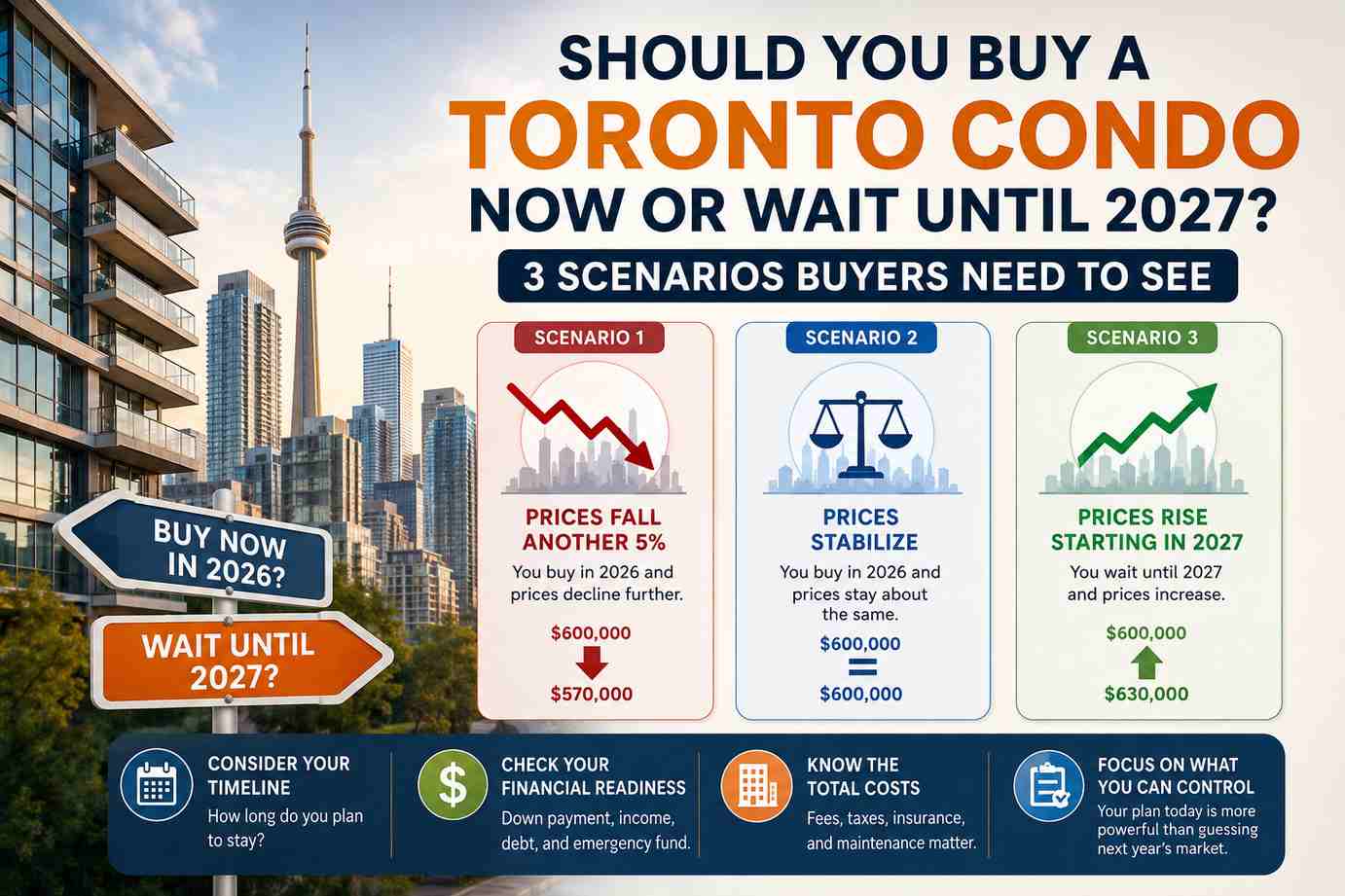
Scenario 1: Buy in 2026 and Prices Fall Another 5%
This is the scenario nervous buyers are imagining.
Suppose you find a condo listed at $600,000 and negotiate the purchase at that price.
Now imagine comparable values decline another 5%.
Your hypothetical market value becomes:
$600,000 → $570,000
On paper, you are down $30,000.
That sounds painful, but it does not automatically mean buying was a mistake.
A home is not a one-year stock trade. If you intend to live there for seven or ten years, the important question is not whether you bought at the exact bottom. It is whether the property fits your budget and whether its long-term ownership costs make sense.
The bigger danger is buying with a short time horizon.
Someone expecting to sell again in two years has far less room for error because selling costs, land-transfer taxes, legal expenses and potential price declines can make a short holding period expensive.
Who should be cautious in this scenario?
Waiting may be sensible if:
- you may leave Toronto within a few years;
- your monthly budget would be stretched after mortgage payments and condo fees;
- your emergency savings would be nearly exhausted after closing;
- you are relying on rapid appreciation to justify the purchase; or
- you are buying primarily because you fear missing the bottom.
A lower purchase price does not make an unaffordable condo affordable.
Scenario 2: Buy in 2026 and the Market Stabilizes
This may be the least exciting scenario—and potentially the most important.
Imagine the same $600,000 condo is still worth roughly $600,000 a year later.
You did not capture a huge housing-market rebound.
But you also did not wait for a crash that never arrived.
Instead, the advantage of purchasing during a softer market may have come from negotiating the transaction itself.
That could mean getting a lower accepted offer, having time to review the condominium's documents, comparing multiple units or walking away when the numbers do not work.
TRREB reported 5,995 GTA home sales in July 2026, down slightly from the previous year, while new listings fell 17.8% year over year. That suggests conditions can change even while the broader market remains relatively subdued.
This matters because buyers waiting for a newspaper headline announcing “Toronto housing has officially bottomed” may discover the market has already started shifting by the time that conclusion becomes obvious.
Housing bottoms are usually easiest to identify after they have happened.
Scenario 3: Wait Until 2027 and Prices Begin Recovering
This is the risk on the other side.
CMHC's current outlook expects Toronto housing demand to improve moving into 2027. Its baseline forecast has Toronto CMA MLS sales increasing from about 63,500 in 2026 to 71,500 in 2027, while the average resale price rises from approximately $1.02 million to $1.05 million.
Those are forecasts, not guarantees.
But CMHC also expects fewer new completions eventually to reduce the flow of additional inventory, while stronger demand could allow sales growth to begin outpacing new listings.
Suppose our hypothetical $600,000 condo instead increases 5%.
$600,000 → $630,000
The buyer who waited now faces a $30,000 higher theoretical purchase price.
Perhaps mortgage rates are better by then.
Perhaps they are not.
That is why waiting solely for lower interest rates can become a trap.
Mortgage rates and property prices do not move independently. If financing becomes meaningfully cheaper and buyer confidence improves, more purchasers can return to the market—potentially increasing competition for attractive units.
The Real Question Is Not 2026 vs. 2027
Here is the more useful way to think about the decision:
What needs to happen in 2027 for waiting to leave you financially better off?
If today's suitable condo costs $600,000, waiting works particularly well if some combination of the following occurs:
- its price falls;
- your down payment grows significantly;
- your income increases;
- your mortgage options improve;
- your other debts decline; or
- you gain greater certainty about where you want to live.
But if you wait and prices rise while your savings barely change, you may actually lose purchasing power.
That makes the decision less about predicting Toronto's housing market and more about comparing your financial position today with the position you realistically expect to have next year.
A $600,000 Condo: What Could the Three Scenarios Look Like?
Consider a simplified example.
| Scenario | Hypothetical Condo Value | Change | What It Could Mean |
|---|---|---|---|
| Prices fall 5% | $570,000 | -$30,000 | Waiting could produce a lower entry price |
| Prices stay flat | $600,000 | $0 | 2026 buyers may benefit mainly from negotiating power |
| Prices rise 5% | $630,000 | +$30,000 | Waiting could increase the required purchase price |
These figures are illustrations, not price forecasts.
Their purpose is to expose something that gets lost in the buy-versus-wait debate: both choices carry risk.
Buying exposes you to the possibility of further declines.
Waiting exposes you to the possibility that the market improves before you enter.
Don't Forget the Cost That Comes Before You Get the Keys
The purchase price is only part of the equation.
Toronto buyers can face both Ontario's provincial land transfer tax and Toronto's Municipal Land Transfer Tax.
For Toronto residential purchases, the city's tax uses graduated rates. The provincial system also applies graduated land-transfer-tax rates. Eligible first-time buyers may qualify for rebates, subject to the applicable requirements.
Buyers also need to budget for expenses such as legal services, title insurance, adjustments, moving expenses and other closing costs that may apply to the transaction.
And condos introduce another critical number:
monthly maintenance fees.
A cheaper condo with unusually high fees can be less attractive than a slightly more expensive unit in a financially healthier building.
Before buying, examine the building's status certificate, reserve fund, maintenance history, insurance situation, planned major work and the possibility of special assessments with appropriate professional advice.
What About the Down Payment?
Federal mortgage rules have also changed the financing landscape.
Since December 15, 2024, the federal insured-mortgage price cap has been $1.5 million, allowing qualifying purchasers of homes below that threshold to obtain an insured mortgage with less than a 20% down payment, subject to mortgage-insurance and lender requirements.
The federal changes also expanded eligibility for 30-year insured mortgage amortizations to all first-time homebuyers and buyers of new builds.
But qualifying for a mortgage does not necessarily mean you should borrow the maximum available.
Keeping cash available after closing can matter more than squeezing every dollar into the down payment.
Buying vs. Renting Changes the Answer
There is another possibility: neither rushing to buy nor obsessing over the 2027 market.
Renting for another year can be a rational financial decision.
If renting a comparable unit costs substantially less than the unrecoverable costs associated with ownership, waiting may allow you to build savings and preserve flexibility.
But the calculation should compare more than rent versus mortgage payment.
Owners also face property tax, condo fees, insurance, mortgage interest, maintenance and transaction costs. Renters, meanwhile, do not build home equity and remain exposed to future rental-market conditions.
If this is the bigger question for you, TwikUp's $2,500 rent versus a $600,000 home comparison breaks down the decision more directly.
Who Has the Strongest Case for Buying Now?
A 2026 purchase becomes more compelling when several things are true at once.
You have stable income.
You have enough cash for the down payment and closing costs without emptying your emergency fund.
You expect to stay for years rather than months.
The monthly ownership cost comfortably fits your budget.
The condo building itself is financially healthy.
And, importantly, you find a property you would still be comfortable owning if its market value temporarily fell after closing.
That last test is powerful.
If a 5% decline next year would make you immediately regret buying, you may be taking more housing risk than you are comfortable carrying.
Who Has the Strongest Case for Waiting Until 2027?
Waiting has a stronger financial argument when another year materially improves your situation.
For example, perhaps you can increase your down payment from $60,000 to $100,000.
Maybe you expect to eliminate a car loan.
Perhaps your employment situation is changing.
Or you are still uncertain whether Toronto is where you want to remain long term.
In those cases, waiting is not necessarily an attempt to time the market.
It is an attempt to become a stronger buyer.
That distinction matters.
What If You're Trying to Predict Toronto Prices Beyond 2027?
Be careful.
The farther a housing forecast extends, the more assumptions it requires about interest rates, employment, population growth, construction, household formation, credit conditions and the broader economy.
CMHC currently sees Toronto resale activity and average prices strengthening in its baseline projections after 2026, but those estimates can change as economic conditions evolve.
For a broader comparison, see TwikUp's Canada housing market outlook by city for 2026–2031.
Long-range forecasts are better treated as scenarios than promises.
TwikUp Insight
The most interesting opportunity in Toronto's 2026 condo market may not be finding the exact bottom.
It may be finding the right unit while buyers still have leverage.
Imagine two buyers.
One spends the next year waiting for Toronto condo prices to fall another 5%.
The other spends the next three months watching listings, comparing buildings and making disciplined offers only when the numbers are attractive.
If prices fall sharply, the patient buyer who waited may win.
If prices stabilize, the buyer who negotiated well in 2026 may be perfectly comfortable.
If demand strengthens in 2027, today's softer conditions could look more attractive in hindsight.
That is why the better question is not:
“Will Toronto condos be cheaper next year?”
It is:
“Would I rather accept today's known price and negotiating conditions, or accept the uncertainty of what 2027 brings?”
For someone financially ready and planning to stay long term, waiting for the perfect bottom can create a different form of risk.
For someone stretched financially, however, a discounted condo is still too expensive.
Bottom Line
There is no evidence that every Toronto condo buyer should rush into the market in 2026.
There is also no guarantee that waiting until 2027 will deliver a better deal.
CMHC's current outlook suggests the GTA remains under price pressure in 2026, with condos particularly affected by elevated supply, while stronger demand and reduced new supply could support a recovery beginning in 2027.
So use 2026 for what the market is currently offering: choice, time and negotiating power.
If the right condo appears at a price you can comfortably carry for years, buying before the market clearly recovers can make sense.
If purchasing would leave you financially stretched, waiting is not losing.
It is buying yourself flexibility.
And in an uncertain housing market, flexibility has value too.
This article is for general informational purposes only and is not financial, mortgage, legal, tax or real-estate advice. Housing forecasts and hypothetical price scenarios are not guarantees of future performance.
Sources
- Toronto condo prices and whether 2026 is becoming a better time to buy
- $2,500 rent versus a $600,000 home comparison
- Canada housing market outlook by city for 2026–2031
- Canada Mortgage and Housing Corporation (CMHC) — Housing Market Outlook 2026
- CMHC — Summer 2026 Housing Market Outlook
- Bank of Canada — July 15, 2026 interest-rate decision
- Bank of Canada — Policy interest-rate data
- Toronto Regional Real Estate Board — Market Watch