
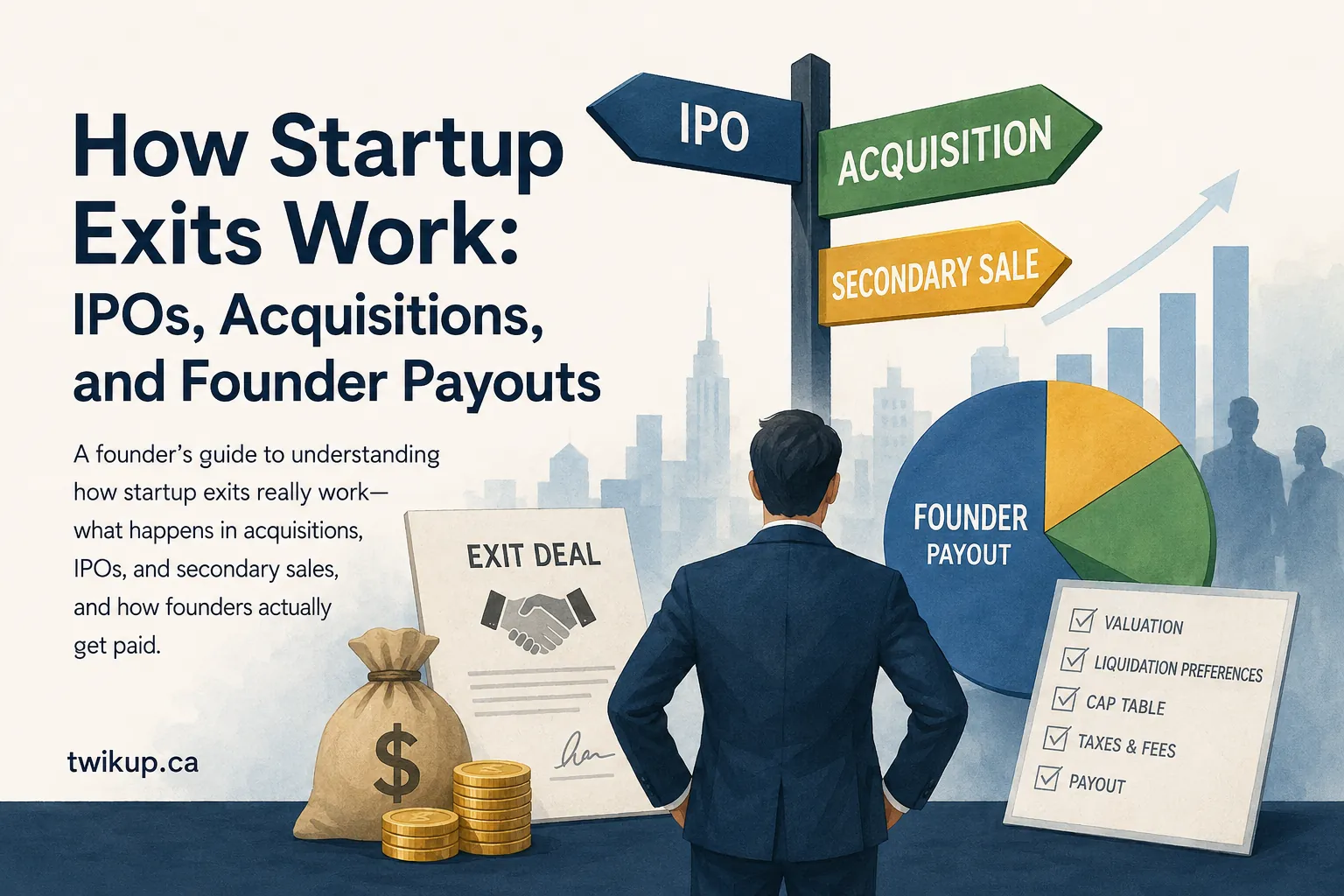
How Startup Exits Work: IPOs, Acquisitions, and Founder Payouts
Every startup founder dreams of a successful exit.
Some imagine ringing the opening bell at Nasdaq.
Others picture selling their company for hundreds of millions of dollars to a global technology giant.
The headlines often celebrate these exits with statements like:
- "Startup acquired for $250 million."
- "Founder becomes billionaire after IPO."
- "Company exits for $1 billion."
But those headlines rarely explain what actually happens behind the scenes.
The truth is that an exit is far more complex than simply selling a company.
Who gets paid first?
How much do investors receive?
What happens to employee stock options?
Does the founder actually receive the amount reported in the news?
Can founders walk away immediately?
These are the questions that determine whether an exit becomes life-changing—or deeply disappointing.
In this guide, we'll explain how startup exits work, compare IPOs with acquisitions, explore founder payouts, and show why understanding your cap table is just as important as building a great company.
💡 TwikUp Insight
The exit is not where wealth is created—it is where years of fundraising decisions, dilution, investor rights, and ownership percentages finally become real money.
Founders who understand exits early make smarter fundraising decisions throughout the life of their startup.
Continue Reading the Startup Investing Series
If you're joining this series for the first time, start here:
Part 1: How First-Time Founders Can Raise Their First Investment
https://twikup.ca/money/investing/how-first-time-founders-can-raise-their-first-investment
Part 2: What Investors Look For Before Funding a Startup
https://twikup.ca/money/investing/what-investors-look-for-before-funding-a-startup
Part 3: Why Most Startup Pitches Fail Even When the Idea Is Good
https://twikup.ca/money/investing/why-most-startup-pitches-fail-even-when-the-idea-is-good
Part 4: How to Build a Pitch Deck That Investors Actually Read
https://twikup.ca/money/investing/how-startup-dilution-works-what-happens-when-investors-buy-equity
Part 5: How Startup Valuations Actually Work Before Revenue
https://twikup.ca/money/investing/how-startup-valuations-actually-work-before-revenue
Part 6: How Startup Dilution Works
https://twikup.ca/money/investing/how-startup-dilution-works-what-happens-when-investors-buy-equity
Part 7: How Startup Cap Tables Work
https://twikup.ca/money/investing/how-startup-cap-tables-work-and-why-founders-must-understand-them
Part 8: SAFE Notes Explained
https://twikup.ca/money/investing/safe-notes-explained-how-startups-raise-money-before-a-valuation
Part 9: Convertible Notes vs SAFE Notes
Part 10: Startup Term Sheets Explained
Part 11: Why Startup Founders Can Get Nothing After Selling Their Company
https://twikup.ca/money/investing/why-startup-founders-can-get-nothing-after-selling-their-company
Part 12: Angel Investors vs Venture Capitalists: Which Is Right for Your Startup?
Part 13: Seed Round vs Series A: What Changes for Founders?
https://twikup.ca/money/investing/seed-round-vs-series-a-what-changes-for-founders-2026-guide
What Is a Startup Exit?
A startup exit is the point where the owners of a company can convert their ownership into cash or publicly tradable shares.
An exit represents the culmination of years of building products, hiring employees, raising investment, and growing customers.
It is the moment when shareholders—including founders, investors, and employees—finally realize financial value from the business.
Although every transaction is different, most startup exits fall into one of five categories.
- Acquisition
- Initial Public Offering (IPO)
- Merger
- Secondary Share Sale
- Asset Sale
While IPOs often receive the most media attention, acquisitions remain by far the most common exit route for venture-backed startups.
Why Do Startups Exit?
Founders don't usually build companies with the goal of selling them immediately.
Instead, exits happen because they create value for everyone involved.
An exit allows:
- Investors to realize returns
- Employees to monetize equity
- Founders to access liquidity
- Buyers to acquire technology or talent
- Public investors to invest in successful businesses
Without exits, venture capital would not function.
Investors provide capital today because they expect an opportunity to sell their ownership later.
The Three Most Common Startup Exit Paths
1. Acquisition
The vast majority of venture-backed startups exit through acquisitions.
In an acquisition, another company purchases the startup.
The buyer could be:
- Microsoft
- Amazon
- Shopify
- Salesforce
- A competitor
- A private equity firm
- Another startup
The buyer acquires either:
- the technology,
- customers,
- intellectual property,
- employees,
- brand,
- revenue,
- or a combination of all of these.
For many founders, acquisitions offer the fastest path to liquidity.
Why Companies Acquire Startups
Acquisitions rarely happen because a company simply has extra cash.
Instead, buyers usually want to accelerate growth.
Some common reasons include:
Faster Product Development
Buying technology is often faster than building it internally.
Entering New Markets
Acquiring an existing business immediately provides customers and market presence.
Eliminating Competition
Buying a competitor can increase market share.
Acquiring Talent
Sometimes buyers primarily want the engineering team.
This is commonly called an Acqui-hire.
Intellectual Property
Patents, AI models, software, or proprietary algorithms may justify an acquisition.
Types of Acquisition Deals
Not every acquisition is structured the same way.
Cash Acquisition
The buyer pays shareholders entirely in cash.
This provides immediate liquidity.
Stock Acquisition
Instead of cash, shareholders receive stock in the acquiring company.
If the acquiring company's stock increases in value, the payout may become much larger over time.
However, it also introduces market risk.
Cash + Stock
Many acquisitions combine both.
Example:
- 60% cash
- 40% acquiring company shares
Earnout
Some acquisitions only pay part of the purchase price upfront.
The remaining amount depends on achieving future milestones such as:
- Revenue targets
- Customer retention
- Product launches
- EBITDA goals
We'll discuss earnouts in detail later in this guide.
Example Acquisition
Suppose your startup is acquired for $80 million.
The deal includes:
- $60 million upfront
- $20 million earnout over two years
If your company successfully meets the agreed milestones, shareholders receive the remaining $20 million.
If not, they may never receive that portion.
This is why the headline acquisition price can sometimes be misleading.
2. Initial Public Offering (IPO)
An IPO occurs when a private company lists its shares on a public stock exchange.
Instead of being owned by a small group of founders and investors, ownership becomes available to millions of public investors.
Examples include:
- Shopify
- Airbnb
- Snowflake
- Coinbase
An IPO allows companies to raise additional capital while providing liquidity opportunities for early shareholders.
However, going public is far more demanding than remaining private.
What Changes After an IPO?
Once a company becomes public, it must comply with extensive reporting and governance requirements.
These include:
- Quarterly financial reporting
- Annual audited statements
- Public disclosures
- Shareholder meetings
- Regulatory compliance
- Analyst coverage
- Market scrutiny
Founders also become accountable to public shareholders.
Every earnings report can influence the company's stock price.
IPO Doesn't Mean Instant Wealth
Many people assume founders become billionaires the day their company goes public.
That's rarely true.
Most IPOs include a lock-up period, typically lasting around six months.
During this period, insiders—including founders and early employees—are generally restricted from selling their shares.
As a result, much of their wealth exists only "on paper" until those restrictions expire and they decide to sell.
Additionally, stock prices can fluctuate significantly after an IPO.
A founder whose shares are valued at $200 million on listing day may ultimately realize much more—or much less—depending on market performance.
3. Secondary Share Sales
Not every liquidity event requires selling the company.
A growing number of startups now allow founders, employees, and early investors to sell some of their shares before an IPO or acquisition.
These transactions are known as secondary sales.
Instead of issuing new shares, existing shareholders sell part of their ownership to another investor.
Secondary sales have become increasingly common because many startups remain private for longer than they did a decade ago.
Secondary Sales: Why They Matter
Secondary sales have become an important part of startup financing, especially for founders who have spent years building a company without taking a significant salary.
Instead of waiting for an IPO or acquisition, founders may sell a small portion of their ownership to later-stage investors.
For example:
- A founder sells 5% of their shares during a Series C funding round.
- An early employee sells vested shares to a growth equity investor.
- An angel investor exits before the company reaches an IPO.
Secondary transactions provide liquidity without requiring the company itself to be sold.
However, they often require approval from the board of directors or existing investors, and many shareholder agreements include restrictions on when and how these sales can occur.
How Founder Payouts Actually Work
One of the biggest misconceptions in the startup world is that founders automatically receive their ownership percentage of the company's sale price.
That is rarely how exits work.
Before founders receive anything, several financial obligations are usually settled first.
These can include:
- Outstanding company debt
- Transaction costs
- Legal fees
- Banker fees
- Investor liquidation preferences
- Employee equity payouts
- Taxes
Only after these obligations have been addressed is the remaining value distributed among shareholders according to the company's capitalization table.
A Simple Founder Payout Example
Imagine a startup is acquired for $100 million.
The ownership structure is:
| Shareholder | Ownership |
|---|---|
| Founders | 40% |
| Investors | 50% |
| Employee Option Pool | 10% |
If there are no investor preferences, debt, or unusual deal terms, the proceeds would generally be distributed proportionally.
| Shareholder | Estimated Payout |
|---|---|
| Founders | $40 Million |
| Investors | $50 Million |
| Employees | $10 Million |
Unfortunately, real startup exits are rarely this straightforward.
Why Founders Sometimes Receive Less Than Expected
The headline acquisition price rarely tells the whole story.
A founder may technically own 30% of the company but receive much less than 30% of the sale proceeds.
This happens because venture investors often own preferred shares, while founders usually own common shares.
Preferred shares frequently include contractual rights that allow investors to recover money before common shareholders receive anything.
This is why understanding your financing documents long before an exit is essential.
Liquidation Preferences
Liquidation preference is one of the most important concepts every founder should understand.
A liquidation preference determines the order in which shareholders are paid when the company is sold.
In most venture-backed startups:
- Investors hold Preferred Shares
- Founders hold Common Shares
Preferred shareholders are usually paid before common shareholders.
Example
Suppose investors invested:
$25 million
They negotiated a 1x liquidation preference.
Years later, the company sells for:
$40 million
The payment sequence may look like this:
Step 1:
Investors recover their original $25 million investment.
Remaining proceeds:
$15 million
Only then are the remaining proceeds distributed according to ownership.
Although the founder may technically own 40% of the company, their payout is based on the remaining amount—not the original acquisition price.
This is exactly why we covered liquidation preferences in detail in:
Part 11: Why Startup Founders Can Get Nothing After Selling Their Company
https://twikup.ca/money/investing/why-startup-founders-can-get-nothing-after-selling-their-company
💡 TwikUp Insight
Many founders negotiate valuation aggressively but spend very little time reviewing liquidation preferences.
In practice, liquidation terms often have a bigger impact on founder payouts than valuation itself.
Participating Preferred Shares
Some investors negotiate even stronger protections.
These are called Participating Preferred Shares.
With participating preferred, investors may:
- Recover their investment first.
AND
- Still participate in the remaining proceeds as shareholders.
This structure significantly reduces founder payouts during smaller exits.
Fortunately, participating preferred structures have become less common in competitive venture markets, but founders should always review their financing documents carefully.
Acquisition vs IPO
Many founders wonder which exit path is better.
The answer depends on the company, market conditions, and long-term goals.
Below is a comparison.
| Factor | Acquisition | IPO |
|---|---|---|
| Speed | Faster | Slower |
| Complexity | Moderate | Extremely High |
| Public Reporting | No | Yes |
| Liquidity | Usually Immediate | Often Delayed |
| Market Risk | Lower | Higher |
| Legal Cost | Moderate | Very High |
| Regulatory Burden | Lower | Significant |
| Founder Control | Often Reduced | May Continue |
An IPO is often considered the most prestigious exit.
However, acquisitions remain far more common and can provide excellent outcomes for founders, investors, and employees.
What Happens to Employees During an Exit?
Employees who hold stock options or restricted stock units (RSUs) may also benefit from a successful exit.
However, the outcome depends on several factors.
These include:
- Vesting status
- Exercise price
- Acquisition terms
- IPO timing
- Company valuation
- Investor rights
Employees sometimes assume that every acquisition creates instant wealth.
That isn't always true.
Possible Employee Outcomes
Option Cash-Out
The buyer purchases vested options for cash.
Employees receive immediate payment.
Option Conversion
Employee options convert into options of the acquiring company.
This allows employees to continue participating in future growth.
Option Cancellation
Sometimes options expire without value.
This typically happens if:
- the exit price is low,
- liquidation preferences consume the proceeds,
- or options are underwater.
New Retention Grants
Acquiring companies often provide fresh equity incentives to encourage key employees to remain after the acquisition.
Founder Lockups and Retention Agreements
Many founders assume selling the company means immediate retirement.
In reality, buyers frequently require founders to remain with the company after acquisition.
Typical commitments range from:
- 12 months
- 24 months
- sometimes even longer.
Founders help:
- integrate products,
- retain customers,
- support engineering teams,
- transition leadership,
- maintain company culture.
Leaving immediately is uncommon.
Earnouts
Many acquisitions include an earnout.
Instead of paying the full purchase price immediately, buyers tie part of the payment to future performance.
For example:
Purchase Price:
$120 Million
Paid immediately:
$80 Million
Earnout:
$40 Million
Conditions:
- Revenue targets
- Customer retention
- Product milestones
- EBITDA goals
If those milestones are achieved, shareholders receive the remaining amount.
If not, that portion may never be paid.
Why Buyers Like Earnouts
Earnouts reduce acquisition risk.
If future performance disappoints, the buyer pays less.
This protects the acquiring company from overpaying.
Why Founders Often Dislike Earnouts
After acquisition, founders usually have less control.
Budgets change.
Teams change.
Priorities change.
The buyer may unintentionally—or intentionally—make achieving the earnout more difficult.
For this reason, founders often negotiate carefully around earnout structures.
Why Cap Tables Matter During an Exit
A startup's capitalization table determines exactly how exit proceeds are distributed.
Every shareholder appears on the cap table.
That includes:
- Founders
- Investors
- Advisors
- Employees
- SAFE holders
- Convertible note holders
A clean cap table makes acquisitions much easier.
A messy cap table can delay or even kill a transaction.
Before an Exit, Buyers Carefully Review
- Share ownership
- Vesting schedules
- Employee options
- Convertible notes
- SAFEs
- Warrants
- Preferred share rights
- Investor approvals
- Board approvals
- Historical financing rounds
Even small documentation mistakes can delay a transaction worth millions.
Due Diligence Before an Exit
Before closing an acquisition, buyers perform extensive due diligence.
Areas commonly reviewed include:
Financial
- Revenue
- Gross margin
- Expenses
- Cash flow
- Debt
Legal
- Contracts
- Employment agreements
- Litigation
- Intellectual property
- Shareholder agreements
Product
- Source code
- Security
- Infrastructure
- Technology stack
Customers
- Churn
- Retention
- Contracts
- Revenue concentration
Operations
- HR
- Compliance
- Governance
- Data privacy
Well-prepared companies complete due diligence much faster and often command stronger negotiating positions.
Can Raising Too Much Hurt Your Exit?
Most founders believe raising more money is always a good thing.
After all, more capital allows you to hire faster, build more products, expand internationally, and outpace competitors.
But there is another side to fundraising that many first-time founders don't realize.
Every funding round raises investor expectations.
The more capital you raise—especially at a high valuation—the higher the expectations for your eventual exit.
This can make it surprisingly difficult to sell your company, even if you receive what most entrepreneurs would consider an excellent acquisition offer.
Example
Imagine a startup raises:
- Series A: $8 million
- Series B: $25 million
- Series C: $60 million
By this stage, investors may expect the company to become worth hundreds of millions—or even billions—of dollars.
Now suppose a strategic buyer offers $180 million to acquire the business.
To many founders, that sounds like a fantastic outcome.
However, if investors expected a much larger exit, they may reject the offer because the return on their investment does not meet their targets.
This illustrates an important lesson:
A larger valuation does not always create a better exit.
Sometimes, disciplined fundraising and sustainable growth produce stronger founder outcomes than chasing the highest possible valuation.
💡 TwikUp Insight
Every funding round should move your company closer to creating value—not simply increase its paper valuation.
Raising capital at unrealistic valuations can reduce your strategic flexibility when acquisition opportunities arise.
Three Founder Payout Scenarios
To understand how exits really work, let's compare three different startups that all announce the same acquisition price.
Although each company sells for $100 million, the founders receive very different outcomes.
Scenario 1: Clean Capital Structure
The company has:
- No debt
- No liquidation preferences
- No complicated investor rights
- Simple common share ownership
Ownership:
| Shareholder | Ownership |
|---|---|
| Founders | 30% |
| Investors | 60% |
| Employees | 10% |
Founder payout:
Approximately $30 million before taxes.
This is the type of outcome many founders imagine when they hear about startup acquisitions.
Scenario 2: Investor Preferences Reduce Founder Returns
The company sells for:
$100 million
However, investors previously invested:
$55 million
with a 1x liquidation preference.
The payment order becomes:
- Investors recover their $55 million.
- Remaining proceeds are distributed according to ownership.
Although the founder still owns 30% of the company, their payout is based on the remaining proceeds—not the full acquisition price.
The headline exit value remains the same, but the founder's actual proceeds are significantly lower.
Scenario 3: Earnout-Heavy Acquisition
The announced acquisition value is:
$100 million
The structure:
- $65 million paid at closing
- $35 million tied to future performance
If revenue targets are achieved over the next two years, shareholders receive the remaining amount.
If the milestones are missed, that additional payment may never materialize.
This is why experienced founders always ask two important questions:
- How much is guaranteed?
- How much depends on future performance?
The advertised acquisition price and the amount founders actually receive can be very different.
Common Exit Mistakes Founders Make
Even exceptional entrepreneurs sometimes make avoidable mistakes during fundraising that reduce their future exit outcomes.
Here are some of the most common.
1. Confusing Valuation with Cash
A startup valued at $500 million is not worth $500 million to the founder.
Valuation reflects the price investors are willing to pay for a small ownership stake—not the amount founders will eventually receive.
2. Ignoring Liquidation Preferences
Many founders focus almost entirely on valuation during fundraising.
In reality, liquidation preferences can have a much greater impact on their final payout.
3. Raising More Money Than Necessary
Additional capital creates additional dilution.
It can also increase investor expectations and reduce acquisition flexibility.
Raise enough to achieve meaningful milestones—not simply because capital is available.
4. Neglecting the Cap Table
Poorly managed cap tables create problems during due diligence.
Missing paperwork, undocumented advisor grants, or unclear ownership records can delay acquisitions or reduce buyer confidence.
5. Assuming an IPO Means Instant Wealth
Founders often face:
- Lock-up periods
- Insider trading restrictions
- Tax planning
- Market volatility
Much of their wealth remains tied to company shares long after the IPO.
6. Overlooking Taxes
Capital gains taxes, employee withholding obligations, cross-border taxation, and transaction structures all influence how much money founders ultimately keep.
Always involve experienced legal and tax advisors before signing exit agreements.
7. Signing Complex Deal Terms Without Advice
A single clause related to:
- earnouts,
- indemnification,
- escrow,
- liquidation preferences,
- or participation rights
can change founder outcomes by millions of dollars.
Experienced startup lawyers are an investment—not an expense.
Preparing Your Startup for a Successful Exit
Great exits don't happen by accident.
Companies that achieve successful acquisitions or IPOs usually spend years preparing for them.
Founders can improve their exit readiness by focusing on the fundamentals.
Maintain Accurate Financial Records
Buyers expect:
- audited or well-organized financial statements,
- predictable revenue,
- strong reporting,
- and transparent accounting.
Poor financial records create unnecessary risk during due diligence.
Keep Legal Documentation Organized
Maintain current versions of:
- customer agreements,
- employment contracts,
- IP assignments,
- shareholder agreements,
- board resolutions,
- and financing documents.
Clean documentation builds buyer confidence.
Understand Your Ownership
Know:
- your current ownership percentage,
- future dilution,
- investor rights,
- option pool allocations,
- and vesting schedules.
Founders should never be surprised by their cap table during acquisition negotiations.
Build Strategic Relationships Early
Many acquisitions begin years before an offer is made.
Large companies often monitor startups long before entering formal discussions.
Strong partnerships, integrations, and customer relationships can eventually become acquisition opportunities.
Canadian Founder Considerations
Canadian startups often face additional considerations during an exit.
Many Canadian companies raise investment from U.S. venture capital firms while remaining incorporated in Canada.
As a result, founders should consider:
- Canadian tax implications
- Cross-border transaction structures
- Intellectual property ownership
- Stock option taxation
- Canadian-Controlled Private Corporation (CCPC) status
- SR&ED documentation
- International investor rights
Early planning with experienced Canadian legal and tax professionals can help founders avoid costly surprises during acquisition or IPO negotiations.
Final Thoughts
Every founder dreams about the exit.
But successful exits are not defined by impressive headlines or billion-dollar valuations.
They are defined by what shareholders actually receive after years of fundraising, dilution, investor rights, taxes, legal agreements, and ownership changes.
Understanding how acquisitions, IPOs, secondary sales, liquidation preferences, cap tables, and founder payouts work gives entrepreneurs a significant advantage long before exit discussions begin.
The best founders prepare for their exit from the day they raise their first dollar—not the day they receive their first acquisition offer.
By understanding the mechanics behind startup exits, founders can negotiate smarter investment terms, make better fundraising decisions, and maximize the long-term value they ultimately create for themselves, their employees, and their investors.
🚀 TwikUp Insight
The best exit strategy isn't built during acquisition negotiations.
It's built through every financing round, every cap table decision, every investor agreement, and every ownership choice made from day one.
Founders who understand the journey from fundraising to exit are the ones most likely to maximize both company value and personal wealth.
Key Takeaways
- Startup exits usually happen through acquisitions, IPOs, mergers, or secondary share sales.
- An announced acquisition price is rarely the same as the founder's final payout.
- Liquidation preferences can significantly reduce founder proceeds.
- IPOs create liquidity opportunities but often include lock-up periods and market risk.
- Secondary sales allow founders and early employees to access liquidity before a full exit.
- Clean cap tables and organized legal records improve acquisition readiness.
- Raising excessive capital at unrealistic valuations can reduce future exit flexibility.
- Canadian founders should consider cross-border tax and legal implications well before an exit process begins.
What's Next in This Series?
Now that you understand how startup exits work, the next step is learning how venture capital firms generate returns and why fund economics influence investment decisions.
Understanding the investor's perspective will help founders negotiate more effectively and build companies that attract long-term capital.
Sources & Helpful References
EY – Global IPO Trends
https://www.ey.com/en_gl/ipo/trends
CB Insights – State of Venture Reports
https://www.cbinsights.com/research/
PitchBook – Venture Capital Reports
https://pitchbook.com/news/reports
Y Combinator – Startup Library
https://www.ycombinator.com/library
BDC – Business Development Bank of Canada
https://www.bdc.ca/en/articles-tools
National Venture Capital Association (NVCA)
MaRS Discovery District
Startup Genome
Continue Reading the TwikUp Startup Investing Series
If you found this guide helpful, continue exploring the rest of our Startup Investing series, where we break down fundraising, venture capital, startup finance, and founder strategy into practical, easy-to-understand guides designed for entrepreneurs, investors, and startup teams.