
Key Takeaways
- Your immune system has two branches.
- Innate immunity reacts fast and generally.
- Adaptive immunity is specific — and remembers.
Two Armies, One Body
The immune system runs on two branches that work together, in the National Institute of Allergy and Infectious Diseases' framing: innate immunity — immediate, present from birth, and general — and adaptive immunity — slower to start, highly specific, and able to create memory.
When something foreign gets in, the innate branch answers first, in minutes to hours. The adaptive branch takes days to mount its first response — but it finishes the job and remembers how.
The innate branch: fast and general
Innate cells carry built-in receptors (such as Toll-like receptors) that recognize general patterns of danger — features common to whole classes of microbes — rather than one specific germ.
Its front-line cells include neutrophils, the most numerous immune cells in your blood, which patrol and swallow bacteria whole (phagocytosis); macrophages, bigger eaters that also help direct the response; dendritic cells, which process what they capture and present it to the adaptive branch — the bridge between the two armies; natural killer cells, which destroy virus-infected and tumour cells; and the complement system, a set of blood proteins that tag microbes for destruction.
The adaptive branch: specific, and it learns
The adaptive branch is built on B cells and T cells, each carrying a unique receptor generated by random gene rearrangement — which is how the system can potentially recognize almost anything, including things it has never seen.
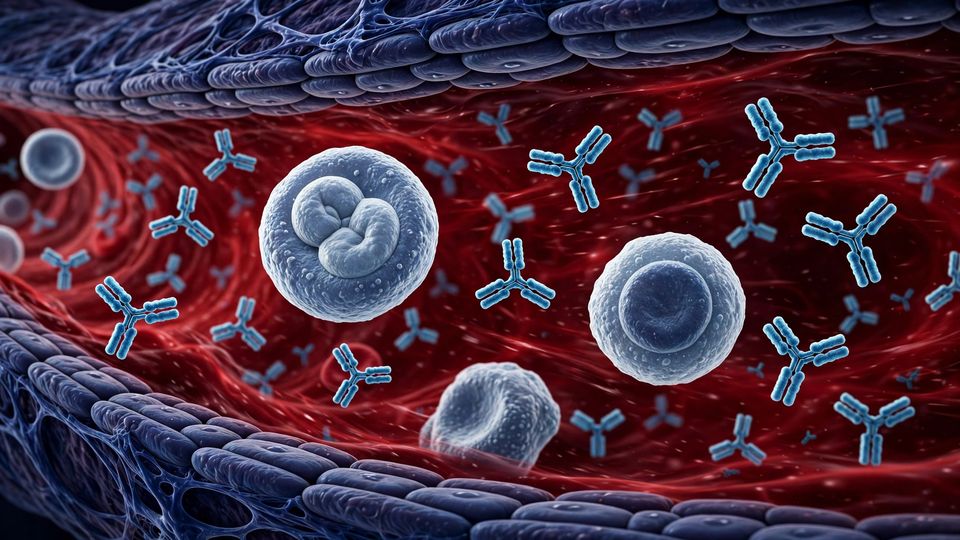
When a B or T cell's receptor matches an invader and innate cells confirm the danger, that cell activates and divides rapidly — clonal expansion — sending copies out to fight. B cells produce antibodies, which neutralize pathogens by blocking them from infecting cells, tag them for destruction, and activate complement. T cells split the labour: CD8 "killer" T cells destroy infected cells directly, while CD4 "helper" T cells activate and recruit other immune cells.
Memory: why the second time is easier
After the fight, some activated B and T cells are kept as memory cells. Meet the same pathogen again and they respond fast — often clearing it before it can establish itself. That is why you usually get a childhood disease once.
Vaccination is this mechanism, borrowed: it trains the adaptive system to build memory against a pathogen without the full risks of the infection itself.
Health note: This explainer describes the immune system in general terms, based on NIH material, and is not medical advice. Questions about your own immunity, vaccines or infections belong with your doctor.
The Twikup Take
The immune system is less a wall than an intelligence service: a fast patrol that recognizes trouble in general, and a slow archive that recognizes you-again enemies forever. Almost everything in medicine — vaccines, allergies, autoimmune disease, cancer immunotherapy — is one of those two branches doing its job, or doing it wrong.
Image: Illustrative image.