
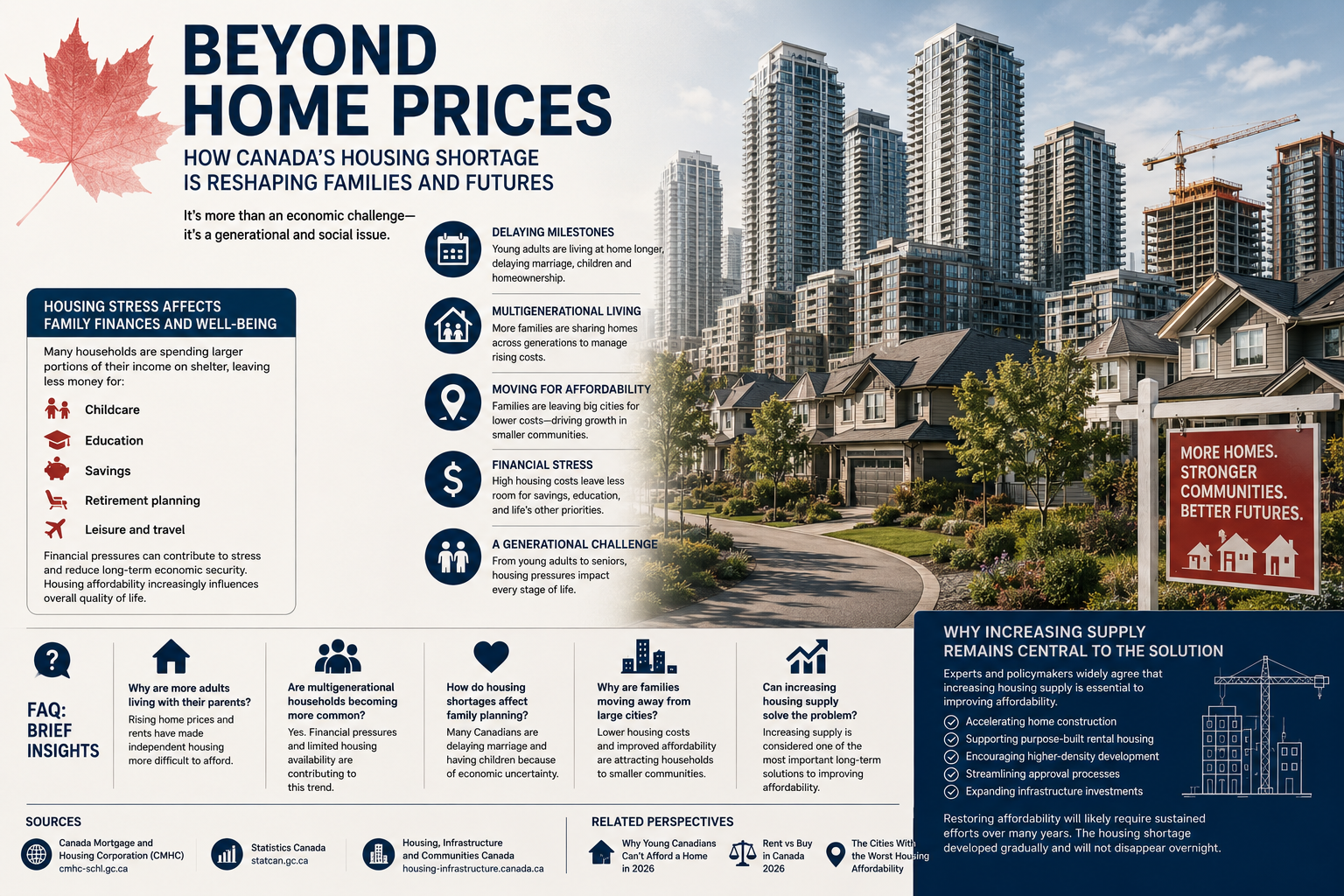
Housing shortages are affecting far more than home prices. Across Canada, the lack of affordable housing is changing family structures, delaying life decisions and reshaping the way many households think about the future.
For growing numbers of Canadians, the housing crisis has become a social issue as much as an economic one.
Rising housing costs are delaying major life milestones
Homeownership has traditionally represented financial stability and independence.
Today, high prices and elevated borrowing costs are causing many young adults to postpone important decisions.
The consequences are increasingly visible:
- Adults are living with parents longer.
- Couples are delaying marriage.
- Families are postponing having children.
- Young professionals are remaining renters for longer periods.
Housing affordability has become closely connected to demographic and lifestyle changes.
Multigenerational households are becoming more common
As affordability pressures intensify, many Canadians are adapting by sharing housing across generations.
Parents, adult children and grandparents are increasingly living under the same roof.
Several factors are contributing to this trend:
- High housing costs.
- Limited availability of larger homes.
- Rising rents.
- Financial pressures affecting younger adults.
For some families, multigenerational living offers financial relief.
For others, it reflects the difficulty of accessing independent housing.
Families are relocating in search of affordability
Housing shortages are influencing migration patterns across the country.
Some households are leaving major cities in search of lower costs and better quality of life.
This movement has contributed to population growth in smaller communities and secondary cities.
However, migration also creates new pressures.
As more people move into previously affordable regions, housing demand rises and affordability challenges spread.
Housing stress affects family finances and well-being
The burden of housing expenses extends beyond monthly payments.
Many households are spending larger portions of their income on shelter, leaving less money for:
- Childcare.
- Education.
- Savings.
- Retirement planning.
- Leisure and travel.
Financial pressures can contribute to stress and reduce long-term economic security.
Housing affordability increasingly influences overall quality of life.
Canada's housing shortage has become a generational issue
The effects of insufficient housing supply are not limited to one age group.
Younger Canadians face barriers to entering the housing market.
Parents are providing financial assistance for down payments.
Older Canadians are reconsidering retirement plans because of rising living costs.
The result is a challenge that spans multiple generations.
Housing shortages are affecting the social fabric of Canadian communities.
Why increasing supply remains central to the solution
Experts and policymakers widely agree that increasing housing supply is essential to improving affordability.
Governments have introduced initiatives aimed at:
- Accelerating home construction.
- Supporting purpose-built rental housing.
- Encouraging higher-density development.
- Streamlining approval processes.
- Expanding infrastructure investments.
However, restoring affordability will likely require sustained efforts over many years.
The housing shortage developed gradually and will not disappear overnight.
FAQ: Brief Insights on Housing Shortages
Why are more adults living with their parents?
Rising home prices and rents have made independent housing more difficult to afford.
Are multigenerational households becoming more common?
Yes. Financial pressures and limited housing availability are contributing to this trend.
How do housing shortages affect family planning?
Many Canadians are delaying marriage and having children because of economic uncertainty.
Why are families moving away from large cities?
Lower housing costs and improved affordability are attracting households to smaller communities.
Can increasing housing supply solve the problem?
Increasing supply is considered one of the most important long-term solutions to improving affordability.
Related Perspectives
Why Young Canadians Can't Afford a Home in 2026
Rent vs Buy in Canada 2026
The Cities With the Worst Housing Affordability
Sources
-
Canada Mortgage and Housing Corporation (CMHC)
-
Statistics Canada
-
Housing, Infrastructure and Communities Canada