
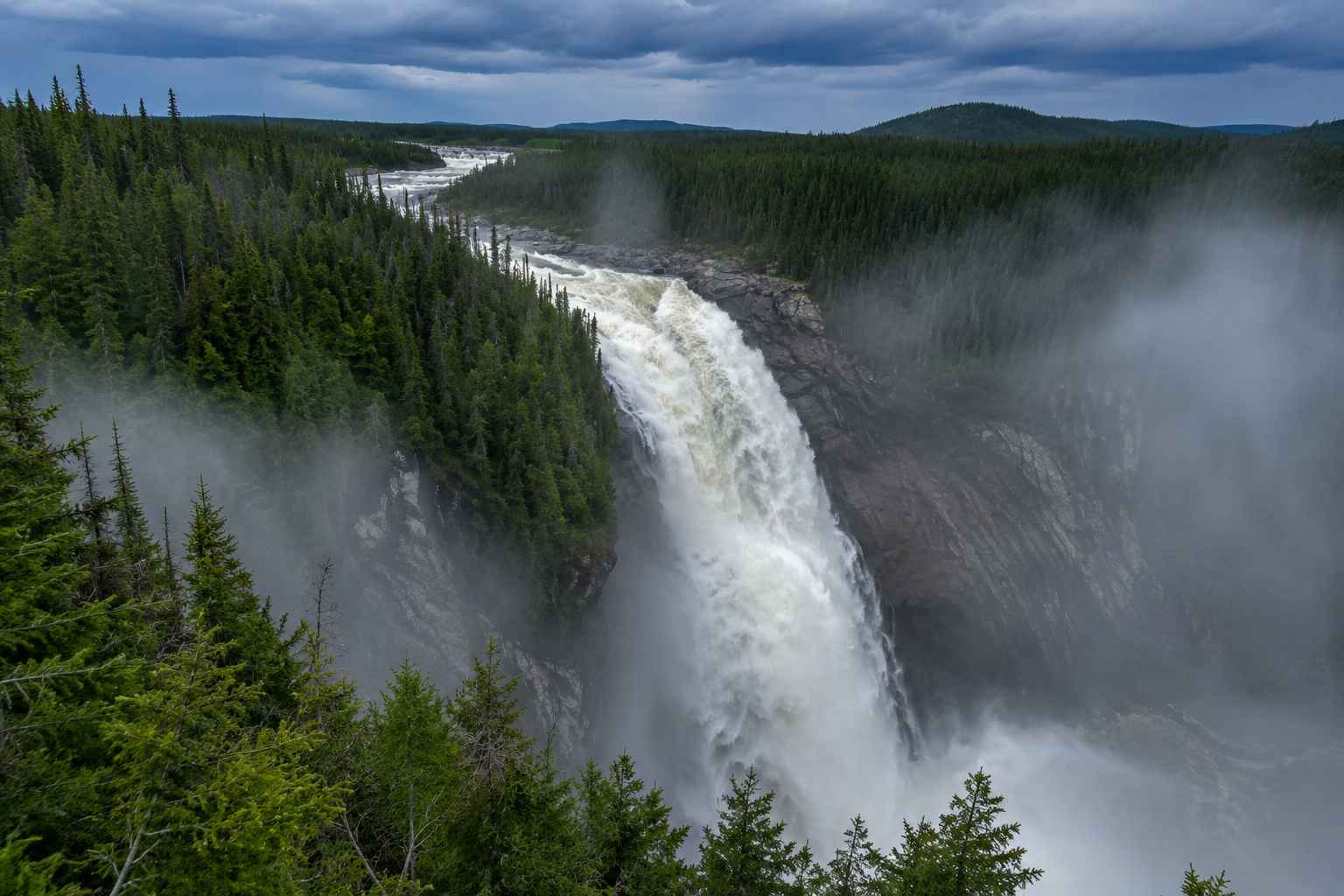
Canada has put an enormous number behind its ambition to become a clean-energy powerhouse: nearly $70 billion.
Prime Minister Mark Carney announced a sweeping electricity agreement on August 17 involving Canada, Québec, Newfoundland and Labrador, Hydro-Québec and Newfoundland and Labrador Hydro.
The plan centres on expanding Churchill Falls, developing the long-discussed Gull Island hydroelectric project, building hundreds of kilometres of transmission infrastructure and opening the door to a major wind development in Labrador.
The federal government describes the combined projects as the largest clean-energy investment in North American history.
The numbers are extraordinary.
But there is another question Canadians should be asking:
Can Canada actually deliver a clean-energy megaproject of this size without repeating the cost overruns, delays and planning failures that plagued Muskrat Falls?
That question matters because Muskrat Falls sits on the same Churchill River system—and its history offers a warning about what can happen between announcing a megaproject and successfully delivering it.
Quick Answer
Canada has announced a clean-energy buildout involving construction projects valued at nearly $70 billion, with up to $10 billion in federal financial support and investments.
The broader plan includes upgrades and expansion at Churchill Falls, a new Gull Island hydroelectric facility, roughly 660 km+ of transmission lines and associated infrastructure, and a proposed 2,000-megawatt onshore wind development in Labrador.
The federal government says the projects together could deliver 14,000 megawatts of clean, renewable power, support 23,000 jobs during construction and contribute approximately $31 billion to Canada's GDP through the early 2040s.
But Canada's recent history with Labrador hydroelectric megaprojects provides an important reason to watch the costs, timelines, assumptions and allocation of financial risk behind those projections.
The scale becomes clearer when you look beyond $70 billion
Imagine Canada's electricity system 10 or 15 years from now.
Electric vehicles are more common. Data centres require enormous amounts of power. Mines want to electrify operations. Manufacturers need reliable electricity, and provinces require additional capacity as more parts of the economy electrify.
Against that backdrop, 14,000 MW is not simply another power project.
The federal government says the planned projects would nearly triple the current generating capacity of Churchill Falls.
The resulting electricity, according to Ottawa, would be enough to light, heat and cool all the homes in Toronto, Montréal and Vancouver combined.
That helps explain why the government is presenting this as much more than an environmental initiative.
It is also an industrial strategy.
What exactly is Canada planning to build?
There are several major pieces.
The existing Churchill Falls Generating Station would undergo upgrades to its 11 turbine units. Those upgrades are expected to add approximately 1,275 MW of capacity, while a further Churchill Falls expansion could add as much as 2,500 MW.
Then comes Gull Island.
The proposed Gull Island hydroelectric project would be a new 2,700-MW generating facility on the Churchill River between Churchill Falls and Muskrat Falls.
Federal project information says Gull Island is expected to generate approximately 12 terawatt-hours of electricity and could come online around 2036–2037.
Moving all that electricity will require another enormous piece of infrastructure.
The federal backgrounder describes plans for 660 km+ of transmission lines and associated power infrastructure connected with the Churchill River projects.
A separate 735-kV transmission line is also proposed between Churchill Falls and Labrador City.
The package also includes a proposed 2,000-MW onshore wind development in Labrador, with its location and other details still under consideration.
But Labrador has seen a megaproject go wrong before
This is where the announcement deserves additional scrutiny.
Follow the Churchill River system downstream through Canada's recent energy history and you eventually arrive at Muskrat Falls.
The Lower Churchill development centred on Muskrat Falls was announced in 2010 with an estimated capital cost of approximately $6.2 billion, including generation and major transmission infrastructure.
By October 2012, the project's estimated capital cost had increased to approximately $7.4 billion.
The development subsequently experienced major cost increases and delays.
Problems became serious enough that Newfoundland and Labrador established a public inquiry into what happened.
Its final report carried an unusually direct title:
“Muskrat Falls: A Misguided Project.”
The inquiry examined decisions made before and after project sanction and raised serious questions about planning, assumptions, oversight and how information surrounding the project was presented to decision-makers and the public.
That history matters today because Canada is again contemplating enormous hydroelectric and transmission development in Labrador.
This wasn't originally Trudeau's project — but Ottawa eventually became deeply involved
Political context is important here.
Muskrat Falls should not simply be labelled a Trudeau government project.
The development was announced and advanced before Justin Trudeau became prime minister in 2015, and the original federal loan guarantee was established under Stephen Harper's Conservative government.
But as Muskrat Falls' financial pressures intensified, the federal government under Trudeau became increasingly involved through federal guarantees, financial flexibility and restructuring negotiations.
By February 2020, Finance Canada said federal loan guarantees for the Lower Churchill projects totalled $7.9 billion.
Ottawa also announced negotiations over financial restructuring and measures that included allowing certain payments to be deferred and expressing willingness to waive some requirements associated with additional cost overruns.
The lesson therefore isn't that one particular prime minister caused Muskrat Falls.
The more useful lesson is broader:
Megaproject problems can survive changes in governments—and public finances and electricity ratepayers can remain exposed to their consequences long after the original political announcement.
The warning for Carney's nearly $70-billion plan
That brings us back to 2026.
Carney's government is not simply announcing one generating station.
The strategy potentially combines:
- Churchill Falls turbine upgrades;
- a major Churchill Falls expansion;
- Gull Island;
- hundreds of kilometres of transmission infrastructure;
- a proposed 2,000-MW wind development;
- infrastructure intended to support critical-minerals development; and
- up to $10 billion in federal financial support and investments.
The economic opportunity is enormous.
So is the execution challenge.
When projects stretch toward the late 2030s, today's construction estimates and economic projections must contend with changes in labour costs, materials prices, interest rates, engineering conditions, environmental requirements, political leadership and electricity demand.
That doesn't mean Gull Island will become another Muskrat Falls.
It means Canadians have a recent example showing why an initial price tag should never be treated as the final measure of success.
The $70-billion question isn't only whether Canada needs more electricity
Canada is likely to require considerably more electricity over the coming decades as transportation, buildings and parts of industry electrify and new power-intensive industries expand.
The harder questions are:
Can the projects be delivered close to budget?
Can they be completed close to schedule?
Will projected electricity demand materialize?
Will the industrial and critical-minerals developments expected to use that electricity actually get built?
And perhaps most importantly:
Who absorbs the financial risk if costs rise substantially?
Those questions may ultimately matter more than the headline investment figure.
Why critical minerals are part of an electricity announcement
Canada isn't only trying to produce additional electricity.
It wants that electricity to unlock additional industrial development.
The Labrador Trough is an approximately 1,100-kilometre geological belt and mining region extending across Labrador and Québec, with major mineral resources including significant iron-ore deposits.
The federal government is referring a new Labrador Trough Clean Power, Critical Minerals and Infrastructure Corridor to the Major Projects Office.
The strategy makes economic sense on paper.
A valuable mineral deposit underground isn't enough to create a successful mine.
Companies also need electricity, transportation infrastructure, financing, workers and access to markets.
Building electricity and industrial infrastructure together could therefore improve the economics of additional Canadian mineral projects.
But it creates another dependency.
Part of the economic case for massive electricity expansion becomes stronger if the industrial development expected around it actually happens.
Nearly $20 million will target mining-enabling infrastructure
Ottawa is also committing nearly $20 million through the First and Last Mile Fund for feasibility and pre-development work connected to the region.
Projects receiving support include work involving transmission around Labrador West, infrastructure connected with the Kami iron-ore project, a proposed power-grid connection and access road for the Lac Knife graphite project, and expanded mineral-handling and rail capacity around Sept-Îles.
The amount is tiny compared with the nearly $70-billion headline.
Strategically, however, it reveals the bigger plan.
Ottawa wants electricity infrastructure to become a foundation for additional industrial and private investment.
The Churchill Falls agreement carries another lesson from history
Churchill Falls itself demonstrates why the structure of a megaproject can matter for generations.
The original 1969 Churchill Falls power contract became deeply controversial in Newfoundland and Labrador as electricity values and market conditions changed over subsequent decades.
The new Definitive Cooperation and Implementation Agreement between Hydro-Québec and Newfoundland and Labrador Hydro establishes a framework to terminate and replace the 1969 Churchill Falls Contract, while advancing the expansion of Churchill Falls and development of Gull Island.
That gives this announcement an unusual historical dimension.
Canada isn't simply planning the next generation of Labrador energy infrastructure.
The parties are simultaneously trying to move beyond the consequences of decisions made decades ago while developing new projects in a region where a much more recent megaproject exposed serious problems with planning, costs and oversight.
23,000 jobs — but the number needs context
Ottawa says the projects could support approximately 23,000 jobs during the construction phase alone.
That's potentially significant.
But construction employment should not be confused with permanent employment once the projects become operational.
Likewise, the government's estimate of approximately $31 billion in GDP contribution through the early 2040s is a projection tied to development of the projects.
Those figures should therefore eventually be assessed alongside actual construction spending, timelines, completed generating capacity and the industrial activity that develops around the infrastructure.
TwikUp Insight: Canada isn't short of megaproject announcements. Execution is the test.
The easiest day in the life of a megaproject can be announcement day.
There are politicians, enormous investment numbers, projected jobs and visions of infrastructure that could transform an economy.
The difficult part comes afterward.
Muskrat Falls demonstrated how dramatically the economics of a megaproject can change when costs, schedules and original assumptions fail to hold.
That doesn't prove the new Churchill Falls and Gull Island developments will fail.
In fact, lessons learned from Muskrat Falls could make today's planners more cautious.
But a nearly $70-billion buildout deserves a higher standard than simply asking how much electricity it could produce.
Can Canada build it on something resembling the expected timeline and budget?
Can governments maintain rigorous oversight across projects stretching through multiple administrations?
Can Indigenous partnerships and consultation be handled effectively?
Can the transmission system and industrial developments arrive when the electricity does?
And can taxpayers and electricity customers be protected if costs rise?
If Canada gets those questions right, Churchill Falls and Gull Island could become infrastructure that powers economic activity for generations.
If it gets them wrong, Canadians already have a project on the same river system that demonstrates how expensive megaproject mistakes can become.
Key Takeaways
- Canada has announced clean-energy construction projects valued at nearly $70 billion.
- Ottawa says the projects could eventually provide approximately 14,000 MW of clean, renewable power.
- The package includes up to $10 billion in federal financial support and investments.
- The plan includes Churchill Falls upgrades and expansion, the 2,700-MW Gull Island project, 660 km+ of transmission infrastructure and a proposed 2,000-MW Labrador wind development.
- Canada's experience with Muskrat Falls provides an important warning about megaproject cost, schedule and oversight risk.
- The Lower Churchill development centred on Muskrat Falls was estimated at approximately $6.2 billion in 2010, including generation and major transmission infrastructure.
- Muskrat Falls predates the Trudeau government, although the federal government subsequently became deeply involved through loan guarantees and financial restructuring efforts.
- The Muskrat Falls public inquiry published its final report under the title “Muskrat Falls: A Misguided Project.”
- Muskrat Falls' experience does not mean Gull Island or the new Churchill Falls developments will fail.
- The long-term test will be actual costs, construction progress, completed capacity, economic benefits and how financial risks are allocated.
Sources
-
Prime Minister of Canada — Prime Minister Carney announces the largest clean energy investment in North American history, August 17, 2026
https://www.pm.gc.ca/en/news/news-releases/2026/08/17/prime-minister-carney-announces-largest-clean-energy-investment-north -
Natural Resources Canada — Churchill Falls, Gull Island, transmission and Labrador development information
https://www.canada.ca/en/natural-resources-canada/news/2026/08/prime-minister-carney-announces-the-largest-clean-energy-investment-in-north-american-history.html -
Government of Newfoundland and Labrador — Muskrat Falls: A Misguided Project, Commission of Inquiry
https://www.gov.nl.ca/em/muskrat-falls-a-misguided-project/ -
Natural Resources Canada — Audit of the Administration of the Lower Churchill Projects Loan Guarantees
https://natural-resources.canada.ca/corporate/planning-reporting/audit-evaluation/audit-administration-lower-churchill-projects-loan-guarantees -
Department of Finance Canada — Government of Canada Announces Negotiations on Financial Restructuring of Lower Churchill Projects, February 10, 2020
https://www.canada.ca/en/department-finance/news/2020/02/government-of-canada-announces-negotiationson-financial-restructuring-of-lower-churchill-projects.html -
Government of Newfoundland and Labrador — Lower Churchill Project announcement, November 2010
https://www.releases.gov.nl.ca/releases/2010/exec/1118n06.htm -
Government of Newfoundland and Labrador — 2012 Muskrat Falls cost update
https://www.releases.gov.nl.ca/releases/2012/exec/1030n01.htm