
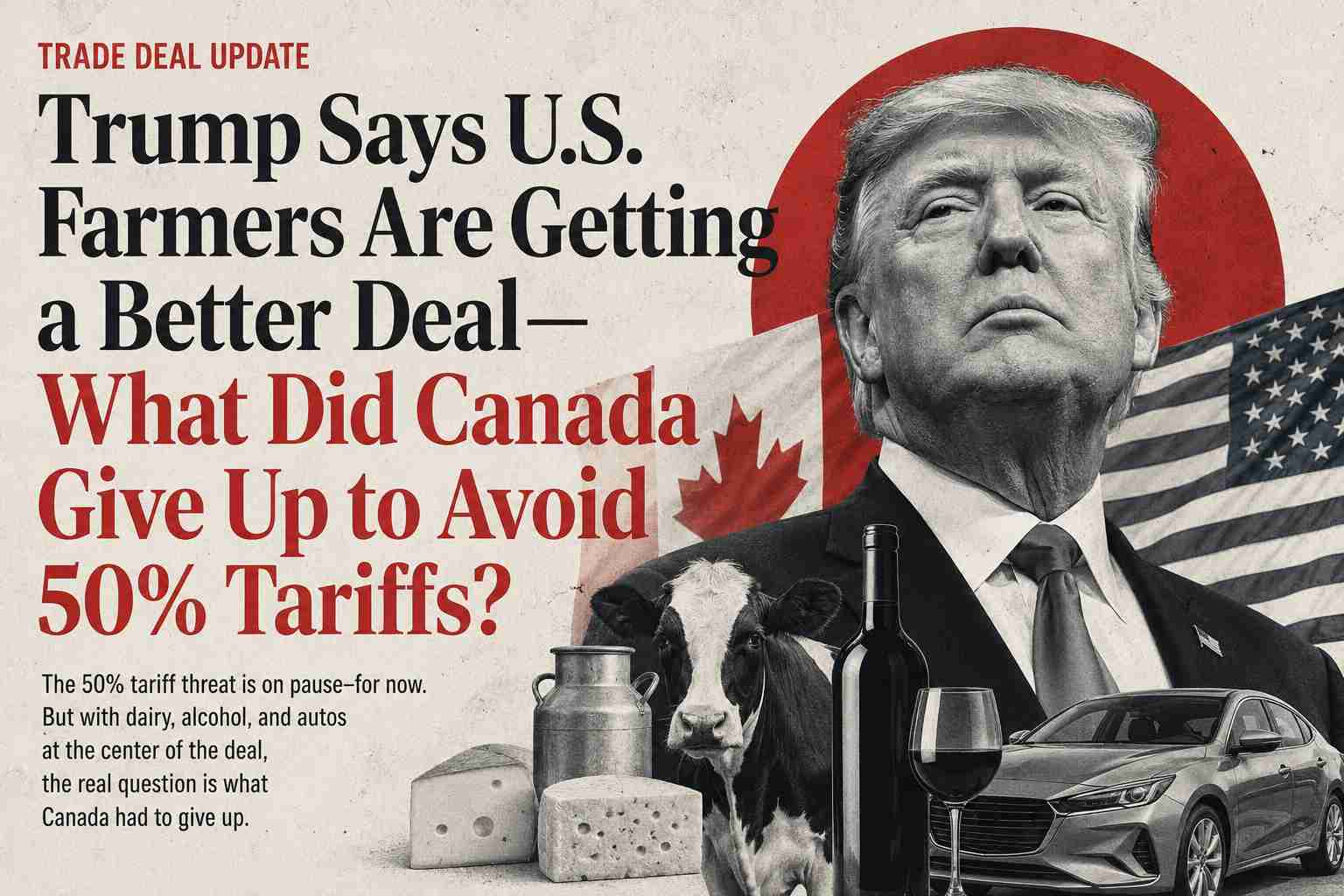
Canada has stepped back from the edge of a potentially painful new trade fight with the United States.
But only temporarily.
President Donald Trump's additional tariffs of 50% on certain Canadian goods were scheduled to take effect on August 19, 2026.
Then, just hours before the deadline, Trump suspended the new duties.
The crucial detail is easy to miss:
The suspension lasts only three days.
Even more important, the White House says the temporary reprieve came after Canada expressed a commitment to remove the disputed measures at the centre of the confrontation.
Those disputes involve three politically and economically sensitive areas:
Canadian dairy.
American alcoholic beverages.
Motor vehicles.
That creates a much bigger question than whether Canada temporarily escaped Trump's tariffs:
What exactly has Ottawa promised to change?
For now, the public does not have the full answer.
And with the tariff clock effectively delayed rather than eliminated, the next few days could reveal whether Canada secured relief through relatively narrow trade adjustments—or offered concessions with much bigger consequences for Canadian farmers, provincial alcohol markets or Ontario's auto sector.
Quick Answer
Trump has not permanently withdrawn the additional 50% tariffs targeting certain Canadian products.
Instead, the White House temporarily suspended their implementation for three days after Canada expressed a commitment to address the disputed trade measures.
The official U.S. proclamation identifies disputes involving dairy, alcoholic beverages and motor vehicles.
But it does not publicly spell out exactly what Canada has committed to change.
That distinction matters.
There is currently no official evidence that Canada has agreed to dismantle dairy supply management.
There is also no basis yet for declaring the broader trade confrontation permanently resolved.
What Canadians have received is a short reprieve—and an important clue from Washington that negotiations have progressed far enough for Canada to indicate that changes are coming.
Key Takeaways
- Trump imposed additional duties of 50% on specified Canadian products under Section 338 of the Tariff Act of 1930.
- Those duties were scheduled to take effect on August 19, 2026.
- Trump suspended their implementation for three days.
- The White House says Canada has expressed a commitment to remove the disputed measures.
- The disputes involve dairy, alcoholic beverages and motor vehicles.
- The White House has not publicly disclosed the complete changes Canada has committed to make.
- Canada's dairy supply-management system continues to exist.
- Greater U.S. dairy market access would not automatically mean the end of supply management.
- Unless a broader settlement follows, Canada has received a temporary reprieve rather than a permanent escape from the tariffs.
And that last distinction may be the most important part of the story.
Canada hasn't necessarily won the tariff fight. It has bought time.
Now Canadians need to know what happened at the negotiating table.
Why Trump Threatened Canada With 50% Tariffs
The confrontation did not begin this week.
In July, Trump invoked Section 338 of the Tariff Act of 1930, an old provision allowing the president to impose additional duties in response to certain discriminatory treatment of U.S. commerce.
The administration targeted Canadian measures in three separate areas.
1. Dairy
The immediate U.S. complaint is more specific than a general attack on Canada's entire supply-management system.
Washington objected to Canada's treatment of U.S. cheese under its tariff-rate quota system, particularly compared with access available for European Union cheese under the Canada-EU Comprehensive Economic and Trade Agreement.
Tariff-rate quotas, or TRQs, allow specified quantities of products to enter at lower tariff rates before substantially higher tariffs apply beyond those quantities.
That might sound like an obscure trade-policy argument.
For Canadian dairy farmers, it is anything but.
Changes to who can access quotas—and how much product can enter Canada—can affect competition inside one of Canada's most protected agricultural markets.
2. Alcohol
Washington also challenged Canadian measures affecting American alcoholic beverages.
The Trump administration argues that U.S. products have faced discriminatory treatment compared with certain competing foreign products.
Because alcohol distribution in Canada involves significant provincial control, any eventual solution could have implications beyond Ottawa.
3. Motor Vehicles
The third confrontation concerns Canada's treatment of certain U.S. motor vehicles.
This may ultimately have the largest economic consequences.
Canada and the United States operate one of the world's most deeply integrated automotive supply chains, particularly through Ontario and the U.S. Midwest.
Vehicles and components can cross the border multiple times during production.
A major tariff confrontation therefore doesn't remain neatly on one side of the border.
Costs can spread through manufacturers, parts suppliers, dealerships, workers and consumers.
Trump's 50% tariff threat gave Washington enormous leverage across all three disputes.
Then the Deadline Arrived
The additional duties were supposed to begin on August 19.
They didn't.
Trump instead signed a proclamation temporarily suspending their implementation.
But this was not an indefinite pause.
The suspension is for three days.
That makes the language explaining why Trump delayed the tariffs especially important.
According to the White House proclamation, negotiations between the United States and Canada had progressed and Canada had expressed a commitment to remove the discriminations or unreasonable and unequal impositions at issue.
That doesn't tell Canadians exactly what Ottawa has promised.
But it tells us something important:
Washington believes Canada has indicated it will change something.
The unanswered question is what.
The 3-Day Reprieve Changes the Story
Imagine two neighbours have been arguing over a property line for weeks.
One threatens to build a wall on Wednesday.
On Tuesday night, he says:
"I'll wait three more days because you've told me you're going to fix the problem."
The dispute isn't over.
The deadline has moved.
And suddenly everyone wants to know what the other neighbour promised.
That is roughly where Canada finds itself.
The tariff suspension is unquestionably positive for Canadian businesses that would otherwise have faced the additional duties immediately.
But Canadians shouldn't confuse three days of breathing room with a permanent settlement.
The real story has moved from the tariff itself to the negotiations behind it.
Why Dairy Could Become the Political Flashpoint
Canada doesn't operate its dairy industry like an ordinary commodity market.
The sector functions under supply management, a system built around three central pillars:
production control, pricing mechanisms and import controls.
In simplified terms, Canada attempts to align domestic production with Canadian demand while controlling foreign access through tariffs and negotiated import quotas.
For dairy farmers, that provides a degree of predictability.
For successive U.S. administrations, parts of the system have represented barriers preventing American producers from gaining greater access to Canadian consumers.
And this fight predates Trump's latest tariff threat by years.
America Already Received More Agricultural Access Under CUSMA
When Canada, the United States and Mexico negotiated CUSMA—the agreement known as USMCA in the United States—Canada already agreed to provide additional access to its agricultural market.
That included new U.S. access involving products such as:
- milk
- cream
- butter
- cheese
- skim milk powder
- other dairy products
- chicken
- eggs
- turkey
Canada also made commitments involving tariffs on products including whey and margarine.
For American agriculture, that represented additional access to parts of Canada's highly protected market.
But it didn't end the dairy fight.
Washington Came Back for More
Dairy subsequently became the subject of formal disputes under CUSMA itself.
In the first major dispute, a panel found that aspects of Canada's dairy tariff-rate quota allocation system were inconsistent with its CUSMA commitments.
Canada changed its policies.
The United States remained dissatisfied.
Another dispute followed.
That second case produced a substantially different result, with the panel rejecting several U.S. arguments and Canada describing the outcome as a victory for its position.
Yet the underlying disagreement never disappeared.
The U.S. Trade Representative has continued identifying Canada's administration of dairy tariff-rate quotas as a trade concern.
That history is important because the current confrontation isn't Trump suddenly discovering Canadian dairy in 2026.
Washington has been trying to secure different or greater access to Canada's dairy market for years.
What has changed is the leverage.
A threatened 50% tariff creates an entirely different negotiating environment.
Imagine You're a Canadian Dairy Farmer Today
Suppose your family operates a dairy farm in Ontario or Quebec.
You've watched successive international trade agreements open portions of Canada's dairy market to foreign competition.
You've adapted your business around those changes.
You've invested in equipment, livestock and facilities based partly on the continued existence of Canada's supply-management framework.
Then Washington threatens Canada with additional tariffs of 50% on specified products.
The deadline approaches.
Suddenly, Trump delays those tariffs for three days.
Then you read the White House proclamation.
It says Canada has expressed a commitment to remove the disputed measures.
And one of those disputes involves dairy.
Your first question probably isn't:
"Did Canada win?"
It's much simpler:
"What did Canada agree to change?"
Right now, the publicly available documents don't provide the complete answer.
Did Canada Give Up Supply Management?
There is currently no official evidence supporting that conclusion.
That distinction is essential.
Canada's dairy supply-management system continues to exist.
And changing dairy market access is not automatically the same thing as eliminating supply management.
Canada could potentially make narrower concessions involving tariff-rate quotas, eligibility rules, market-access quantities or other administrative mechanisms without dismantling the underlying system.
Those changes could still matter enormously to farmers.
But they would be fundamentally different from abolishing supply management.
So the responsible conclusion today is:
Dairy is clearly part of the dispute. Canada has indicated to Washington that changes are coming. But we do not yet know the scale of those changes.
Dairy May Not Be Canada's Biggest Concession
The farmer story is politically powerful, but focusing exclusively on dairy could obscure the other two disputes.
Alcohol
The United States has challenged Canadian treatment of American alcoholic beverages.
A negotiated solution could therefore involve changes to how U.S. alcohol is imported, distributed, purchased or sold in parts of Canada.
The details will matter because Canada's alcohol market involves both federal trade rules and provincial distribution systems.
Motor Vehicles
Autos could carry even greater economic consequences.
Canada's automotive sector is heavily concentrated in Ontario and deeply connected with U.S. production.
Parts and partially assembled vehicles routinely move across the border during manufacturing.
That makes major trade barriers particularly disruptive.
If Canada has committed to changing some aspect of its automotive trade treatment in exchange for tariff relief, the economic consequences could extend far beyond dealerships.
Ontario factories, parts suppliers and thousands of workers could have a stake in the eventual settlement.
So Who Won?
Nobody should declare a winner yet.
Canada clearly benefits from preventing the 50% additional tariffs from taking effect on August 19.
Even a temporary delay reduces the immediate shock facing affected exporters.
But the tariffs have not disappeared permanently.
Canada received a three-day suspension.
And according to Washington, Canada expressed a commitment to address the disputed measures.
That creates two different questions.
Question one: Did Canada permanently avoid Trump's 50% tariffs?
Not yet.
Canada received a three-day reprieve from their scheduled implementation while negotiations continue.
Question two: What has Canada indicated it will change?
That's now the much bigger question.
Watch These Five Things Over the Next Three Days
When additional details emerge, Canadians should look beyond whether Trump announces that the tariffs are gone.
The substance of the settlement matters more.
Dairy market access
Does Canada give American producers additional quota access or change who is eligible to receive existing quota?
Supply management
Do the concessions affect only the administration of imports, or do they alter a fundamental pillar of Canada's supply-management system?
Those are very different outcomes.
Alcohol
Will federal or provincial rules affecting American alcoholic beverages change?
Motor vehicles
Will Canada modify tariffs, import treatment or other policies affecting U.S.-made vehicles?
The tariff threat itself
Most importantly, does Washington permanently withdraw the additional 50% duties?
Or does the threat remain available if negotiations break down?
The answers will determine whether Canada negotiated its way out of a potentially damaging trade confrontation—or simply shifted some of the economic cost into another part of the Canadian economy.
TwikUp Insight
The easiest headline today would be:
Canada avoided Trump's 50% tariffs.
But that's not quite what happened.
Canada received three additional days.
And buried inside the White House proclamation is a more consequential statement: Washington says Canada has expressed a commitment to remove the disputed measures.
That is where Canadians should focus.
The tariff threat gave Washington significant negotiating leverage.
Canada had an equally powerful incentive to prevent another major trade barrier from hitting exporters dependent on the American market.
Now we know negotiations have progressed enough for Trump to delay the tariffs.
What we don't know is the price of that progress.
If the eventual solution gives American dairy producers substantially greater access to Canada's market, dairy farmers could bear part of the cost.
If the changes are limited to relatively technical quota rules, Ottawa may be able to resolve the confrontation without fundamentally altering supply management.
If autos account for a significant portion of the compromise, Ontario could become the centre of the story.
And if provincial alcohol rules change, the consequences could appear somewhere completely different.
That is why declaring victory today would be premature.
Canada hasn't escaped the tariff threat yet. It has received a three-day window to finish the job.
The most important question is no longer simply whether Trump will impose 50% tariffs.
It is:
What has Canada promised to change to make sure he doesn't?
Until Ottawa and Washington disclose the details, that's the part of this trade story Canadians still don't know.
Sources
The White House — Temporary Suspension of Additional Duties to Offset Canadian Discrimination Against the Commerce of the United States With Respect to Alcoholic Beverages, Dairy, and Motor Vehicles
https://www.whitehouse.gov/presidential-actions/2026/08/temporary-suspension-of-additional-duties-to-offset-canadian-discrimination-against-the-commerce-of-the-united-states-with-respect-to-alcoholic-beverages-dairy-and-motor-vehicles/
The White House — Additional Duties Concerning Canadian Dairy
https://www.whitehouse.gov/presidential-actions/2026/07/imposing-additional-duties-to-offset-canadian-discrimination-against-the-commerce-of-the-united-states-with-respect-to-dairy/
The White House — Additional Duties Concerning Canadian Alcoholic Beverages
https://www.whitehouse.gov/presidential-actions/2026/07/imposing-additional-duties-to-offset-canadian-discrimination-against-the-commerce-of-the-united-states-with-respect-to-alcoholic-beverages/
The White House — Additional Duties Concerning Canadian Motor Vehicles
https://www.whitehouse.gov/presidential-actions/2026/07/imposing-additional-duties-to-offset-canadian-discrimination-against-the-commerce-of-the-united-states-with-respect-to-motor-vehicles/
United States Trade Representative — USMCA Agriculture Commitments
https://ustr.gov/trade-agreements/free-trade-agreements/united-states-mexico-canada-agreement/fact-sheets/strengthening
United States Trade Representative — 2026 Trade Policy Agenda and 2025 Annual Report
https://ustr.gov/sites/default/files/files/Press/Releases/2026/2026%20Trade%20Policy%20Agenda%202025%20Annual%20Report.pdf
Agriculture and Agri-Food Canada — Canadian Dairy Sector Profile
https://agriculture.canada.ca/en/sector/animal-industry/canadian-dairy-information-centre/dairy-sector-profile
Government of Canada — Canada Welcomes CUSMA Dairy Tariff-Rate Quota Panel Findings
https://www.canada.ca/en/global-affairs/news/2023/11/canada-welcomes-cusma-dispute-settlement-panel-findings-on-dairy-tariff-rate-quotas.html