
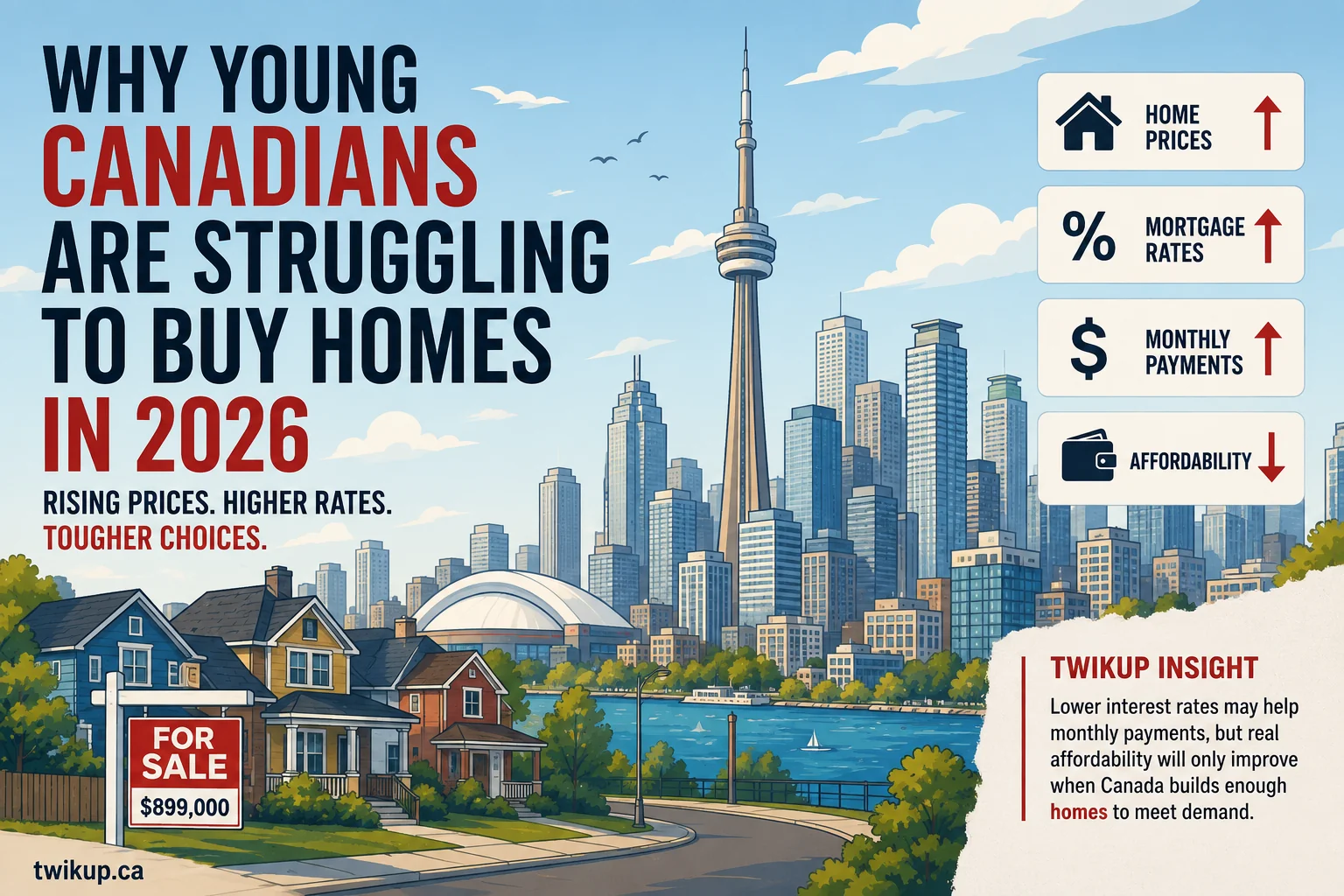
Why Young Canadians Are Struggling to Buy Homes in 2026
Buying a home was once seen as a normal milestone of adulthood in Canada. In 2026, that milestone feels much harder to reach for many young Canadians.
Rising home prices, higher borrowing costs, limited housing supply, population growth, and slower income growth have changed the path to homeownership. For many first-time buyers, owning a home is no longer a near-term goal. It has become a long-term financial challenge that requires more planning, more income, and more patience than previous generations needed.
Canada’s housing affordability crisis is no longer just a Toronto or Vancouver issue. It is now affecting young buyers across the country, from major cities to mid-sized communities.
Key Takeaways
- Young Canadians are struggling to buy homes because home prices have grown faster than incomes in many markets.
- Higher mortgage rates have increased monthly payments and made qualification harder.
- Canada’s housing shortage remains one of the biggest structural reasons affordability has worsened.
- The crisis has spread beyond Toronto and Vancouver into cities such as Calgary, Ottawa, Halifax, Montreal, and smaller growth markets.
- Lower interest rates may help buyers, but they will not solve the affordability crisis without more housing supply.
- Young Canadians are delaying marriage, children, relocation, and independent living because housing costs are reshaping life decisions.
Why Housing Affordability Has Become So Difficult in Canada
The biggest challenge facing young Canadians is that housing has become expensive from multiple directions at the same time.
A buyer today is not only dealing with high home prices. They are also dealing with elevated mortgage payments, stricter qualification rules, higher rents while saving, rising property taxes, insurance costs, and a limited supply of homes in many regions.
That combination has made homeownership feel increasingly out of reach.
For previous generations, buying a starter home was often possible with steady employment and disciplined saving. In 2026, many young buyers need two strong incomes, family assistance, a larger down payment, and a willingness to compromise on location or property type.
A Widening Gap Between Incomes and Home Prices
One of the biggest reasons young Canadians are struggling to buy homes is the growing gap between wages and property prices.
Over the past decade, home prices in many Canadian cities rose faster than household incomes. During the pandemic housing boom, prices accelerated sharply in several markets. Even though some regions later cooled, affordability did not fully recover because borrowing costs remained high.
This created a difficult reality:
- Saving for a down payment takes longer.
- Mortgage qualification has become harder.
- Monthly payments consume a larger share of income.
- Buyers need higher incomes to purchase the same type of home.
- Entry-level homes are no longer affordable in many urban markets.
For many young Canadians, the problem is not a lack of effort. The numbers simply no longer work the way they once did.
The Down Payment Problem
A higher home price means a higher down payment.
For example, a buyer purchasing a $500,000 home needs far less upfront cash than someone purchasing a $900,000 home. But in many Canadian cities, even modest condos, townhouses, and starter homes now require large down payments.
This creates a frustrating cycle.
Young Canadians often pay high rent while trying to save for a down payment. But because rent consumes so much monthly income, saving becomes slower. By the time they save more money, home prices may have moved again.
This is one reason many first-time buyers now rely on:
- Family support.
- Dual incomes.
- Longer saving timelines.
- Smaller properties.
- More distant locations.
- First Home Savings Accounts.
- RRSP Home Buyers’ Plan withdrawals.
The traditional path of saving independently for a few years and buying a starter home has become much harder.
Twikup Insight
The Canadian housing crisis is not only about high prices. It is about timing.
Young buyers are being asked to save larger down payments while also paying higher rent, qualifying under stricter mortgage rules, and competing in markets where supply is limited.
Even if interest rates decline, affordability may not improve enough unless Canada builds more homes in the places where people actually want and need to live.
Housing Shortages Have Become a Structural Problem
Canada’s housing crisis did not happen overnight.
Years of population growth, limited construction, zoning restrictions, municipal approval delays, labour shortages, and rising building costs have created a long-term imbalance between housing demand and housing supply.
The Canada Mortgage and Housing Corporation has repeatedly warned that Canada needs significantly more homes to restore affordability. This means the problem is not only financial. It is structural.
Several factors have contributed to the shortage:
- Not enough homes built relative to population growth.
- Lengthy municipal approval processes.
- Limited serviced land in high-demand areas.
- Labour shortages in construction.
- Rising costs for materials, land, and financing.
- Resistance to higher-density housing in some communities.
- Insufficient purpose-built rental construction.
When demand grows faster than supply, prices rise. That is exactly what has happened in many Canadian housing markets.
Why Supply Matters More Than Many Buyers Realize
Many buyers focus mainly on mortgage rates because rates directly affect monthly payments.
But supply is just as important.
If Canada does not build enough homes, lower interest rates could bring more buyers back into the market without creating enough new listings. That can push prices higher again.
This is why affordability cannot be solved by interest rates alone.
A healthier housing market needs:
- More starter homes.
- More rental housing.
- More family-sized condos.
- More townhouses.
- More multiplexes.
- Faster approvals.
- More construction labour.
- Better infrastructure to support growth.
Without enough supply, young Canadians will continue competing for too few homes.
Mortgage Costs Have Changed the Economics of Ownership
Housing affordability is not determined only by the price of a home. It is also determined by the cost of borrowing money.
When mortgage rates rise, the same home becomes more expensive to carry each month.
For young Canadians, this has changed the buying calculation. A home that looked affordable at a lower mortgage rate may become unaffordable at a higher rate, even if the purchase price does not change.
Higher mortgage costs affect buyers in three major ways:
-
Monthly payments increase. Buyers must spend more each month on the same mortgage amount.
-
Mortgage qualification becomes harder. Lenders assess whether buyers can afford payments under stress-tested conditions.
-
Buying power declines. A buyer may qualify for a smaller mortgage than expected.
This is why some buyers have delayed purchases, reduced budgets, or shifted from detached homes to townhouses, condos, or smaller communities.
Example: How Higher Rates Reduce Buying Power
A buyer may think affordability is mainly about the home price. But the mortgage rate can dramatically change what they can afford.
| Factor | Lower Rate Environment | Higher Rate Environment |
|---|---|---|
| Home price | More manageable | More difficult |
| Monthly mortgage payment | Lower | Higher |
| Stress test impact | Easier qualification | Harder qualification |
| Buyer confidence | Higher | Lower |
| Property expectations | Larger home or better location | Smaller home or farther location |
This is why many young Canadians feel stuck. Prices remain high, and monthly payments remain difficult.
Condos and Townhouses Are No Longer Easy Entry Points
For years, condos and townhouses were considered entry-level options for first-time buyers.
That is still true in some markets, but less than before.
In many cities, condo prices have increased significantly. Monthly condo fees, insurance costs, property taxes, and mortgage payments can make ownership expensive even when the purchase price is lower than a detached home.
Townhouses have also become more competitive because they appeal to young families priced out of detached homes.
As a result, the “starter home” has become harder to find.
Young buyers are often forced to choose between:
- A smaller condo in a central area.
- A townhouse farther from work.
- A detached home in a smaller community.
- Renting longer.
- Living with parents longer.
- Buying with family support.
- Moving to a lower-cost province or region.
Delayed Homeownership Is Reshaping Life Decisions
Housing affordability is not only a real estate issue. It affects how people live.
When young Canadians cannot buy homes, many other life decisions are delayed or changed.
The effects are visible across the country:
- Adults are living with parents longer.
- Couples are postponing marriage.
- Families are delaying having children.
- Workers are relocating to smaller cities.
- Some people are leaving expensive provinces.
- Multigenerational living is becoming more common.
- Renters are staying in rental housing longer.
- Young families are accepting longer commutes.
Housing is connected to almost every major life decision.
When housing becomes unaffordable, it changes family planning, career choices, migration patterns, and long-term wealth building.
Why the Problem Is Spreading Beyond Toronto and Vancouver
For many years, Canada’s housing affordability conversation focused mainly on Toronto and Vancouver.
That is no longer enough.
Affordability pressure has spread into many other regions. Cities such as Calgary, Ottawa, Halifax, Montreal, Hamilton, Kitchener-Waterloo, London, and smaller growth communities have all experienced housing pressure in different ways.
Several forces have contributed to this spread:
- Interprovincial migration.
- Remote and hybrid work.
- Population growth.
- Investors searching for lower-cost markets.
- Limited housing supply in mid-sized cities.
- Rising construction costs.
- Higher rental demand.
This means young Canadians who once hoped to “move somewhere cheaper” may find fewer affordable options than expected.
Canadian Housing Affordability by Market Type
| Market Type | What Young Buyers Face |
|---|---|
| Toronto and Vancouver | Very high prices, large down payments, intense affordability pressure |
| Calgary and Edmonton | More affordable than Toronto/Vancouver but rising demand and population growth |
| Ottawa and Montreal | More moderate than the largest markets but increasingly expensive for first-time buyers |
| Halifax and Atlantic Canada | Strong population growth and limited supply have pushed prices and rents higher |
| Smaller Ontario cities | Many became more expensive after pandemic-era migration |
| Rural areas | Lower prices in some cases, but fewer jobs, services, and housing options |
The affordability crisis is national, but it does not look the same everywhere.
Are Lower Interest Rates Enough to Fix Housing Affordability?
Lower interest rates can help buyers because they reduce borrowing costs.
But they are not enough on their own.
If rates fall, more buyers may return to the market. If supply remains limited, that extra demand can push prices up again.
This is why affordability depends on both sides of the equation:
- Demand: buyers, population growth, immigration, investor activity, interest rates.
- Supply: new construction, zoning, approvals, labour, infrastructure, land availability.
A lower mortgage rate may improve monthly payments, but it does not automatically make homes affordable if prices rise at the same time.
What Young Canadians Can Do Before Buying
Even in a difficult market, young buyers can improve their position by preparing early.
Here are practical steps to consider before entering the housing market:
1. Get Mortgage Pre-Approval Early
A mortgage pre-approval helps buyers understand their realistic budget before shopping.
It can show:
- How much you may qualify for.
- What monthly payments could look like.
- Whether your credit score needs improvement.
- How much down payment you need.
- Whether debt levels are too high.
Pre-approval does not guarantee final approval, but it gives buyers a clearer starting point.
2. Build a Larger Emergency Fund
Owning a home comes with costs beyond the mortgage.
Buyers should prepare for:
- Property taxes.
- Home insurance.
- Utilities.
- Repairs.
- Maintenance.
- Condo fees if applicable.
- Closing costs.
- Moving costs.
A home should not consume every dollar of savings.
3. Reduce High-Interest Debt
Credit card debt, personal loans, and car payments can reduce mortgage qualification.
Before buying, young Canadians should focus on lowering debt payments where possible.
This improves debt ratios and increases financial flexibility.
4. Compare More Than One Lender
Mortgage offers can vary between banks, credit unions, monoline lenders, and brokers.
Comparing options may help buyers find a better rate, better terms, or more flexible conditions.
The lowest rate is not always the best mortgage. Buyers should also compare:
- Prepayment options.
- Penalties.
- Fixed vs variable terms.
- Portability.
- Renewal conditions.
- Flexibility if income changes.
5. Be Realistic About Location
Location remains one of the biggest affordability factors.
Young buyers may need to compare:
- Central urban condos.
- Suburban townhouses.
- Smaller cities.
- Commuter communities.
- Provinces with lower average prices.
The right choice depends on career, family, lifestyle, and long-term plans.
Should Young Canadians Wait to Buy a Home?
There is no one-size-fits-all answer.
Waiting may make sense if:
- Your job situation is uncertain.
- You have not saved enough for closing costs.
- Your debt is too high.
- You are unsure where you want to live.
- Your monthly payment would be uncomfortable.
- You do not have an emergency fund.
Buying may make sense if:
- You have stable income.
- You can afford the payment comfortably.
- You plan to stay for several years.
- You understand the full cost of ownership.
- You are not relying on unrealistic price growth.
- You have compared renting vs buying carefully.
The best decision is not always “buy now” or “wait forever.” The best decision is the one that protects your financial stability.
Rent vs Buy: Why the Decision Is More Complicated in 2026
In the past, many Canadians believed buying was always better than renting.
In 2026, the decision is more complicated.
Renting may provide flexibility, lower responsibility, and time to save. Buying may provide stability, long-term equity growth, and control over housing.
But buying too early can create financial stress if the budget is too tight.
A smart rent-vs-buy decision should compare:
| Question | Why It Matters |
|---|---|
| How long will you live there? | Short ownership periods can be costly |
| Can you afford repairs? | Homeowners pay for maintenance |
| Is rent much cheaper than owning? | Renting may allow more saving or investing |
| Is your income stable? | Mortgage payments require consistency |
| Do you need flexibility? | Renting can make relocation easier |
| Are you emotionally ready? | Ownership adds responsibility |
For many young Canadians, renting longer may not be a failure. It may be a strategic decision.
What Governments Are Doing to Improve Affordability
Governments across Canada have introduced policies to increase housing supply and improve affordability.
These include:
- Housing infrastructure funding.
- Faster municipal approvals.
- Higher-density zoning reforms.
- Support for purpose-built rental housing.
- Federal housing programs.
- Incentives for new construction.
- Measures targeting housing speculation.
- Support for affordable housing projects.
However, housing shortages that developed over many years cannot be fixed quickly.
Even strong policies may take years to produce enough new homes to meaningfully improve affordability.
What Could Improve Affordability in the Future
Housing affordability could improve if several things happen together:
- More homes are built.
- Rental supply increases.
- Approval timelines become faster.
- Construction labour shortages ease.
- Interest rates become more manageable.
- Wages grow faster.
- Infrastructure supports new communities.
- More family-sized housing is added.
- Cities allow more density near transit and jobs.
No single solution will fix the problem.
Canada needs a combination of supply growth, smarter planning, financial discipline, and long-term housing policy.
The Bigger Economic Impact of Unaffordable Housing
Housing affordability affects more than individual buyers.
It also affects Canada’s economy.
When housing is too expensive:
- Workers may avoid high-cost cities.
- Employers may struggle to attract talent.
- Young families may delay children.
- Consumer spending may weaken.
- Household debt may rise.
- Wealth inequality may increase.
- Younger generations may fall behind older homeowners.
Housing is not just shelter. It is connected to productivity, family stability, labour mobility, and long-term wealth.
That is why Canada’s housing affordability crisis has become one of the country’s most important economic challenges.
FAQ: Housing Affordability in Canada
Why are young Canadians struggling to buy homes?
Young Canadians are struggling because home prices, mortgage costs, rents, and down payment requirements have increased faster than many incomes. Limited housing supply has also made competition worse in many markets.
Is Canada’s housing crisis only a Toronto and Vancouver problem?
No. Toronto and Vancouver remain among the most expensive markets, but affordability pressures have spread to many other cities, including Calgary, Ottawa, Halifax, Montreal, Hamilton, and smaller growth communities.
Will lower interest rates make homes affordable again?
Lower rates may help reduce monthly payments, but they will not solve the crisis alone. If housing supply remains limited, lower rates could increase buyer demand and push prices higher again.
Why does Canada have a housing shortage?
Canada’s housing shortage is linked to years of insufficient construction, population growth, zoning restrictions, municipal approval delays, labour shortages, infrastructure limits, and rising development costs.
Should young Canadians buy a home in 2026?
It depends on income stability, savings, debt levels, location, mortgage affordability, and long-term plans. Buying can make sense for financially prepared households, but renting longer may be smarter if ownership would create financial stress.
Are condos still a good first home option?
Condos can still be a good entry point, but buyers must consider condo fees, insurance, property taxes, special assessments, and resale potential. In some cities, condos are no longer as affordable as they once were.
What is the biggest factor affecting housing affordability?
The biggest factors are home prices, mortgage rates, income growth, and housing supply. Supply is especially important because a shortage of homes keeps competition high.
Can young Canadians still build wealth without buying a home?
Yes. Homeownership is one path to wealth, but not the only one. Renters can still build wealth through disciplined saving, investing, career growth, business ownership, and avoiding excessive debt.
Final Thoughts
Young Canadians are not struggling to buy homes because they lack ambition. They are facing a housing market that has changed dramatically.
Home prices are higher. Mortgage payments are larger. Down payments take longer to save. Rental costs make saving harder. Housing supply has not kept pace with demand.
The result is a generation that must approach homeownership differently.
For some, buying may still be possible with preparation, flexibility, and realistic expectations. For others, renting longer, moving markets, or waiting may be the more financially responsible choice.
Canada’s housing affordability crisis will not be solved overnight. But understanding the forces behind it can help young Canadians make better decisions, avoid financial stress, and plan for homeownership with more confidence.