
The Fake Government Call Scam: How Fraudsters Pretend to Be CBSA, CRA, Police, and Immigration Officers
Part 2 of Twikup's Canadian Scam Awareness Series
Before reading this article, start with Part 1:
➡️ The $704 Million Scam Crisis: How Canadians Are Losing Money Every Day in 2026 https://twikup.ca/canada/crime-safety/the-704-million-scam-crisis-how-canadians-are-losing-money-every-day-in-2026
Quick Answer
No legitimate Canadian government agency will threaten immediate arrest, deportation, imprisonment, account suspension, or police action over the phone and demand payment through gift cards, cryptocurrency, e-Transfers, or wire transfers.
If someone claiming to be from the Canada Revenue Agency (CRA), Canada Border Services Agency (CBSA), police, immigration authorities, or another government department demands immediate payment, it is almost certainly a scam.
Why This Scam Works So Well
Fraudsters understand one thing better than most people realize:
Fear makes people act before they think.
That's why fake government scams remain among the most successful frauds targeting Canadians.
Victims often receive calls, texts, emails, or voicemails claiming to be from:
- Canada Revenue Agency (CRA)
- Canada Border Services Agency (CBSA)
- Immigration officials
- Local police departments
- RCMP officers
- Courts or legal authorities
- Service Canada
The goal is simple:
Create panic and force victims to send money before they have time to verify the story.
The CRA Tax Scam
One of the most common frauds reported across Canada involves criminals pretending to be Canada Revenue Agency agents.
The scam typically follows a predictable script.
Victims are told:
- They owe unpaid taxes
- A tax audit uncovered violations
- An arrest warrant has been issued
- Police are on their way
- Their assets may be seized
- They must pay immediately
The fraudster then pressures the victim to make a payment immediately.
Common payment requests include:
- Gift cards
- e-Transfers
- Bitcoin
- Cryptocurrency wallets
- Wire transfers
Victims are often instructed not to tell anyone about the call.
Some scammers even stay on the phone continuously while directing victims to stores, banks, Bitcoin ATMs, or money transfer locations.
The Fake Police Officer Follow-Up
In some reported cases, victims who hesitate receive a second phone call.
This caller claims to be:
- A police officer
- An RCMP investigator
- A local police department representative
The fake officer "confirms" the CRA story and warns that arrest is imminent unless payment is made immediately.
This two-person scam makes the fraud appear more believable.
The CBSA and Immigration Deportation Scam
Another rapidly growing fraud involves fake immigration or border officers.
Victims may be told:
- Their visa has problems
- Their immigration status is under review
- A passport discrepancy was found
- A border violation occurred
- Deportation proceedings have started
Scammers often target:
- International students
- New immigrants
- Temporary foreign workers
- Permanent residence applicants
The fraudster claims the issue can be resolved quickly if the victim pays a fee immediately.
Victims are threatened with:
- Deportation
- Visa cancellation
- Immigration bans
- Arrest
These threats are designed to trigger panic and stop victims from seeking advice.
The Climate Action Incentive Payment Scam
Another increasingly common scam claims that a government benefit payment has not been processed.
Victims receive messages saying:
"Your Climate Action Incentive Payment has not been claimed or processed yet."
The message includes a link.
The link directs victims to a fake government website where scammers attempt to steal:
- Banking information
- Login credentials
- Personal identification
- Social insurance information
The Biggest Red Flags
If any government representative asks for the following, stop immediately.
Gift Cards
Government agencies do not collect taxes or fees using:
- Amazon gift cards
- Apple gift cards
- Google Play cards
- Prepaid cards
Any request for gift cards is a major warning sign.
Cryptocurrency Payments
Government agencies do not demand:
- Bitcoin
- Ethereum
- Crypto wallets
- Digital asset transfers
If cryptocurrency is requested, it is a scam.
Wire Transfers
Fraudsters frequently request:
- Western Union
- MoneyGram
- International wire transfers
Government agencies do not use these methods for urgent collections.
Immediate Threats
Be suspicious if someone says:
- "Pay now or you'll be arrested."
- "Police are on the way."
- "Your visa will be cancelled today."
- "You will be deported."
- "Don't tell anyone."
These are classic scam tactics.
Caller ID Can No Longer Be Trusted
Many Canadians assume a displayed phone number proves legitimacy.
Unfortunately, that is no longer true.
Scammers regularly spoof numbers to appear as:
- CRA phone numbers
- Local police departments
- RCMP offices
- Government agencies
The phone number on your screen can be fake even if it appears genuine.
How to Spot a Fake Government Website
Modern scam websites often look nearly identical to official government pages.
However, the web address usually reveals the truth.
Examples of suspicious domains include:
- cra-login-canada.com
- cra-account-notice.info
- crareturnreview.cfd
Watch for:
- Extra words
- Misspellings
- Unusual endings
- Additional characters
- Rearranged government names
Examples:
- crra
- c-ra
- carev
- revagency
What Official Government Websites Look Like
Most federal government websites:
- Begin with canada.ca
- End with .gc.ca
Examples include:
- canada.ca
- canada.ca/taxes
- canada.ca/myaccount
- canada.ca/be-scam-smart
- canada.ca/cra-scam-alert
- cyber.gc.ca
- publicsafety.gc.ca
Important exception websites include:
- rcmp.ca
- antifraudcentre.ca
- getcybersafe.ca
- reportcyberandfraud.canada.ca
- cybertip.ca
A missing "." before ".gc.ca" is often a scam warning sign.
What To Do If You Receive One of These Calls
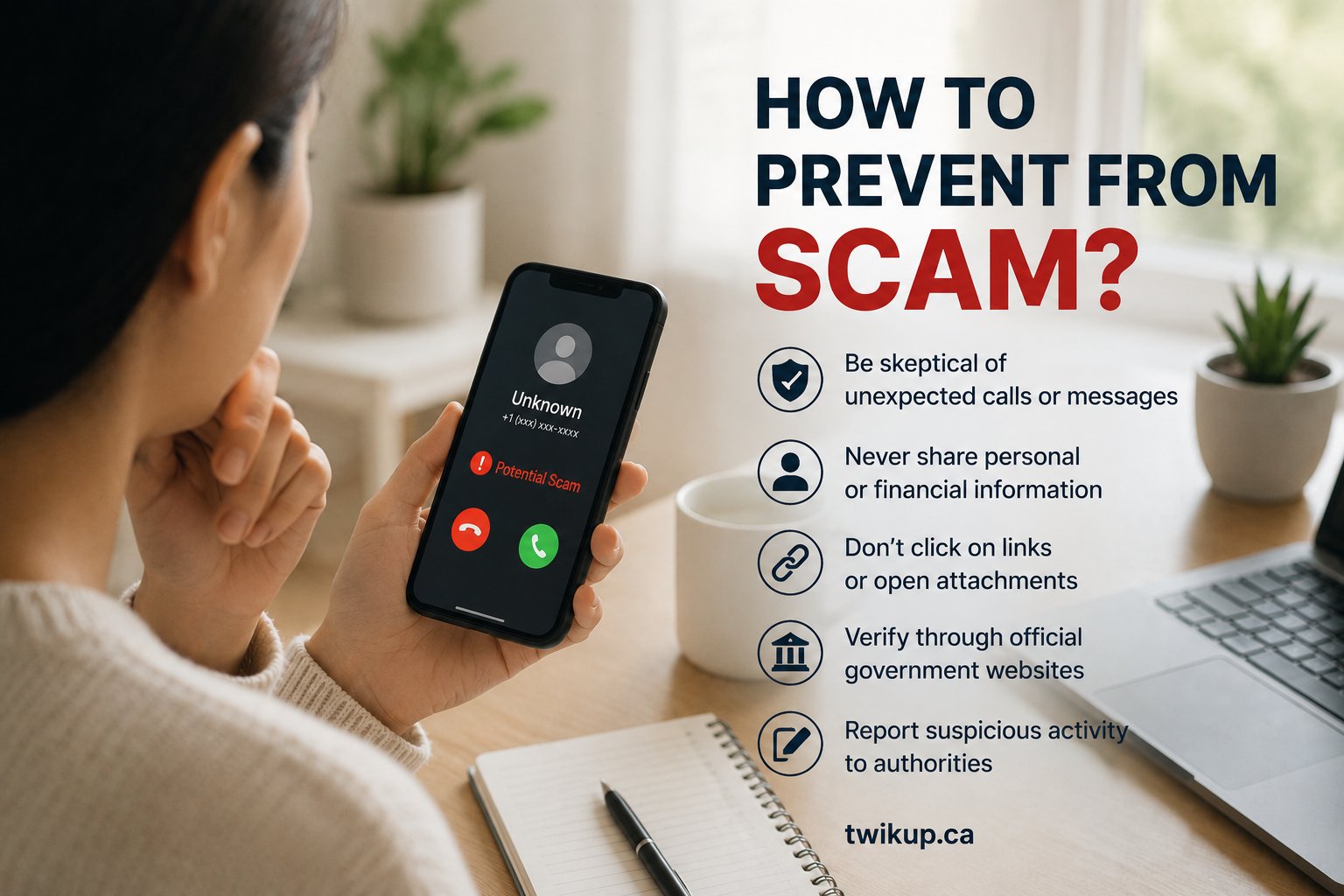
Follow this checklist:
✅ Hang up immediately
✅ Do not click links
✅ Do not provide personal information
✅ Do not send money
✅ Independently verify the phone number
✅ Visit the official government website directly
✅ Contact the organization yourself
✅ Report the scam
Real Example: Why Victims Fall for It
Imagine receiving a call stating:
"A warrant has been issued because of unpaid taxes. Officers are being dispatched to your home. You can avoid arrest by paying today."
Most people know it sounds suspicious.
But when the caller knows:
- Your name
- Your address
- Your phone number
And the caller ID displays a government agency number, many victims panic.
That panic is exactly what scammers rely on.
Twikup Insight
The most dangerous government impersonation scams are not successful because people are careless.
They're successful because scammers deliberately create a high-pressure situation where victims believe they have only minutes to act.
The moment someone demands immediate payment while threatening arrest, deportation, legal action, or police involvement, stop the conversation.
Real government agencies may contact you about legitimate matters, but they do not force instant payments through gift cards, cryptocurrency, wire transfers, or secret phone calls.
A useful rule for every Canadian:
The more urgent the demand, the more likely it is a scam.
Key Takeaways
- CRA, CBSA, police, and immigration impersonation scams remain widespread across Canada.
- Fraudsters commonly use arrest and deportation threats.
- Gift cards, Bitcoin, e-Transfers, and wire transfers are major red flags.
- Caller ID can be spoofed and cannot be trusted alone.
- Official Government of Canada websites generally begin with canada.ca or end with .gc.ca.
- Never click links from unexpected government messages.
- Always verify information directly through official government channels.
Sources
-
Edmonton Police Service – CRA Scam Awareness https://www.edmontonpolice.ca/CrimePrevention/PersonalFamilySafety/Frauds/CRA
-
Government of Canada – Recognize Scams and Fraud https://www.canada.ca/en/revenue-agency/corporate/scams-fraud/recognize-scam.html
-
Canadian Anti-Fraud Centre https://antifraudcentre-centreantifraude.ca
-
Competition Bureau Canada – Fraud Prevention Month 2026 https://www.canada.ca/en/competition-bureau/news/2026/03/fraud-prevention-month-to-bring-hidden-crime-into-the-spotlight.html