
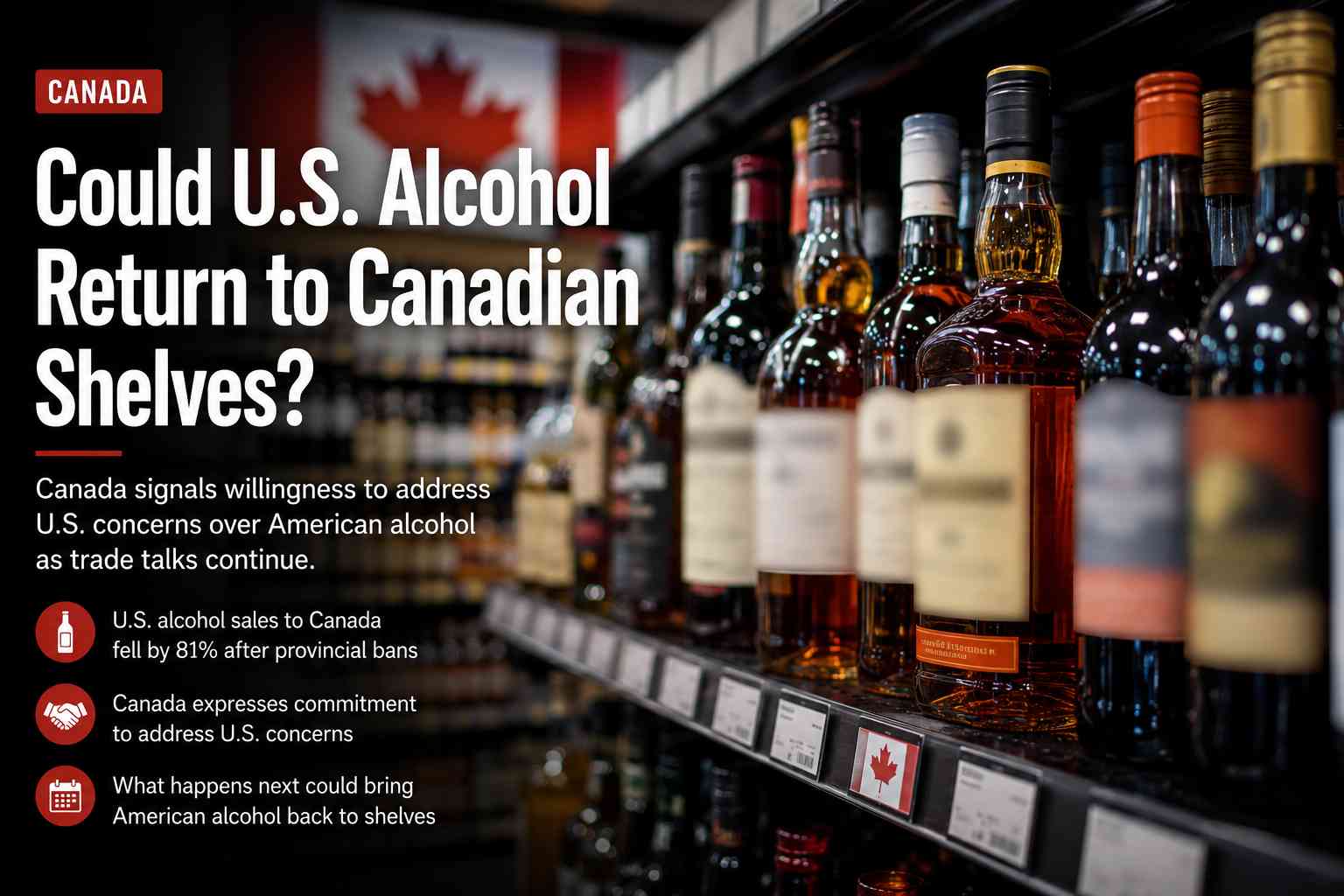
For more than a year, Canadians walking through many provincial liquor stores have seen one of the most visible consequences of the Canada-U.S. trade fight:
American alcohol disappearing from shelves.
Bourbon, California wine and other U.S.-made alcoholic beverages became caught in a political battle that moved far beyond tariffs at the border.
Now, there is a potentially important shift.
The White House says Canada has expressed a commitment to remove measures that the United States considers discriminatory against American alcoholic beverages as negotiations between the two countries continue.
That does not mean U.S. alcohol is officially returning to liquor-store shelves across Canada today.
But it raises a much more interesting question for consumers:
Could American wine, bourbon and other U.S. alcohol soon start coming back?
Quick Answer
There is no confirmed nationwide return of U.S. alcohol to Canadian liquor-store shelves.
However, an August 18, 2026 White House proclamation says Canada has expressed a commitment to address measures Washington considers discriminatory or unequal treatment of U.S. commerce, including measures affecting American alcoholic beverages.
That represents a potentially important change in the trade dispute.
But there are two major reasons Canadians should not interpret it as an announcement that American alcohol is coming back immediately.
First, the statement represents the U.S. government's characterization of the negotiations. The precise commitments Canada may ultimately make regarding alcohol have not yet been publicly detailed in a final agreement.
Second, alcohol purchasing and distribution in Canada largely operate through provincial systems. Any visible return of American products will therefore depend heavily on what provincial governments and liquor authorities do next.
The clearest signal for consumers will come when individual provinces or liquor authorities announce that U.S. purchases or sales are resuming.
How American Alcohol Became Part of the Trade War
Alcohol became one of Canada's most visible responses to escalating U.S. trade measures.
Beginning in March 2025, provinces and territories across Canada halted the purchase, distribution or retailing of U.S. alcoholic beverages as part of the response to the trade dispute.
Ontario took one of the most consequential steps.
The LCBO stopped purchasing U.S. products and removed American-produced spirits, wine, cider, beer, ready-to-drink beverages and other affected products from its retail channels.
For shoppers, the impact was unusually easy to see.
Trade disputes normally involve percentages, customs classifications and economic statistics.
This one showed up directly on store shelves.
A bottle of American bourbon or California wine could suddenly become a symbol of the broader Canada-U.S. dispute.
But the situation is no longer identical across the country.
According to the White House, Alberta and Saskatchewan lifted their restrictions on U.S. alcoholic beverages in June 2025.
That distinction matters.
The question today is therefore not simply whether "Canada" will put American alcohol back on shelves. It is whether provinces that continue to restrict U.S. products — including Ontario — will eventually change their policies as negotiations progress.
The U.S. Says Its Alcohol Sales to Canada Collapsed
The economic impact cited by Washington is substantial.
According to the White House, U.S. exports of alcoholic beverages to Canada fell from approximately US$718 million to US$137 million when comparing March 2025 through February 2026 with the corresponding previous 12-month period.
That represents a decline of roughly 81%.
Washington argues that Canadian measures disproportionately targeted American producers while alcoholic beverages from other countries continued to be sold.
The Trump administration eventually responded by targeting Canada's treatment of American alcohol with additional trade measures.
But the numbers also help explain why alcohol has remained part of the negotiations.
This was not merely a symbolic dispute.
For American wineries, distillers, brewers and other producers that had relied on Canadian buyers, access to a major neighbouring market contracted dramatically.
Now the Language Has Changed
This is where the story becomes more interesting.
In its August 18 proclamation, the White House said senior U.S. officials had provided President Donald Trump with information about ongoing negotiations with Canada.
According to the U.S. administration, Canada has expressed a commitment to remove measures that Washington considers discriminatory or unequal.
Alcoholic beverages are specifically part of that dispute.
That wording matters.
For months, the argument centred on U.S. complaints that Canadian measures were unfairly restricting American products.
Now Washington is publicly saying there has been movement from the Canadian side.
But there is an important distinction between movement in negotiations and a completed policy reversal.
The White House proclamation does not tell Canadians that provincial liquor authorities have resumed purchasing U.S. alcohol.
It does not provide a date when American products will return.
And it does not provide a list of provinces or products affected by whatever final arrangement may emerge.
For now, the development should be viewed as a negotiating signal — not a reopening announcement.
Does This Mean American Alcohol Is Coming Back to Ontario?
Not yet.
That distinction is essential.
The White House proclamation does not announce that Ontario's LCBO has restarted purchases of American alcohol.
LCBO's existing guidance says it stopped purchasing U.S. products and that affected products are not available through its retail and wholesale channels.
Until Ontario or the LCBO announces a change, consumers should not assume that American bourbon, California wine or other U.S. products are about to reappear.
But Ontario is worth watching closely.
Before the restrictions, LCBO said it carried more than 3,600 products from 35 U.S. states, representing annual sales of up to approximately C$965 million.
That means any decision to restart purchases could have significant consequences for both consumers and American producers.
It would also provide one of the clearest signals that negotiations are beginning to produce changes Canadians can actually see.
Why Alcohol Matters More Than Its Trade Value
Alcohol represents something bigger than the dollar value of the products involved.
It became one of the few parts of the Canada-U.S. trade conflict that ordinary consumers could physically see.
A tariff imposed at the border can feel abstract.
A familiar bottle disappearing from a store shelf does not.
Removing U.S. alcohol also gave provincial governments a highly visible way to respond to American trade measures while directing more consumer attention toward Canadian products and products from other countries.
That visibility also makes reversing the policy politically significant.
Putting American alcohol back on shelves would therefore represent more than another import decision.
For consumers, it could become one of the most obvious everyday signs that the Canada-U.S. trade relationship is changing.
What Could Return?
If provincial restrictions are eventually lifted, affected categories could include:
- American bourbon and whiskey
- California and other U.S. wines
- American beer
- U.S.-made spirits
- ready-to-drink alcoholic beverages
- other American products previously carried by provincial liquor systems
But lifting restrictions would not necessarily mean every previously available bottle returns immediately.
Provincial purchasing decisions, supplier relationships, inventory availability, distribution logistics and consumer demand could all influence what comes back — and how quickly.
Some suppliers may need to re-establish orders.
Liquor authorities may need to rebuild inventories.
Individual products previously carried by provincial retailers may not automatically be reordered.
For now, there is no official nationwide list of U.S. alcoholic products being restored to Canadian shelves.
What Canadians Should Watch Next
The next stage of this story will probably happen at the provincial level.
Three developments would provide much stronger evidence that American alcohol is actually returning.
First: Canada publicly details the alcohol commitments being discussed with Washington.
That would clarify whether provincial restrictions are explicitly part of a broader trade arrangement and what changes are expected.
Second: Ontario or other provinces announce that restrictions are being lifted.
A government announcement would move the story from diplomatic negotiations toward actual policy change.
Third: provincial liquor authorities restart purchasing U.S. products.
For consumers, this may be the most important signal of all.
Once organizations such as the LCBO begin placing orders again, the question would no longer be whether American alcohol could return.
It would become:
Which products are coming back — and when will Canadians see them on shelves?
Key Takeaways
U.S. alcohol has not officially returned to liquor-store shelves across Canada.
The White House says Canada has expressed a commitment to address measures Washington considers discriminatory or unequal, including measures affecting American alcoholic beverages.
According to White House figures, U.S. alcohol exports to Canada fell roughly 81%, from approximately US$718 million to US$137 million, following the introduction of provincial restrictions.
The situation is not uniform nationwide: the White House says Alberta and Saskatchewan lifted their restrictions in June 2025.
Ontario's restrictions remain particularly important because LCBO previously carried more than 3,600 U.S. products from 35 states, with annual sales of up to approximately C$965 million.
Any actual return will depend on the final Canada-U.S. negotiations and, critically, what individual provincial governments and liquor authorities decide to do.
TwikUp Insight
This may become one of the most interesting consumer stories to emerge from the Canada-U.S. trade dispute.
Tariffs are normally something people read about.
The alcohol dispute was something Canadians could see.
American bottles disappeared. Shelf space changed. Canadian alternatives suddenly received more attention.
That is why their potential return could carry equally powerful symbolism.
If U.S. bourbon and California wine eventually begin appearing again in Ontario and other provinces that continue to restrict them, it would be one of the clearest everyday signs that the trade relationship between Canada and the United States is changing.
But Canada has not reached that moment yet.
For now, the story is not:
"American alcohol is back."
The more accurate story is:
Washington says Canada is willing to address the dispute that pushed U.S. alcohol out of many Canadian liquor stores. Now the question is whether those negotiations actually lead provinces to put the bottles back on the shelves.
Sources
The White House — Temporary Suspension of Additional Duties to Offset Canadian Discrimination Against the Commerce of the United States With Respect to Alcoholic Beverages, Dairy, and Motor Vehicles — August 18, 2026
The White House — Imposing Additional Duties to Offset Canadian Discrimination Against the Commerce of the United States With Respect to Alcoholic Beverages — July 20, 2026
LCBO — LCBO to Stop Selling U.S. Products in Response to U.S. Tariffs on Canadian Goods — March 4, 2025