
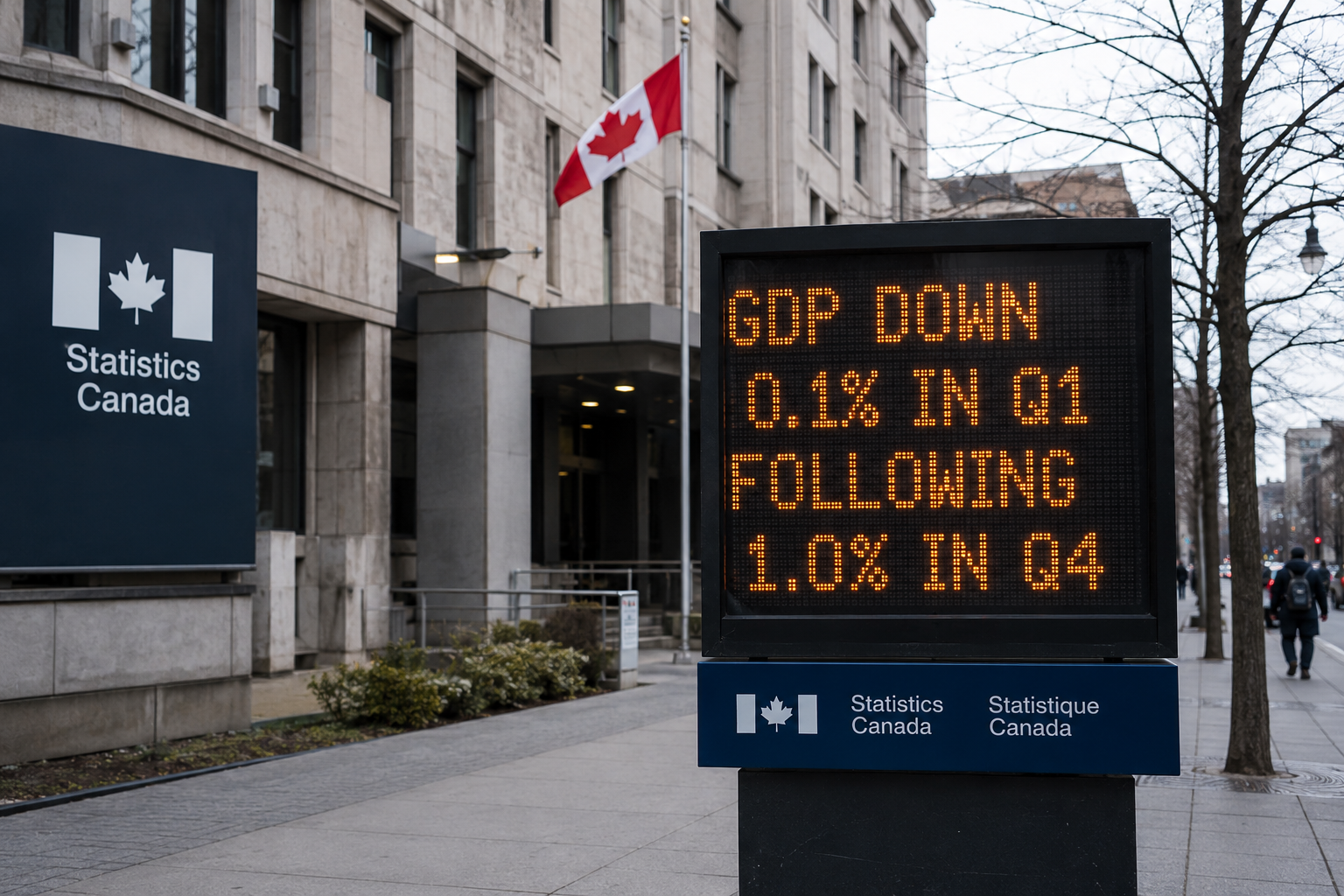
Canada's economy has recorded two consecutive quarters of declining gross domestic product (GDP), meeting the common definition of a technical recession. While the term has become a political flashpoint, economists say it does not automatically mean Canada is experiencing a full recession.
What Happened
Statistics Canada reported that Canada's real GDP contracted by 0.1 per cent on an annualized basis in the first quarter of 2026. That followed a one per cent contraction in the fourth quarter of 2025.
Two consecutive quarters of economic contraction are commonly referred to as a technical recession.
The data quickly entered the political spotlight.
U.S. President Donald Trump shared a Bloomberg News article about Canada's economic decline and added the comment "51st state!" on social media.
Conservative Leader Pierre Poilievre also pointed to the GDP figures as criticism of the Liberal government led by Prime Minister Mark Carney.
However, economists caution that the term technical recession does not necessarily indicate a severe economic downturn.
What Is a Technical Recession?
A technical recession occurs when an economy records negative GDP growth for two consecutive quarters.
GDP measures the total value of goods and services produced in an economy. Because economies typically expand over time, two straight quarters of contraction can signal weakness.
There is an important caveat.
Statistics Canada regularly revises economic data after initial publication. The latest GDP figures are preliminary and could be adjusted in future releases.
That means the current technical recession designation could change if revised data show different growth results.
Is Canada Officially in a Recession?
Not according to the measure commonly used by Canada's leading recession-watchers.
The Business Cycle Council of the Toronto-based C.D. Howe Institute acts as Canada's unofficial recession arbiter. The council does not rely solely on two quarters of negative GDP growth.
Instead, it evaluates what members call the "three P" test:
- Pronounced decline in economic activity
- Persistent weakness over time
- Pervasive weakness across industries
Steven Ambler, a member of the council and fellow-in-residence at the C.D. Howe Institute, said the recent GDP figures do not automatically satisfy those conditions.
According to Ambler, a pronounced decline would typically be closer to a one per cent contraction sustained across two quarters.
For context, previous recessions identified by the council included:
- 5.3 per cent decline in 1981-82
- 3.4 per cent decline in 1992
- 4.4 per cent decline during the 2008-09 financial crisis
- 12.7 per cent decline at the start of the COVID-19 pandemic
The council also examines whether weakness is widespread across sectors.
Its latest diffusion index assessment found more industries expanding than contracting, suggesting the slowdown is not broadly spread across the economy.
Why Economists Still See Warning Signs
Even if Canada is not officially in a recession, economists say the latest figures highlight economic weakness.
Walid Hejazi, professor of economic analysis and policy at the University of Toronto's Rotman School of Management, described the technical recession as a mild contraction rather than a major economic crisis.
Canada's economy is generally expected to grow by roughly two to three per cent annually. The recent figures show it is falling short of that pace.
Other indicators also point to challenges:
- Canada's unemployment rate reached 6.9 per cent in April
- Youth unemployment rose to 14.3 per cent
- Business investment has declined
- Residential construction has weakened
These trends suggest parts of the economy are under pressure even without a formal recession declaration.
What This Means for Canada
For most Canadians, a technical recession does not automatically mean mass layoffs or an economic emergency.
However, slower growth can affect hiring, wages, investment, and consumer confidence.
Job seekers may face increased competition as employers become more cautious. Workers may also feel less secure about their employment prospects if economic growth remains weak.
Economists say Canadians should pay attention to broader economic trends rather than focus solely on the recession label.
The bigger concern is whether weak growth becomes entrenched and spreads across more sectors of the economy.
What Happens Next?
Several factors will determine whether concerns deepen or ease:
- Future Statistics Canada GDP revisions
- Upcoming employment data
- Business investment trends
- Housing and construction activity
- Whether economic weakness spreads across industries
If growth rebounds in coming quarters, the current slowdown could prove temporary.
If weakness becomes more pronounced, persistent, and pervasive, Canada's recession debate could take on greater significance.