
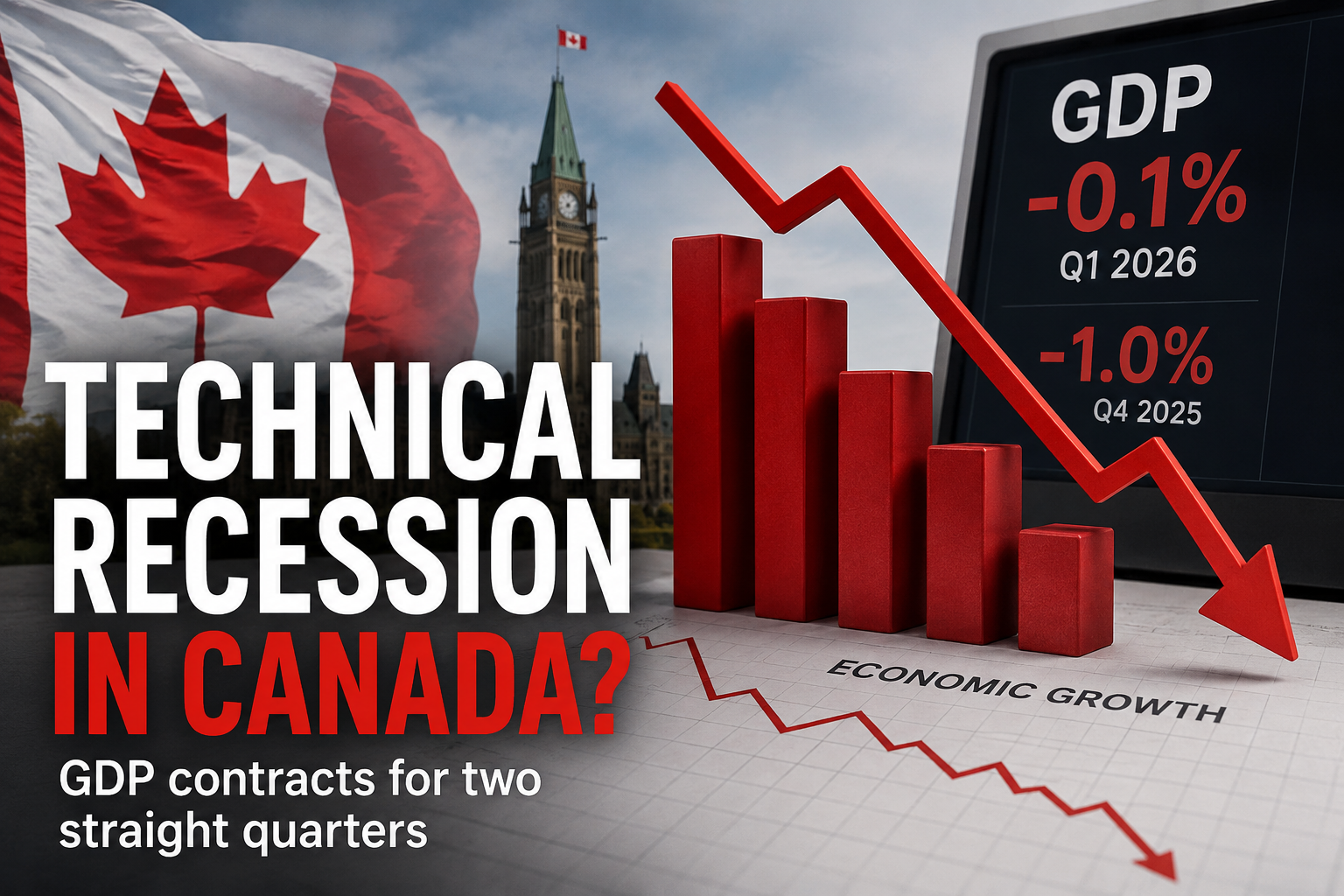
Canada recorded two consecutive quarters of annualized GDP contraction, meeting the commonly used definition of a technical recession. Yet economists say the designation alone does not necessarily signal the kind of broad economic downturn traditionally associated with a recession, even as several indicators point to a slowing economy.
Two Consecutive GDP Declines Trigger Recession Debate
Statistics Canada reported that real gross domestic product contracted at an annualized rate of 0.1 per cent in the first quarter of 2026. The result followed a revised annualized decline of one per cent in the fourth quarter of 2025.
Because two straight quarters of negative growth are widely used as the benchmark for a technical recession, the figures immediately sparked debate among politicians, economists and market observers.
The data also entered the political arena. U.S. President Donald Trump referenced the development while reviving comments about Canada becoming the "51st state." Conservative Leader Pierre Poilievre used the figures to criticize the economic management of Prime Minister Mark Carney's government.
However, the GDP estimates remain preliminary and could be revised in future releases.
Why a Technical Recession Is Not the Same as a Recession
A technical recession is based on a simple measure: two consecutive quarters of GDP contraction. But Canada's unofficial recession arbiter relies on a broader set of indicators before determining whether the economy is truly in recession.
The Business Cycle Council of the C.D. Howe Institute evaluates economic downturns using what it calls the "three P" framework. A recession must be:
-
Pronounced
-
Persistent
-
Pervasive
Council member Steven Ambler argues that the recent GDP decline does not automatically meet those standards. In his view, a pronounced downturn would generally involve a significantly larger drop in economic activity.
Past Canadian recessions were considerably deeper:
| Period | GDP Decline |
|---|---|
| 1981-82 Recession | 5.3% |
| 1992 Recession | 3.4% |
| 2008-09 Financial Crisis | 4.4% |
| Early Pandemic Recession | 12.7% |
| Q4 2025 GDP | -1.0% annualized |
| Q1 2026 GDP | -0.1% annualized |
The council also examines how broadly weakness is spread across industries. Its most recent diffusion index showed more sectors expanding than contracting, suggesting the slowdown is not yet widespread throughout the economy.
The Economy Is Slowing Even Without an Official Recession
While many economists are cautious about the recession label, few dispute that Canada's economy is facing challenges.
Recent data show:
-
Unemployment rose to 6.9 per cent in April, the highest level in six months.
-
Youth unemployment reached 14.3 per cent.
-
Business investment has weakened.
-
Residential construction activity has declined.
These indicators point to an economy that is growing more slowly than expected, even if it does not meet the broader criteria for a recession.
Walid Hejazi, a professor of economic analysis and policy at the University of Toronto's Rotman School of Management, describes the current situation as a mild contraction rather than a severe downturn.
The concern is not an immediate economic crisis but the fact that growth is falling short of the pace normally associated with a healthy economy.
Why the Label Matters Beyond the Numbers
Economic language can shape behaviour.
When households hear the word "recession," they may become more cautious about spending, borrowing or making major purchases. Businesses may also delay hiring, investment or expansion plans.
That shift in sentiment can itself become an economic factor. Reduced confidence often leads to weaker spending and slower economic activity, creating additional pressure on growth.
Canada may have met the technical definition of a recession, but current data do not yet point to the broad and sustained decline typically associated with past recessions. Nevertheless, several indicators suggest that economic momentum is weakening.
For workers, that could mean a more competitive labour market. For businesses, it may encourage greater caution around future investment decisions.
What Comes Next for Canada's Economy?
Future revisions to Statistics Canada's GDP data could alter the current picture, potentially changing whether the economy continues to meet the technical recession threshold.
Economists will also be watching employment figures, business investment, housing activity and industry-level performance to determine whether weakness spreads more broadly across the economy.
Trade tensions with the United States remain another factor influencing business confidence and economic growth.
For now, many economists view the latest figures as evidence of economic softness rather than confirmation of a broad recession. Upcoming economic data will provide a clearer indication of whether the slowdown deepens or begins to stabilize.
Related Perspectives
Canada GDP Growth
Mark Carney's Economic Agenda
Canada-U.S. Trade Tensions